Together is not easy

This infographic titled “Together” emphasizes the critical importance of parallel processing = working together across all domains – computing, AI, and human society.

Core Concept:

The Common Thread Across All 5 Domains – ‘Parallel Processing’:

  1. Parallel Processing – Simultaneous task execution in computer systems
  2. Deep Learning – AI’s multi-layered neural networks learning in parallel
  3. Multi Processing – Collaborative work across multiple processors
  4. Co-work – Human collaboration and teamwork
  5. Social – Collective cooperation among community members

Essential Elements of Parallel Processing:

  • Sync (Synchronization) – Coordinating all components to work harmoniously
  • Share (Sharing) – Efficient distribution of resources and information
  • Optimize (Optimization) – Maximizing performance while minimizing energy consumption
  • Energy (Energy) – The inevitable cost required when working together

Reinterpreted Message: “togetherness is always difficult, but it’s something we have to do.”

This isn’t merely about the challenges of cooperation. Rather, it conveys that parallel processing (working together) in all systems requires high energy costs, but only through optimization via synchronization and sharing can we achieve true efficiency and performance.

Whether in computing systems, AI, or human society – all complex systems cannot advance without parallel cooperation among individual components. This is an unavoidable and essential process for any sophisticated system to function and evolve. The insight reveals a fundamental truth: the energy investment in “togetherness” is not just worthwhile, but absolutely necessary for progress.

With Claude

Synchronization Issues

From Claude with some prompting
This diagram illustrates various synchronization issues and their solutions in system synchronization processes. Let me break it down into three main parts:

  1. Copy-related Issues
  • Problems: High Load and Lack of Real Time
  • Solutions:
    • Increment Copy
    • Sync Scheduling
  1. Replication-related Issues
  • Problem: Network Delay
  • Solutions:
    • Timestamp Control
    • Checksum for comparison
  1. Synchronization-related Issues
  • Problems: Deadlock and Race Condition
  • Solutions:
    • Timeout settings
    • Priority Control
    • Semaphore/Mutex
    • Failure Recovery

Key Processes:

  • Maintaining “Keep the Same” status between systems
  • Detecting and notifying all changes (Noti & Detect All Changes)
  • Reflecting changes to other systems (reflect)

The diagram is well-structured with these notable features:

  1. Hierarchical Organization
  • Shows synchronization issues from top to bottom level
  • Progresses from Copy → Replications → Synchronization → Process Synchronization
  1. Clear Problem-Solution Mapping
  • Problems presented on the left (High Load, Network Delay, Deadlock, etc.)
  • Solutions presented on the right (visualized as green buttons)
  1. Visual Consistency
  • Problems shown in orange boxes
  • Solutions shown in green buttons
  • Process flows clearly indicated with arrows
  1. Practical Approach
  • Includes both theoretical concepts and practical implementation elements
  • Incorporates operational considerations like Failure Recovery

This structured organization serves as a valuable guide for understanding and solving complex synchronization problems in distributed systems or database replication systems.

Not Real-Simultaneous Works

From Claude with some prompting
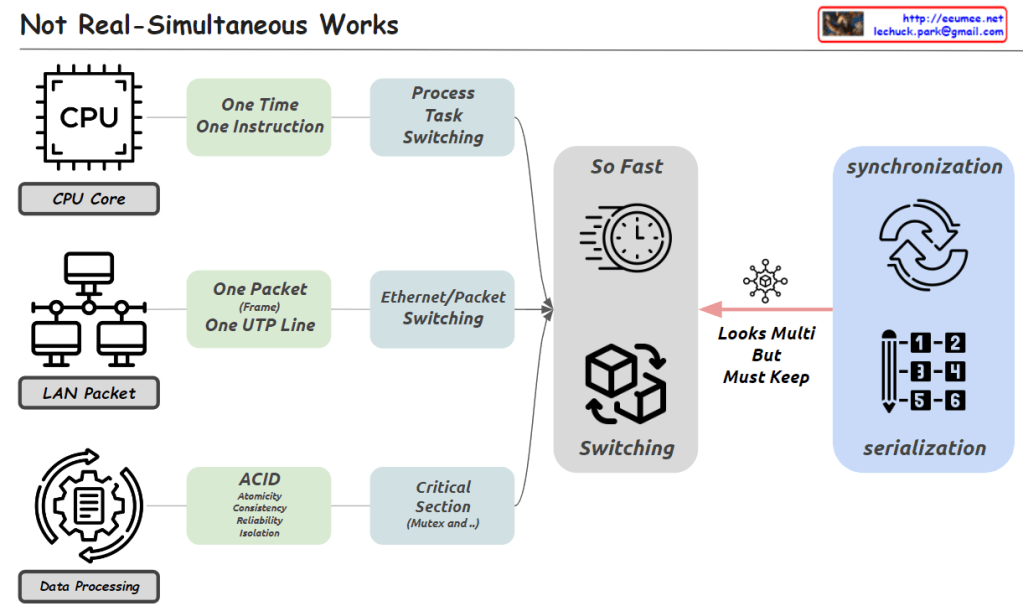
The image emphasizes that while it may appear to be simultaneous processing, it is actually very fast serial processing.

From the perspectives of the CPU, LAN, and data processing, each can only handle one unit of work at a time. The CPU can execute one instruction, the network can transmit one packet line, and in data processing, critical sections require mutual exclusion and serialization.

However, due to very fast switching techniques like process/task switching and Ethernet/packet switching, multiple tasks appear to be happening concurrently. But in reality, it is processing single units of work in rapid serial fashion.

So concurrency is achieved through fast serial processing, not parallel processing. Even so, in critical areas, synchronization and serialization are required to maintain data integrity.

In essence, the image highlights that while it looks like simultaneous processing, concurrency is actually implemented through extremely fast serial processing of single work units at a time.

NTP

From DALL-E with some prompting
The image appears to be a visual explanation of the Network Time Protocol (NTP). At the top, there’s a title, “Network Time Protocol,” and below it, there are icons arranged along a line that seems to represent servers, energy symbols, a thermometer, a surveillance camera, and storage devices. These icons are connected by arrows, indicating the flow of synchronization signals for time.

Below these icons, there are two messages. The first message says, “Sync Time of data from all connected Machine,” suggesting the synchronization of time across data from all connected devices. The second message reads, “sequence of events and causal relationship,” referring to the order of events and their causality. Underneath this message, icons representing the universe, Earth, a forest, and a group of people are displayed, which likely denote the concept of “Universal Time.”

Overall, the image emphasizes the importance of using Network Time Protocol to synchronize time across various devices and systems, accurately recording the sequence and causality of events, and maintaining consistent universal time globally. There’s an email address displayed in the top right corner of the image, but personal identity information cannot be shared.