Silicon Photonics

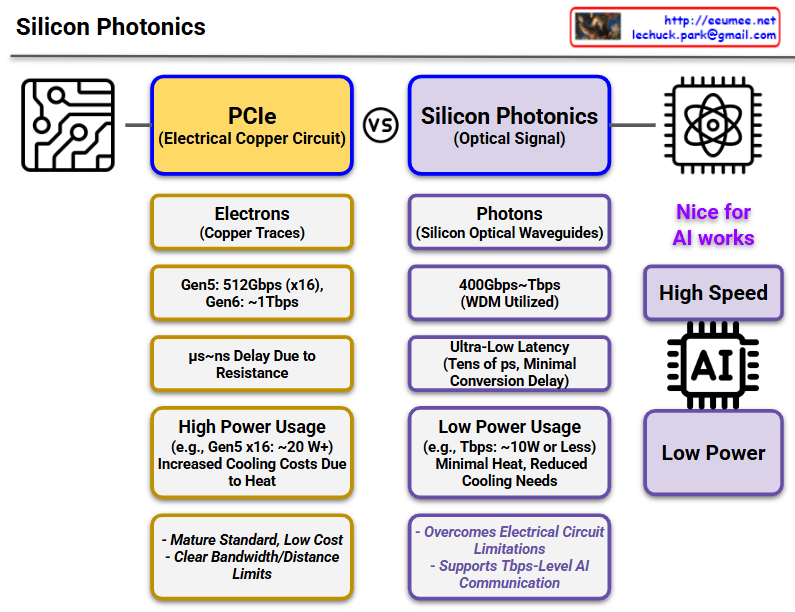
This diagram compares PCIe (Electrical Copper Circuit) and Silicon Photonics (Optical Signal) technologies.

PCIe (Left, Yellow Boxes)

  • Signal Transmission: Uses electrons (copper traces)
  • Speed: Gen5 512Gbps (x16), Gen6 ~1Tbps expected
  • Latency: μs~ns level delay due to resistance
  • Power Consumption: High (e.g., Gen5 x16 ~20W), increased cooling costs due to heat generation
  • Pros/Cons: Mature standard with low cost, but clear bandwidth/distance limitations

Silicon Photonics (Right, Purple Boxes)

  • Signal Transmission: Uses photons (silicon optical waveguides)
  • Speed: 400Gbps~7Tbps (utilizing WDM technology)
  • Latency: Ultra-low latency (tens of ps, minimal conversion delay)
  • Power Consumption: Low (e.g., 7Tbps ~10W or less), minimal heat with reduced cooling needs
  • Key Benefits:
    • Overcomes electrical circuit limitations
    • Supports 7Tbps-level AI communication
    • Optimized for AI workloads (high speed, low power)

Key Message

Silicon Photonics overcomes the limitations of existing PCIe technology (high power consumption, heat generation, speed limitations), making it a next-generation technology particularly well-suited for AI workloads requiring high-speed data processing.

With Claude
AI DC Energy Optimization

Core Technologies for AI DC Power Optimization

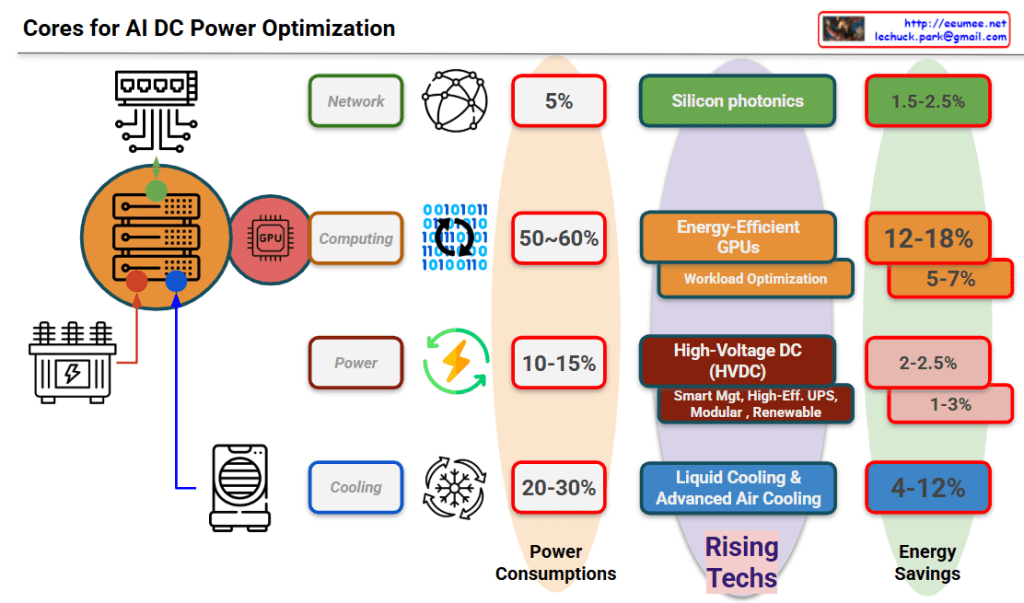
This diagram systematically illustrates the core technologies for AI datacenter power optimization, showing power consumption breakdown by category and energy savings potential of emerging technologies.

Power Consumption Distribution:

  • Network: 5% – Data transmission and communication infrastructure
  • Computing: 50-60% – GPUs and server processing units (highest consumption sector)
  • Power: 10-15% – UPS, power conversion and distribution systems
  • Cooling: 20-30% – Server and equipment temperature management systems

Energy Savings by Rising Technologies:

  1. Silicon Photonics: 1.5-2.5% – Optical communication technology improving network power efficiency
  2. Energy-Efficient GPUs & Workload Optimization: 12-18% (5-7%) – AI computation optimization
  3. High-Voltage DC (HVDC): 2-2.5% (1-3%) – Smart management, high-efficiency UPS, modular, renewable energy integration
  4. Liquid Cooling & Advanced Air Cooling: 4-12% – Cooling system efficiency improvements

This framework presents an integrated approach to maximizing power efficiency in AI datacenters, addressing all major power consumption areas through targeted technological solutions.

With Claude