Digital Service

From DALL-E with some prompting
The image outlines the workflow and components of digital data services. It begins with data collection from various sources, which is then subjected to a verification process to ensure its integrity. The verified data is stored in a database and undergoes the ETL process (Extract, Transform, Load) to be formatted appropriately for analysis. This data is visualized to facilitate insightful analysis, which then feeds into an AI learning process. The outcomes of this analysis are applied in the service stage where established processes are confirmed and automation tools are implemented to deliver the final service. The AI model, refined by learning from the data, plays a critical role in enhancing the precision and efficiency of the service provided.

Digital Works

From DALL-E with some prompting
The image highlights the centrality of data in digital operations. Data manifests in various forms and is at the core of all digital processes, from traditional CPU tasks to contemporary AI/ML services. The CPU utilizes the Von Neumann architecture to execute instructions that process data. Programs manipulate this data to perform desired operations. Databases store and manage this data, while AI/ML learns from the data and generates predictive models. Ultimately, all these processes culminate in services that are delivered to users. Throughout these stages, the fundamental programming principle of ‘If’ (condition) and ‘Then’ (action) is applied, facilitating data-driven decisions and enabling automated processing.

Hardware Ages

From DALL-E with some prompting
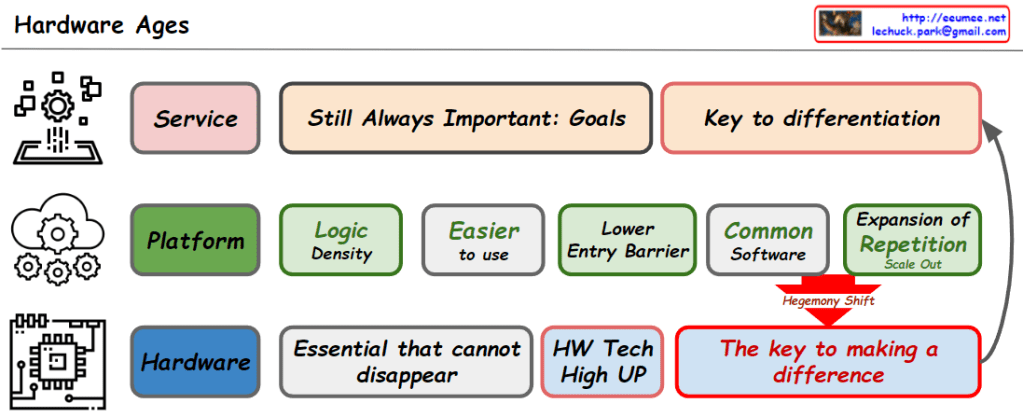
The diagram illustrates the evolution of computing services, signaling a shift from software-centric cloud services to hardware infrastructure as a means of differentiation. As software becomes more accessible and commonplace, the focus is highlighted on the essential, enduring nature of hardware and its growing importance in establishing a competitive edge in the industry, a movement termed ‘Hegemony Shift’.