ML System Engineering

This image illustrates the core pillars of ML System Engineering, outlining the journey from raw data to a responsible, deployed model.


  1. Data Engineering: Data Quality & Skew Prevention
    • Focuses on building robust pipelines to ensure high-quality data. It aims to prevent “training-serving skew,” where the model performs well during training but fails in real-world production due to data inconsistencies.
  2. Model Optimization: Accuracy vs. Efficiency
    • Involves balancing competing metrics such as model size, memory usage, latency, and accuracy. The goal is to optimize models to meet specific hardware constraints without sacrificing predictive performance.
  3. Training Infrastructure: Distributed Training & Convergence
    • Highlights the technical backbone required to scale AI. It focuses on the seamless integration of hardware, data, and algorithms through distributed systems to ensure models converge efficiently and quickly.
  4. Deployment & Operations: MLOps & Edge-to-Cloud
    • Covers the lifecycle of a model in production. MLOps ensures continuous adaptation and monitoring across various environments, from massive Cloud infrastructures to resource-constrained TinyML (edge) devices.
  5. Ethics & Governance: Fairness & Accountability
    • Treats non-functional requirements like fairness, privacy, and transparency as core engineering priorities. It includes “fairness audits” to ensure the AI operates responsibly and remains accountable to its users.

Summary

  • ML System Engineering bridges the gap between theoretical research and real-world production by focusing on data integrity and hardware-aware model optimization.
  • It utilizes MLOps and distributed infrastructure to ensure scalable, continuous deployment across diverse environments, from the Cloud to the Edge.
  • The framework establishes Ethics and Governance as fundamental engineering requirements to ensure AI systems are fair, transparent, and accountable.

#MLSystemEngineering #MLOps #ModelOptimization #DataEngineering #DistributedTraining #TinyML #ResponsibleAI #EdgeComputing #AIGovernance

With Gemini
Human Rules Always


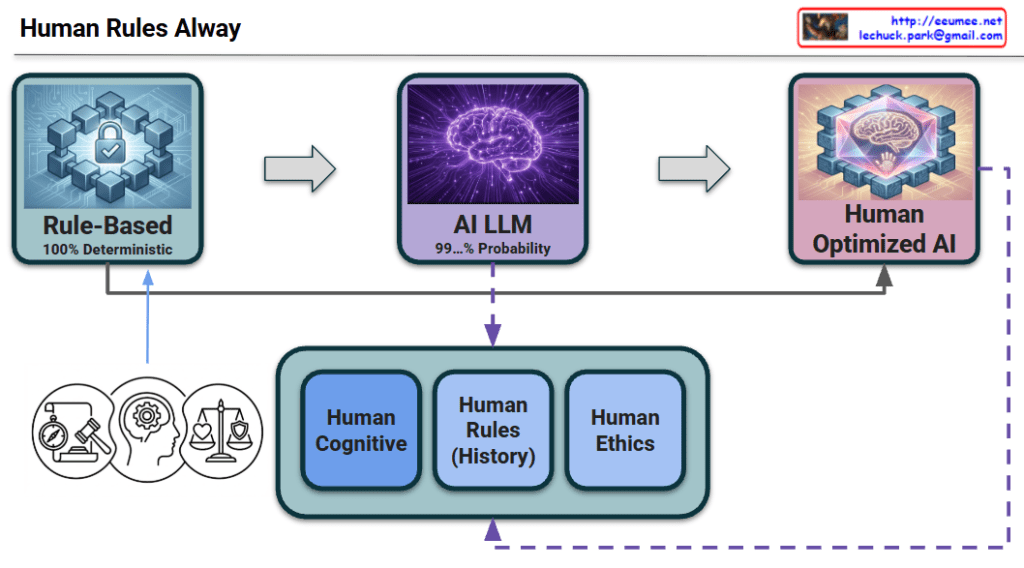
The Evolutionary Roadmap to Human-Optimized AI

This diagram visualizes the history and future direction of intelligent systems. It illustrates the evolution from the era of manual programming to the current age of generative AI, and finally to the ultimate goal where human standards perfect the technology.

1. The 3 Stages of Technological Evolution (Top Flow)

  • Stage 1: Rule-Based (The Foundation / Past)
    • Concept: “The Era of Human-Defined Logic”
    • Context: This represents the starting point of computing where humans explicitly created formulas and coded every rule.
    • Characteristics: It is 100% Deterministic. While accurate within its scope, it cannot handle the complexity of the real world beyond what humans have manually programmed.
  • Stage 2: AI LLM (The Transition / Present)
    • Concept: “The Era of Probabilistic Scale”
    • Context: We have evolved into the age of massive parallel processing and Large Language Models.
    • Characteristics: It operates on 99…% Probability. It offers immense scalability and creativity that rule-based systems could never achieve, but it lacks the absolute certainty of the past, occasionally leading to inefficiencies or hallucinations.
  • Stage 3: Human Optimized AI (The Final Goal / Future)
    • Concept: “The Era of Reliability & Efficiency”
    • Context: This is the destination we must reach. It is not just about using AI, but about integrating the massive power of the “Present” (AI LLM) with the precision of the “Past” (Rule-Based).
    • Characteristics: By applying human standards to control the AI’s massive parallel processing, we achieve a system that is both computationally efficient and strictly reliable.

2. The Engine of Evolution: Human Standards (Bottom Box)

This section represents the mechanism that drives the evolution from Stage 2 to Stage 3.

  • The Problem: Raw AI (Stage 2) consumes vast energy and can be unpredictable.
  • The Solution: We must re-introduce the “Human Rules” (History, Logic, Ethics) established in Stage 1 into the AI’s workflow.
  • The Process:
    • Constraint & Optimization: Human Cognition and Rules act as a pruning mechanism, cutting off wasteful parallel computations in the LLM.
    • Safety: Ethics ensure the output aligns with human values.
  • Result: This filtering process transforms the raw, probabilistic energy of the LLM into the polished, “Human Optimized” state.

3. The Feedback Loop (Continuous Evolution)

  • Dashed Line: The journey doesn’t end at Stage 3. The output from the optimized AI is reviewed by humans, which in turn updates our rules and ethical standards. This circular structure ensures that the AI continues to evolve alongside human civilization.

This diagram declares that the future of AI lies not in discarding the old “Rule-Based” ways, but in fusing that deterministic precision with modern probabilistic power to create a truly optimized intelligence.


#AIEvolution #FutureOfAI #HybridAI #DeterministicVsProbabilistic #HumanInTheLoop #TechRoadmap #AIArchitecture #Optimization #ResponsibleAI

Human with AI

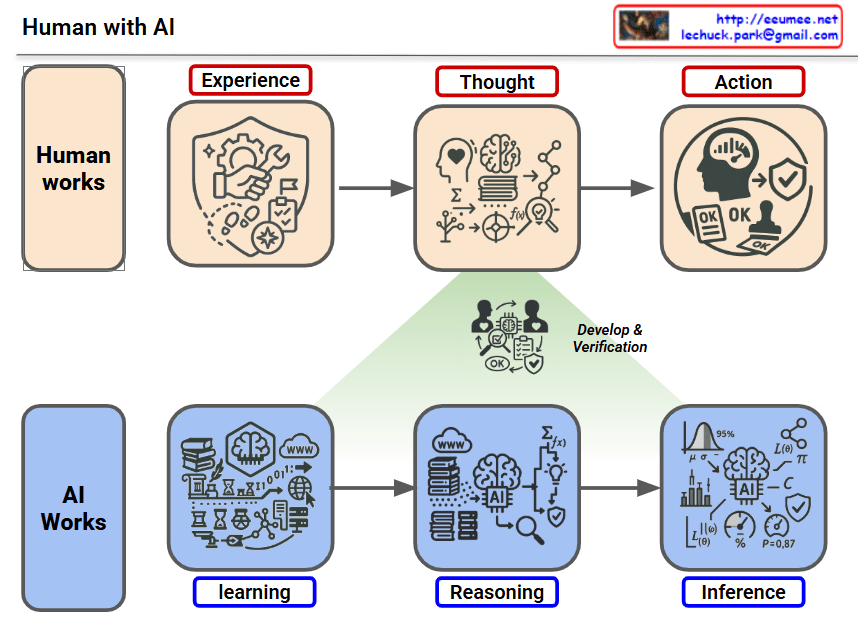
This image titled “Human with AI” illustrates the collaborative structure between humans and AI.

Top: Human works

Humans operate through three stages:

  1. Experience – Collecting various experiences and information
  2. Thought – Thinking and judging by combining emotions, logic, and intuition
  3. Action – Executing final decisions

Bottom: AI Works

AI operates through similar three stages:

  1. Learning – Learning from databases and patterns
  2. Reasoning – Analyzing and judging through algorithms and calculations
  3. Inference – Deriving results based on statistics and probabilities

Core: Human-AI Collaboration Structure

The green arrow in the center with “Develop & Verification” represents the process where humans verify AI’s reasoning results and make final judgments (Thought) to connect them to actual actions (Action).

In other words, when AI analyzes data and presents reasoning results, humans review and verify them to ultimately decide whether to execute – representing a Human-in-the-loop system. AI assists decision-making, but the final judgment and action are under human responsibility.


Summary

This diagram illustrates a Human-in-the-loop AI system where AI processes data and provides reasoning, but humans retain final decision-making authority. Both humans and AI follow similar learning-thinking-acting cycles, but human verification serves as the critical bridge between AI inference and real-world action. This structure emphasizes responsible AI deployment with human oversight.

#HumanAI #AICollaboration #HumanInTheLoop #AIGovernance #ResponsibleAI #AIDecisionMaking #HumanOversight #AIVerification #HumanCenteredAI #AIEthics

With Claude