Operation with LLM

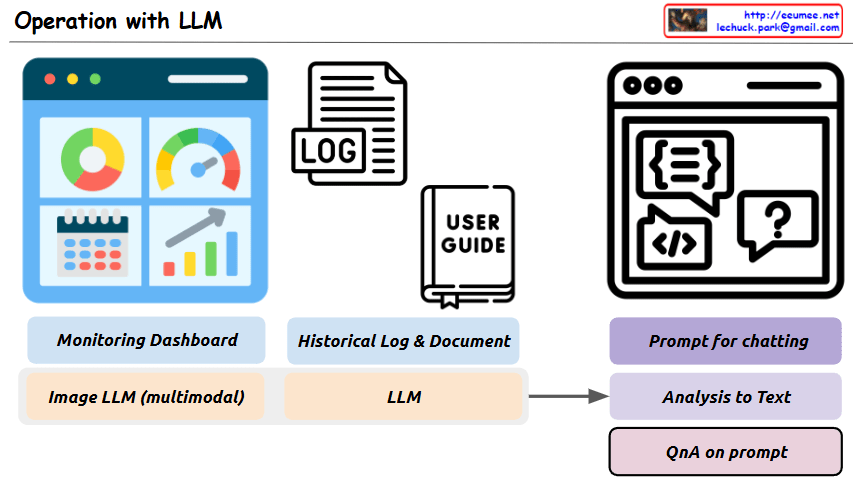
This image is a diagram titled “Operation with LLM,” showing a system architecture that integrates Large Language Models (LLMs) with existing operational technologies.

The main purpose of this system is to more efficiently analyze and solve various operational data and situations using LLMs.

Key components and functions:

  1. Top Left: “Monitoring Dashboard” – Provides an environment where LLMs can interpret image data collected from monitoring screens.
  2. Top Center: “Historical Log & Document” – LLMs analyze system log files and organize related processes from user manuals.
  3. Top Right: “Prompt for chatting” – An interface for interacting with LLMs through appropriate prompts.
  4. Bottom Left: “Image LLM (multimodal)” – Represents multimodal LLM functionality for interpreting images from monitoring screens.
  5. Bottom Center: “LLM” – The core language model component that processes text-based logs and documents.
  6. Bottom Right:
    • “Analysis to Text” – LLMs analyze various input sources and convert them to text
    • “QnA on prompt” – Users can ask questions about problem situations, and LLMs provide answers

This system aims to build an integrated operational environment where problems occurring in operational settings can be easily analyzed through LLM prompting and efficiently solved through a question-answer format.

With Claude
Eventlog with LLM

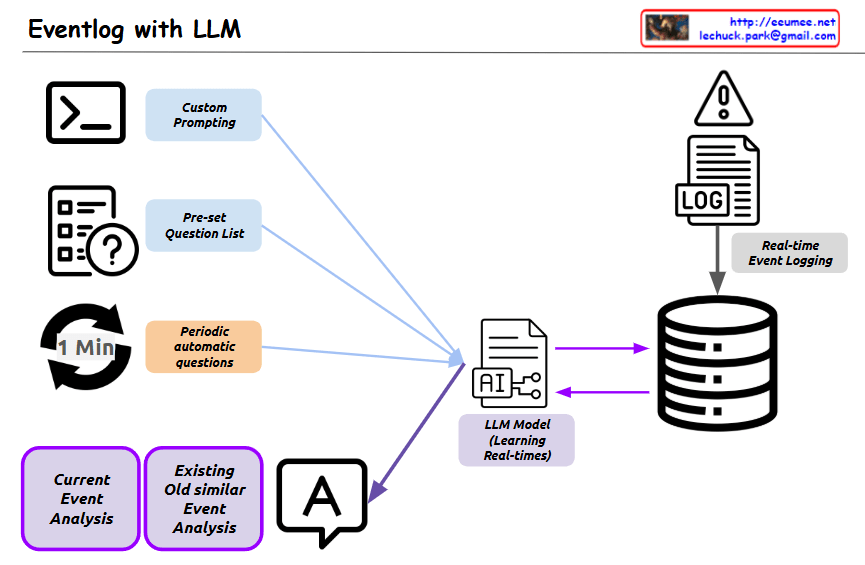
  1. Input methods (left side):
    • A command line/terminal icon with “Custom Prompting”
    • A questionnaire icon with “Pre-set Question List”
    • A timer icon (1 Min) with “Periodic automatic questions”
  2. Processing (center):
    • An “LLM Model” component labeled as “Learning Real-times”
    • Database/storage components for “Real-time Event Logging”
  3. Output/Analysis (bottom):
    • Two purple boxes for “Current Event Analysis” and “Existing Old similar Event Analysis”
    • A text/chat bubble showing output

This system collects and updates unstructured text-based event logs in real-time, which are then learned by the LLM. Through user-input questions, predefined question lists, or periodically auto-generated questions, the system analyzes current events and compares them with similar past cases to provide comprehensive analytical results.

The primary purpose of this system is to efficiently process large volumes of event logs from increasingly large and complex IT infrastructure or business systems. This helps operators easily identify important events, make quick judgments, and take appropriate actions. By leveraging the natural language processing capabilities of LLMs, the system transforms complex log data into meaningful insights, significantly simplifying system monitoring and troubleshooting processes.

With Claude