Data Security

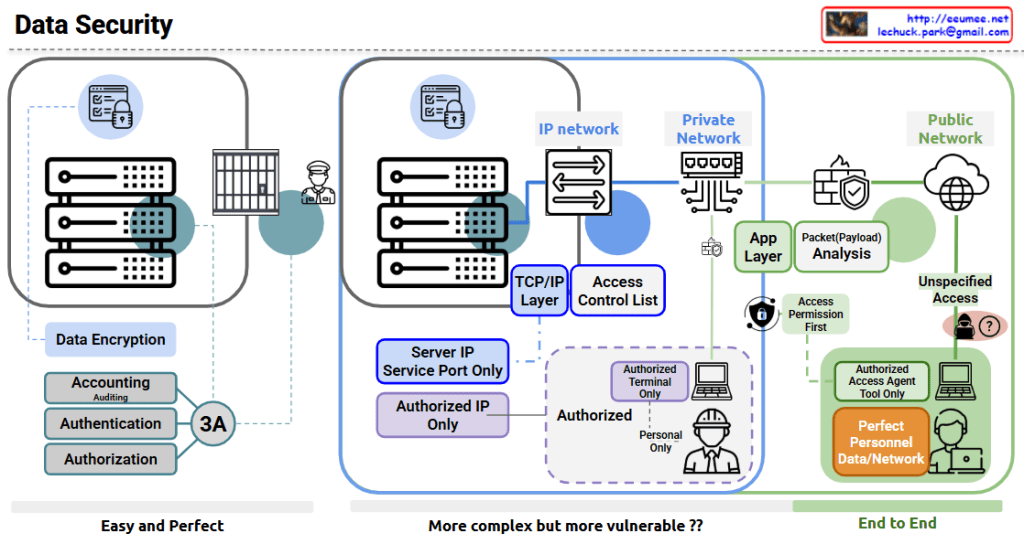
The image shows a comprehensive data security diagram with three main approaches to securing data systems. Let me explain each section:

  1. Left Section – “Easy and Perfect”:
    • Features data encryption for secure storage
    • Implements the “3A” security principles: Accounting (with Auditing), Authentication, and Authorization
    • Shows server hardware protected by physical security (guard)
    • Represents a straightforward but effective security approach
  2. Middle Section – “More complex but more vulnerable??”:
    • Shows an IP network architecture with:
      • Server IP and service port restrictions
      • TCP/IP layer security
      • Access Control Lists
      • Authorized IP only policy
      • Authorized terminal restrictions
      • Personnel authorization controls
  3. Right Section – “End to End”:
    • Divides security between Private Network and Public Network
    • Includes:
      • Application layer security
      • Packet/Payload analysis
      • Access Permission First principle
      • Authorized Access Agent Tool restrictions
      • “Perfect Personnel Data/Network” security approach
      • Unspecified Access concerns (shown with question mark)

The diagram illustrates the evolution of data security approaches from simpler encryption and authentication methods to more complex network security architectures, and finally to comprehensive end-to-end security solutions. The diagram questions whether more complex systems might actually introduce more vulnerabilities, suggesting that complexity doesn’t always equal better security.

With Claude

Data with the AI

From Claude with some prompting
the key points from the diagram:

  1. Reality of Internet Open Data:
    • Vast amount of open data exists on the internet including:
      • Mobile device data
      • Email communications
      • Video content
      • Location data
    • This open data is utilized by major AI companies for LLM training
    • Key players:
      • OpenAI’s ChatGPT
      • Anthropic’s Claude
      • Google’s Gemini
      • Meta’s LLaMA
  2. Competition Implications:
    • Competition between LLMs trained on similar internet data
    • “Who Winner?” and “A Winner Takes ALL?” suggests potential monopoly in the base LLM market
    • This refers specifically to models trained on public internet data
  3. Market Outlook:
    • While the base LLM market might be dominated by a few players
    • Private enterprise data remains a key differentiator
    • “Still Differentiated and Competitive” indicates ongoing competition through enterprise-specific data
    • Companies can leverage RAG-like technology to combine their private data with LLMs for unique solutions
  4. Key Implications:
    • Base LLM market (trained on internet data) may be dominated by few winners
    • Enterprise competition remains vibrant through:
      • Unique private data assets
      • RAG integration with base LLMs
      • Company-specific implementations
    • Market likely to evolve into dual structure:
      • Foundation LLMs (based on internet data)
      • Enterprise-specific AI services (leveraging private data)

This structure suggests that while base LLM technology might be dominated by a few players, enterprises can maintain competitive advantage through their unique private data assets and specialized implementations using RAG-like technologies.

This creates a market where companies can differentiate themselves even while using the same foundation models, by leveraging their proprietary data and specific use-case implementations.