GPU vs NPU on Deep learning

This diagram illustrates the differences between GPU and NPU from a deep learning perspective:

GPU (Graphic Process Unit):

  • Originally developed for 3D game rendering
  • In deep learning, it’s utilized for parallel processing of vast amounts of data through complex calculations during the training process
  • Characterized by “More Computing = Bigger Memory = More Power,” requiring high computing power
  • Processes big data and vectorizes information using the “Everything to Vector” approach
  • Stores learning results in Vector Databases for future use

NPU (Neuron Process Unit):

  • Retrieves information from already trained Vector DBs or foundation models to generate answers to questions
  • This process is called “Inference”
  • While the training phase processes all data in parallel, the inference phase only searches/infers content related to specific questions to formulate answers
  • Performs parallel processing similar to how neurons function

In conclusion, GPUs are responsible for processing enormous amounts of data and storing learning results in vector form, while NPUs specialize in the inference process of generating actual answers to questions based on this stored information. This relationship can be summarized as “training creates and stores vast amounts of data, while inference utilizes this at the point of need.”

With Claude

New infra age

From Claude with some prompting
This image illustrates the surge in data and the advancement of AI technologies, particularly parallel processing techniques that efficiently handle massive amounts of data. As a result, there is a growing need for infrastructure technologies that can support such data processing capabilities. Technologies like big data processing, parallel processing, direct memory access, and GPU computing have evolved to meet this demand. The overall flow depicts the data explosion, the advancement of AI and parallel processing techniques, and the evolution of supporting infrastructure technologies.

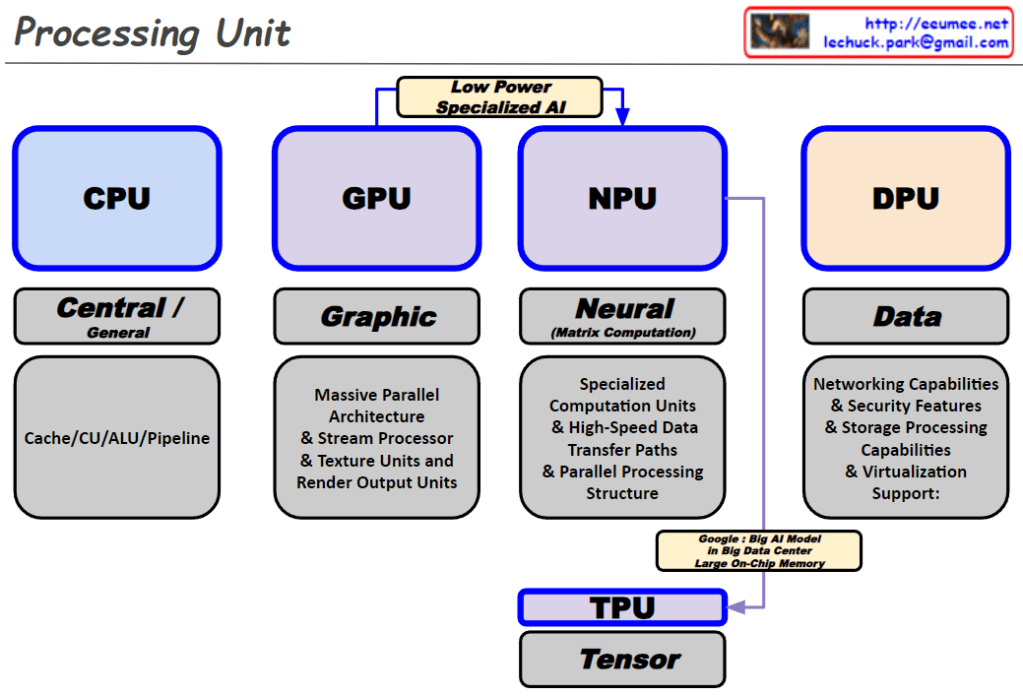
Processing UNIT

From DALL-E With some prompting

Processing Unit

  • CPU (Central Processing Unit): Central / General
    • Cache/Control Unit (CU)/Arithmetic Logic Unit (ALU)/Pipeline
  • GPU (Graphics Processing Unit): Graphic
    • Massive Parallel Architecture
    • Stream Processor & Texture Units and Render Output Units
  • NPU (Neural Processing Unit): Neural (Matrix Computation)
    • Specialized Computation Units
    • High-Speed Data Transfer Paths
    • Parallel Processing Structure
  • DPU (Data Processing Unit): Data
    • Networking Capabilities & Security Features
    • Storage Processing Capabilities
    • Virtualization Support
  • TPU (Tensor Processing Unit): Tensor
    • Tensor Cores
    • Large On-Chip Memory
    • Parallel Data Paths

Additional Information:

  • NPU and TPU are differentiated by their low power, specialized AI purpose.
  • TPU is developed by Google for large AI models in big data centers and features large on-chip memory.

The diagram emphasizes the specialized nature of NPU and TPU for AI tasks, highlighting their low power consumption and specialized computation capabilities, particularly for neural and tensor computations. It also contrasts these with the more general-purpose capabilities of CPUs and the graphic processing orientation of GPUs. DPU is presented as specialized for handling data-centric tasks involving networking, security, and storage in virtualized environments.