MPFT: Multi-Plane Fat-Tree for Massive Scale and Cost Efficiency


MPFT: Multi-Plane Fat-Tree for Massive Scale and Cost Efficiency

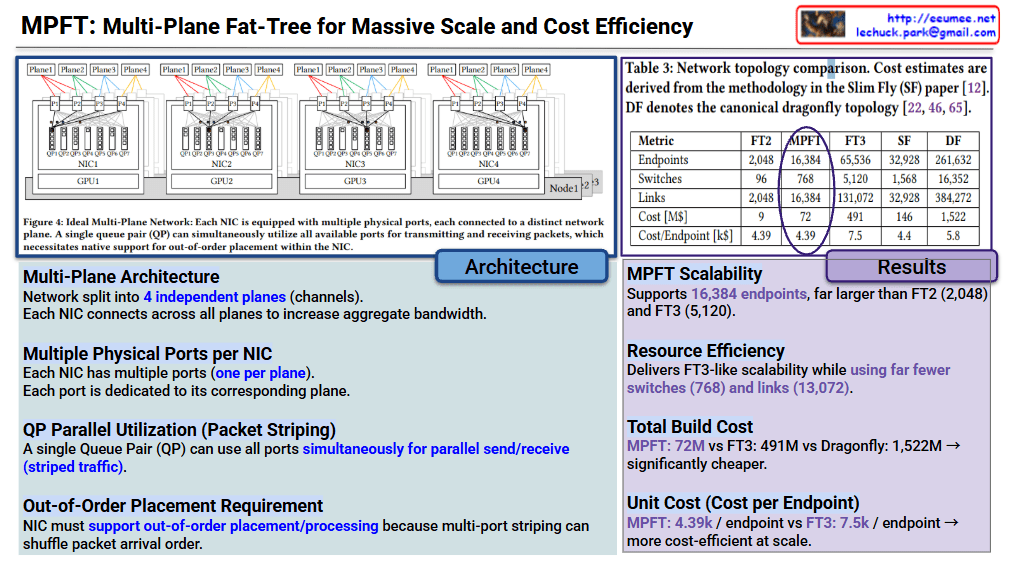
1. Architecture Overview (Blue Section)

The core innovation of MPFT lies in parallelizing network traffic across multiple independent “planes” to maximize bandwidth and minimize hardware overhead.

  • Multi-Plane Architecture: The network is split into 4 independent planes (channels).
  • Multiple Physical Ports per NIC: Each Network Interface Card (NIC) is equipped with multiple ports—one for each plane.
  • QP Parallel Utilization (Packet Striping): A single Queue Pair (QP) can utilize all available ports simultaneously. This allows for striped traffic, where data is spread across all paths at once.
  • Out-of-Order Placement: Because packets travel via different planes, they may arrive in a different order than they were sent. Therefore, the NIC must natively support out-of-order processing to reassemble the data correctly.

2. Performance & Cost Results (Purple Section)

The table compares MPFT against standard topologies like FT2/FT3 (Fat-Tree), SF (Slim Fly), and DF (Dragonfly).

MetricMPFTFT3Dragonfly (DF)
Endpoints16,38465,536261,632
Switches7685,12016,352
Total Cost$72M$491M$1,522M
Cost per Endpoint$4.39k$7.5k$5.8k
  • Scalability: MPFT supports 16,384 endpoints, which is significantly higher than a standard 2-tier Fat-Tree (FT2).
  • Resource Efficiency: It achieves high scalability while using far fewer switches (768) and links compared to the 3-tier Fat-Tree (FT3).
  • Economic Advantage: At $4.39k per endpoint, it is one of the most cost-efficient models for large-scale data centers, especially when compared to the $7.5k cost of FT3.

Summary

MPFT is presented as a “sweet spot” solution for AI/HPC clusters. It provides the high-speed performance of complex 3-tier networks but keeps the cost and hardware complexity closer to simpler 2-tier systems by using multi-port NICs and traffic striping.


#NetworkArchitecture #DataCenter #HighPerformanceComputing #GPU #AITraining #MultiPlaneFatTree #MPFT #NetworkingTech #ClusterComputing #CloudInfrastructure
Multi-Plane Network Topology ( deepseek v3)

Multi-Plane Network Topology for Scalable AI Clusters

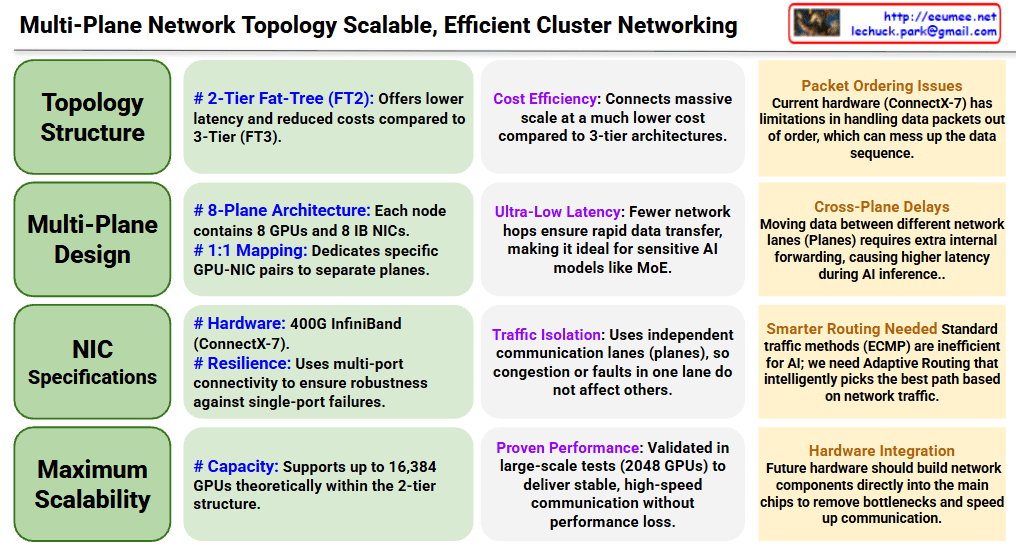
Core Architecture (Left – Green Sections)

Topology Structure

  • Adopts 2-Tier Fat-Tree (FT2) architecture for reduced latency and cost efficiency compared to 3-Tier
  • Achieves massive scale connections at much lower cost than 3-tier architectures

Multi-Plane Design

  • 8-Plane Architecture: Each node contains 8 GPUs and 8 IB NICs
  • 1:1 Mapping: Dedicates specific GPU-NIC pairs to separate planes

NIC Specifications

  • Hardware: 400G InfiniBand (ConnectX-7)
  • Resilience: Multi-port connectivity ensures robustness against single-port failures

Maximum Scalability

  • Theoretically supports up to 16,384 GPUs within the 2-tier structure

Advantages (Center – Purple Sections)

Cost Efficiency: Connects massive scale at much lower cost compared to 3-tier architectures

Ultra-Low Latency: Fewer network hops ensure rapid data transfer, ideal for latency-sensitive AI models like MoE

Traffic Isolation: Independent communication lanes (planes) prevent congestion or faults in one lane from affecting others

Proven Performance: Validated in large-scale tests with 2048 GPUs, delivering stable and high-speed communication

Challenges (Right – Orange Sections)

Packet Ordering Issues: Current hardware (ConnectX-7) has limitations in handling out-of-order data packets

Cross-Plane Delays: Moving data between different network planes requires extra internal forwarding, causing higher latency during AI inference

Smarter Routing Needed: Standard traffic methods (ECMP) are inefficient for AI; requires Adaptive Routing that intelligently selects the best path based on network traffic

Hardware Integration: Future hardware should build network components directly into main chips to remove bottlenecks and speed up communication


Summary

This document presents a multi-plane network topology using 2-tier Fat-Tree architecture that scales AI clusters up to 16,384 GPUs cost-effectively with ultra-low latency. The 8-plane design with 1:1 GPU-NIC mapping provides traffic isolation and resilience, though challenges remain in packet ordering and cross-plane communication. Future improvements require smarter routing algorithms and deeper hardware-network integration to optimize AI workload performance.

#AIInfrastructure #DataCenterNetworking #HPC #InfiniBand #GPUCluster #NetworkTopology #FatTree #ScalableComputing #MLOps #AIHardware #DistributedComputing #CloudInfrastructure #NetworkArchitecture #DeepLearning #AIatScale

Large Scale Network Driven Design ( Deepseek V3)

Deepseek v3 Large-Scale Network Architecture Analysis

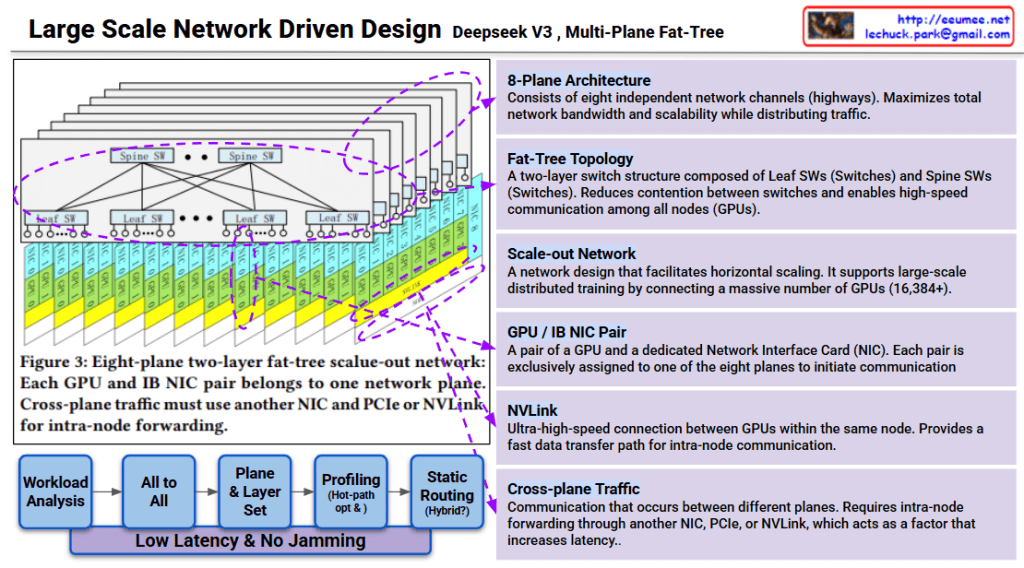
This image explains the Multi-Plane Fat-Tree network structure of Deepseek v3.

Core Architecture

1. 8-Plane Architecture

  • Consists of eight independent network channels (highways)
  • Maximizes network bandwidth and distributes traffic for enhanced scalability

2. Fat-Tree Topology

  • Two-layer switch structure:
    • Leaf SW (Leaf Switches): Directly connected to GPUs
    • Spine SW (Spine Switches): Interconnect leaf switches
  • Enables high-speed communication among all nodes (GPUs) while minimizing switch contention

3. GPU/IB NIC Pair

  • Each GPU is paired with a dedicated Network Interface Card (NIC)
  • Each pair is exclusively assigned to one of the eight planes to initiate communication

Communication Methods

NVLink

  • Ultra-high-speed connection between GPUs within the same node
  • Fast data transfer path used for intra-node communication

Cross-plane Traffic

  • Occurs when communication happens between different planes
  • Requires intra-node forwarding through another NIC, PCIe, or NVLink
  • Primary factor that increases latency

Network Optimization Process

The workflow below minimizes latency and prevents network congestion:

  1. Workload Analysis
  2. All to All (analyzing all-to-all communication patterns)
  3. Plane & Layer Set (plane and layer assignment)
  4. Profiling (Hot-path opt K) (hot-path optimization)
  5. Static Routing (Hybrid) (hybrid static routing approach)

Goal: Low latency & no jamming

Scalability

This design is a scale-out network for large-scale distributed training supporting 16,384+ GPUs. Each plane operates independently to maximize overall system throughput.


3-Line Summary

Deepseek v3 uses an 8-plane fat-tree network architecture that connects 16,384+ GPUs through independent communication channels, minimizing contention and maximizing bandwidth. The two-layer switch topology (Spine and Leaf) combined with dedicated GPU-NIC pairs enables efficient traffic distribution across planes. Cross-plane traffic management and hot-path optimization ensure low-latency, high-throughput communication for large-scale AI training.

#DeepseekV3 #FatTreeNetwork #MultiPlane #NetworkArchitecture #ScaleOut #DistributedTraining #AIInfrastructure #GPUCluster #HighPerformanceComputing #NVLink #DataCenterNetworking #LargeScaleAI

With Claude