Human-AI Collaborative Reasoning

This image illustrates the collaborative problem-solving process between humans and AI through reasoning, emphasizing their complementary relationship rather than a simple comparison.

Key Components and Interpretation

1. AI’s Operational Flow (Upper Section)

  • Big Data → Learning → AI Model: The process by which AI builds models through learning from vast amounts of data
  • Reasoning → Inferencing → Answer: The process by which AI receives questions and generates answers through reasoning

2. Human Role (Lower Section)

  • Experience: Knowledge and information acquired through direct experience
  • Logic: A logical thinking framework built upon experience
  • Reasoning: The cognitive process that combines experience and logic

3. Critical Interaction Mechanisms

Question:

  • Human reasoning results are input to AI in the form of sophisticated questions
  • These are not simple queries, but systematic and meaningful questions based on experience and logic

Answer:

  • AI’s responses are fed back into the human reasoning process
  • Humans verify AI’s answers and integrate them into new experiences and logic for deeper reasoning

4. Core Message

The red-highlighted phrase “humans must possess a strong, experience-based logical framework” represents the diagram’s central theme:

  • To collaborate effectively with AI, humans must also possess strong logical thinking frameworks based on experience
  • The ability to provide appropriate questions and properly verify and utilize AI’s responses is essential

Conclusion

This image demonstrates that human roles do not disappear in the AI era, but rather become more crucial. Human reasoning abilities based on experience and logic play a pivotal role in AI collaboration, and through this, humans and AI can create synergy for better problem-solving. The diagram presents a collaborative model where both entities work together to achieve superior results.

The key insight is that AI advancement doesn’t replace human thinking but rather requires humans to develop stronger reasoning capabilities to maximize the potential of human-AI collaboration.

With Claude, Gemini
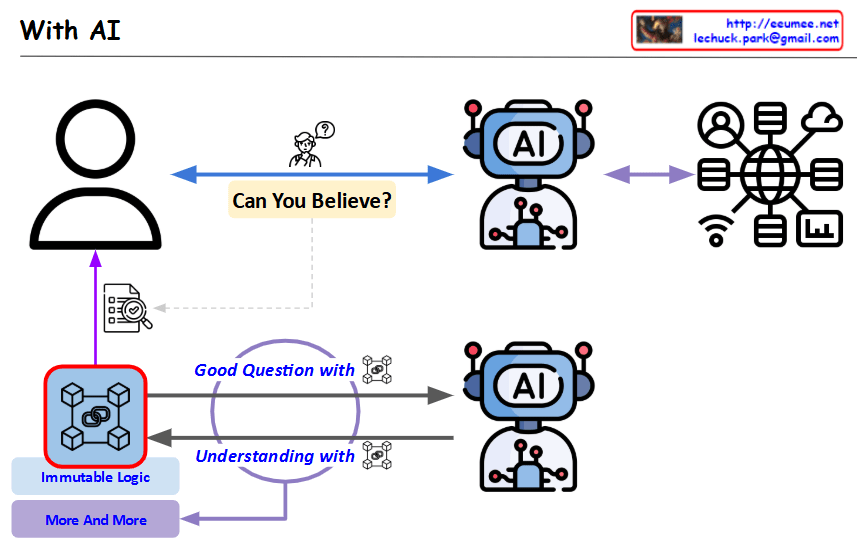
With AI

This diagram illustrates the effective collaboration method with AI:

Key Components:

  1. Upper Section: User-AI-Network Connection
  • “Can You Believe?” emphasizes the need to verify and not blindly trust the outputs of AI that has learned from the internet and vast amounts of data
  • While AI has access to extensive networks/data, verification of this information’s reliability is essential
  1. Lower Section: Logical Foundation and Development
  • “Immutable Logic” forms the foundation
  • Through this logical foundation, “Good Questions” and “Understanding” with AI occur in a cyclical process
  • “More And More” represents continuous development through this process

Core Message:

  • When utilizing AI, the most crucial element is the user’s own solid logical foundation
  • Verify and evaluate AI outputs based on this immutable logic
  • Continuously develop one’s own logic and knowledge through verified information and understanding
  • While AI is a powerful tool, its outputs must be logically verified by the user

This presents an approach not of simply using AI, but of critically evaluating AI outputs through one’s logical foundation and growing together through this process.

The diagram emphasizes that successful interaction with AI requires:

  • Having your own robust logical framework
  • Critical evaluation of AI-provided information
  • Using verified insights to enhance your own understanding
  • Maintaining a balanced approach where AI serves as a tool for growth rather than an unquestioned authority

This creates a virtuous cycle where both the user’s logical foundation and their ability to effectively utilize AI continuously improve.

With Claude

Both are equally unexplainable

From Claude with some prompting
This image compares human intelligence and artificial intelligence, emphasizing that both are “equally unexplainable” in certain aspects:

  1. Human Intelligence:
    • Uses 100% math and logic, but based on limited experience and data.
    • Labeled “Not 100% depend on Experience,” indicating experience alone is insufficient.
    • When decision-making under time constraints, humans make the “best choice” rather than a 100% perfect choice.
    • Shows a process of: Event → Decision with Time Limit → Action.
  2. Artificial Intelligence:
    • Based on big data, GPU/CPU processing, and AI models (including LLMs).
    • Labeled as “Unexplainable AI Model,” highlighting the difficulty in fully interpreting AI decision-making processes.
    • Demonstrates a flow of: Data input → Neural network processing → “Nice but not 100%” output.
    • Like human intelligence, AI also makes best choices within limited data and time constraints.
  3. Key Messages:
    • AI is not a simple logic calculator but a system mimicking human intelligence.
    • AI decisions, like human decisions, are not 100% perfect but the best choice under given conditions.
    • We should neither overestimate nor underestimate AI, but understand its limitations and possibilities in a balanced way.
    • Both human and artificial intelligence have unexplainable aspects, reflecting the complexity and limitations of both systems.

This image emphasizes the importance of accurately understanding and appropriately utilizing AI capabilities by comparing it with human intelligence. It reminds us that while AI is a powerful tool, human judgment and ethical considerations remain crucial. The comparison underscores that AI, like human intelligence, is making the best possible decisions based on available data and constraints, rather than providing infallible, 100% correct answers.