Intelligent Event Analysis Framework ( Holistic Intelligent Diagnosis)

This diagram illustrates a sophisticated framework for Intelligent Event Processing, designed to provide a comprehensive, multi-layered diagnosis of system events. It moves beyond simple alerts by integrating historical context, spatial correlations, and future projections.

1. The Principle of Recency-First Scoring (Top Section)

The orange cone expanding toward the Current Events represents the Time-Decay or Recency-First Scoring model.

  • Weighted Importance: While “Old Events” are maintained for context, the system assigns significantly higher weight to the most recent data.
  • Sensitivity: This ensures the AI remains highly sensitive to emerging trends and immediate anomalies while naturally phasing out obsolete patterns.

2. Multi-Dimensional Correlation Search (Box 1)

When a current event is detected, the system immediately executes a Correlation Search across three primary dimensions to establish a spatial and logical context:

  • Device Context: Investigates if the issue is isolated to the same device, related devices, or common device types.
  • Spatial Context (Place): Analyzes if the event is tied to a specific location, a relative area (e.g., the same rack), or a common facility environment.
  • Customer Context: Checks for patterns across the same customer, relative accounts, or common customer profiles.

3. Similarity-Based Pattern Matching (Box 2)

By combining the results of the Correlation Search with the library of “Old Events,” the system performs Pattern Matching with Priorities.

  • This step identifies historical precedents that most closely resemble the current event’s “fingerprint.”
  • It functions similarly to Case-Based Reasoning (CBR), leveraging past solutions to address present challenges.

4. Holistic Intelligent Diagnosis (Green Box)

This is the core engine where three distinct analytical disciplines converge to create an actionable output:

  • ③ Historical Analysis: Utilizes the recency-weighted scores to understand the evolution of the current issue.
  • ④ Root Cause Analysis (RCA): Drills down into the underlying triggers to identify the “why” behind the event.
  • ⑤ Predictive Analysis: Projects the likely future trajectory of the event, allowing for proactive rather than reactive management.

Summary

For the platform, this diagram serves as the “brain” of the operation. It demonstrates how the agent doesn’t just see a single data point, but rather a “Holistic” picture that connects the dots across time, space, and causality.


#DataCenterOps #AI #EventProcessing #RootCauseAnalysis #PredictiveMaintenance #DataAnalytics #IntelligentDiagnosis #SystemMonitoring #TechInfrastructure

with Gemini

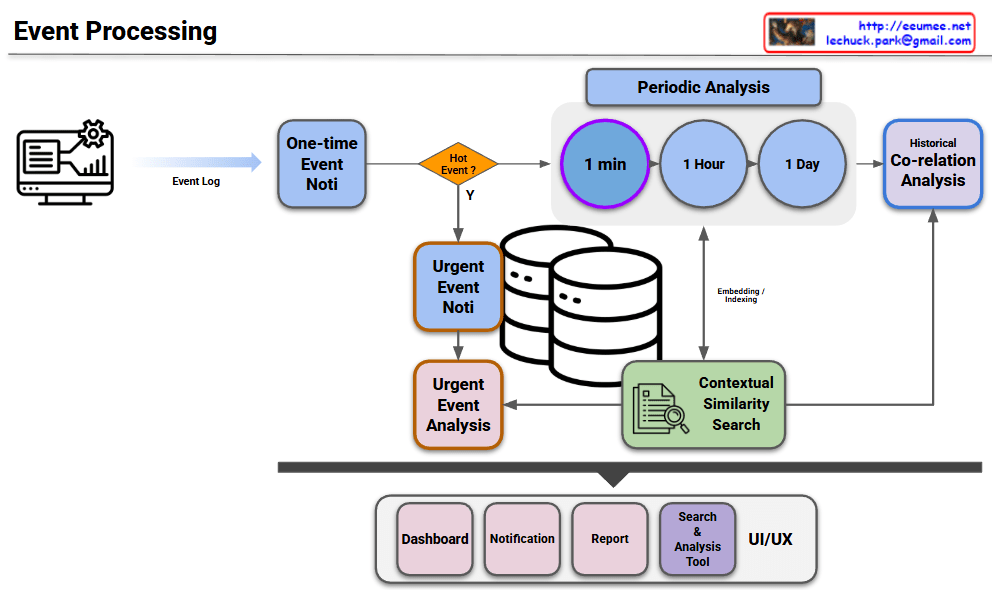
Event Processing

This diagram illustrates a workflow that handles system logs/events by dividing them into real-time urgent responses and periodic deep analysis.

1. Data Ingestion & Filtering

  • Event Log → One-time Event Noti: The process begins with incoming event logs triggering an initial, single-instance notification.
  • Hot Event Decision: A decision node determines if the event is critical (“Hot Event?”). This splits the workflow into two distinct paths: a Hot Path for emergencies and an Analytical Path for deeper insights.

2. Hot Path (Real-time Response)

  • Urgent Event Noti & Analysis: If identified as a “Hot Event,” the system immediately issues an urgent notification and performs an urgent analysis while persisting the data to the database. This path appears designed to minimize MTTD (Mean Time To Detect) for critical failures.

3. Periodic & Contextual Analysis (AIOps Layer)

This section indicates a shift from simple monitoring to intelligent AIOps.

  • Periodic Analysis: Events are aggregated and analyzed over fixed time windows (1 min, 1 Hour, 1 Day). The purple highlight on “1 min” suggests the current focus is on short-term trend analysis.
  • Contextual Similarity Search: This is a critical advanced feature. By explicitly mentioning “Embedding / Indexing,” the architecture suggests the use of Vector Search (likely via a Vector DB). It implies the system doesn’t just match keywords but understands the semantic context of an error to find similar past cases.
  • Historical Co-relation Analysis: This module synthesizes the periodic trends and similarity search results to correlate the current event with historical patterns, aiding in Root Cause Analysis (RCA).

4. User Interface (UI/UX)

The processed insights are delivered to the user through four channels:

  • Dashboard: High-level status visualization.
  • Notification: Alerts for urgent issues.
  • Report: Summarized periodic findings.
  • Search & Analysis Tool: A tool for granular log investigation.

Summary

  1. Hybrid Architecture: Efficiently separates critical “Hot Event” handling (Real-time) from deep “Periodic Analysis” (Batch) to balance speed and insight.
  2. Semantic Intelligence: Incorporates “Contextual Similarity Search” using Embeddings, enabling the system to identify issues based on meaning rather than just keywords.
  3. Holistic Observability: interconnected modules (Urgent, Periodic, Historical) feed into a comprehensive UI/UX to support rapid decision-making and post-mortem analysis.

#EventProcessing #SystemArchitecture #VectorSearch #Observability #RCA