By Charts

This image visually explains various ways charts help in decision-making.

Here’s a breakdown of the key elements:

Left Side:

  • An icon representing a chart is shown. This signifies the role of charts in visually representing data.

Center:

Five main roles of charts in contributing to decision-making are listed:

  1. Detecting Short-Term Anomalies (Problem Identification): Charts help in identifying short-term unusual patterns and pinpointing problems.
  2. Analyzing Long-Term Trends (Future Planning & Identifying Savings Opportunities): Charts are used to understand long-term data tendencies, which aids in future planning and discovering cost-saving opportunities.
  3. Comparing Against Baselines (Performance Measurement & Benchmarking): Charts are utilized to measure current performance against predefined baselines and for benchmarking purposes.
  4. Identifying Savings Opportunities: Through chart analysis, areas or methods for cost reduction can be identified.
  5. Communicating Insights Effectively (Stakeholder Reporting & Decision Making): Charts are valuable for visualizing complex data in an easy-to-understand manner, assisting in stakeholder reporting and supporting decision-making.

Right Side:

  • An icon depicting people connected by arrows is visible, with the text “Help for Decisions.” This indicates that all the roles of charts mentioned above ultimately aim to facilitate effective decision-making.

In summary, this image emphasizes that charts go beyond simple data visualization; they are essential tools for identifying problems, understanding trends, measuring performance, discovering opportunities, and ultimately leading to clear decision-making through data analysis.

With Gemini

Human Control

Human-Centered AI Decision-Making System

This diagram illustrates a human-in-the-loop AI system where humans maintain control over critical decision-making processes.

System Components

Top Process Flow:

  • Data QualityAnalysisDecision
  • Sequential workflow with human oversight at each stage

Bottom Control Layer:

  • AI Works in the central processing area
  • Ethics Human Rules (left side) – Human-defined ethical guidelines
  • Probability Control (right side) – Human oversight of AI confidence levels

Human Control Points:

  • Human Intent feeds into the system at the beginning
  • Final Decision remains with humans at the end
  • Human Control emphasized as the foundation of the entire system

Key Principles

  1. Human Agency: People retain ultimate decision-making authority
  2. AI as Tool: AI performs analysis but doesn’t make final decisions
  3. Ethical Oversight: Human-defined rules guide AI behavior
  4. Transparency: Probability controls allow humans to understand AI confidence
  5. Accountability: Clear human responsibility throughout the process

Summary: This represents a responsible AI framework where artificial intelligence enhances human decision-making capabilities while ensuring humans remain in control of critical choices and ethical considerations.

With Claude

Nice Action

This “Nice Action” diagram illustrates how decision-making processes work similarly for both humans and AI:

  1. Dual Structure of All Choices: Every decision inherently consists of elements of certainty and uncertainty.
  2. Certainty Expansion Strategy: The first step “① Expansion ‘Certain’ First” demonstrates the strategy of maximizing the use of already certain information. This establishes a foundation for decision-making based on known facts.
  3. Uncertainty Upgrade: The second step “② Upgrade Possibility to near 100%” represents the process of increasing the probability of uncertain elements to bring them as close as possible to certainty. While complete certainty cannot be achieved for all elements, obtaining sufficiently high probability enhances the reliability of decisions.
  4. Similarity to Machine Learning and AI: This decision-making model is remarkably similar to how modern machine learning and AI function. AI systems also operate based on certain data (learned patterns) and use probabilistic approaches for uncertain elements to derive optimal decisions.
  5. Transition to Action: Once sufficient certainty is established, the final “ACTION” step can be taken to implement the decision.

This diagram provides insight into how human intuitive decision-making and AI’s algorithmic approach fundamentally follow the same principle—maximizing certainty while managing uncertainty to an acceptable level. The “AI, too” notation explicitly emphasizes this similarity.

With Claude

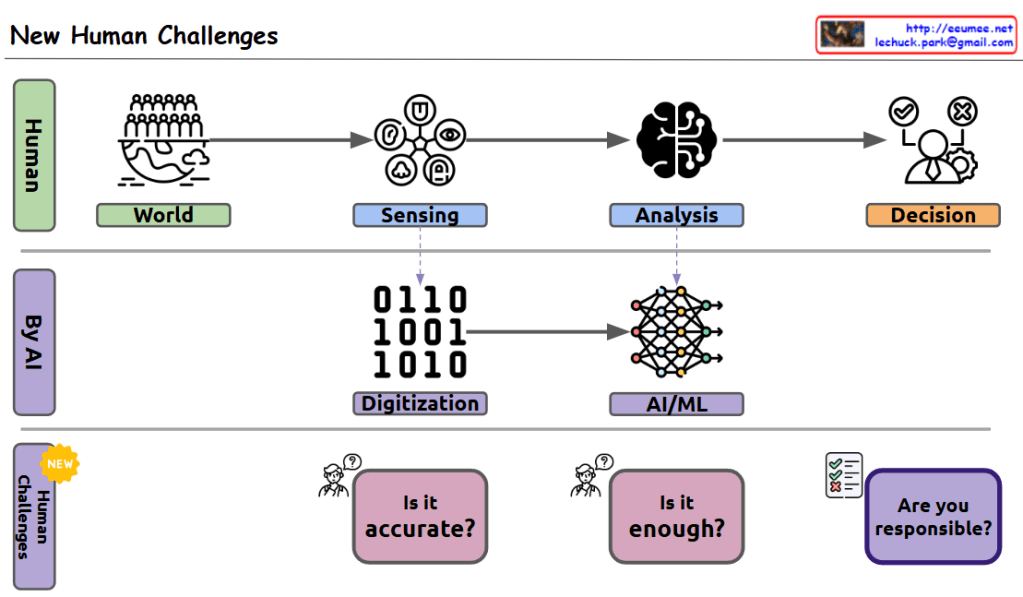
New Human Challenges

This image titled “New Human Challenges” illustrates the paradigm shift in information processing in the AI era and the new roles humans must assume.

The diagram is structured in three tiers:

  1. Human (top row): Shows the traditional human information processing flow. Humans sense information from the “World,” perform “Analysis” using the brain, and make final “Decisions” based on this analysis.
  2. By AI (middle row): In the modern technological environment, information from the world is “Digitized” into binary code, and this data is then processed through “AI/ML” systems.
  3. Human Challenges (bottom row): Highlights three key challenges humans face in the AI era:
    • “Is it accurate?” – Verifying the quality and integrity of data collection processes
    • “Is it enough?” – Ensuring the trained data is sufficient and balanced to reflect all perspectives
    • “Are you responsible?” – Reflecting on whether humans can take ultimate responsibility for decisions suggested by AI

This diagram effectively demonstrates how the information processing paradigm has shifted from human-centered to AI-assisted systems, transforming the human role from direct information processors to supervisors and accountability holders for AI systems. Humans now face new challenges focused on ensuring data quality, data sufficiency and balance, and taking responsibility for final decision-making.

With Claude

100% is the direction, not Now

This image illustrates a key concept about leadership and decision-making.

The main message, titled “100% is the direction, not Now,” conveys that while perfection (100%) should be our aspiration and direction, it’s not a realistic immediate goal under real-world constraints.

Key elements in the diagram:

  • On the left, a silhouette of a person running toward the 100% goal
  • In the upper right, a circle marked “100%” with text below stating “100% is only with All the conditions of the world”
  • In the center, a thinking figure asking “Is it possible to consider all conditions?” alongside the constraints “with Limited Resource & Limited Time”
  • Below, the text “to make the most efficient decision based on current Conditions” next to “90%?”
  • At the bottom, “Leadership skills” is highlighted

The core message is that it’s nearly impossible to achieve 100% of our goals when considering all real-world limitations of time and resources. An important leadership skill is finding the balance and determining what a realistic “90%” achievement looks like in the present circumstances – making efficient decisions based on current conditions rather than pursuing an unattainable perfect outcome. Leaders must direct their teams toward the 100% ideal while making balanced decisions about what can actually be accomplished now.

A probability world

From DALL-E with some prompting
The image explores how human decision-making has evolved from data analysis to probabilistic judgments. Initially, rules derived from data led to definitive decisions, but with the advent of AI, we have returned to probabilistic decision-making. The phrases at the top suggest that the real world may be inherently probabilistic and that humans still lack complete knowledge of the quantum realm.