Unknown conditions

From DALL-E with some prompting
The image conveys that the response to external conditions and the infinite number of conditions that humans cannot precisely analyze is becoming possible through Artificial Intelligence (AI), especially deep learning. The top part represents the traditional programming approach, where predefined actions are executed given known conditions, as indicated by the “if (conditions) then (actions)” code snippet and the “100% analyzed” phrase, highlighting the need for conditions to be fully analyzed. In contrast, the bottom part illustrates how AI, even with unknown conditions, can learn from data and autonomously determine appropriate actions. Data-driven AI actions suggest the capability to recognize complex patterns and make autonomous decisions, demonstrating the potential of deep learning technologies to go beyond human analysis in various contexts.
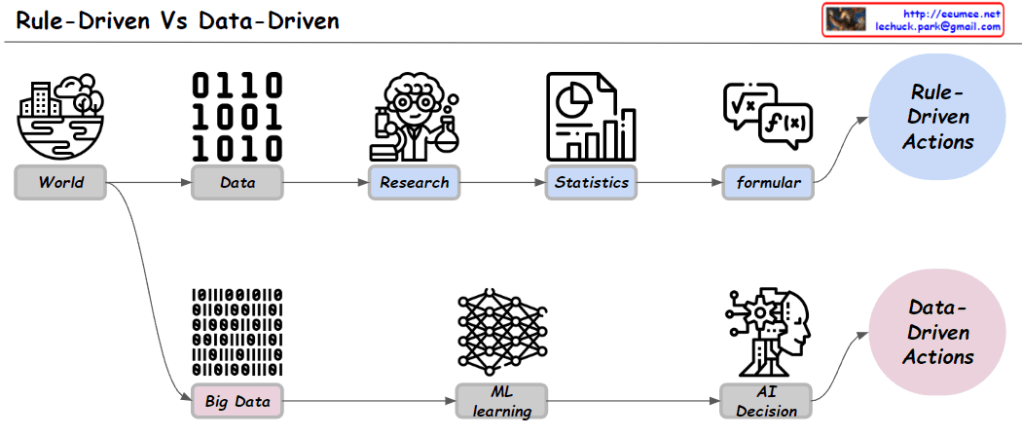
Rule-Driven Vs Data-Driven

From the Bard with some prompting

Rule-based and data-driven systems are two different approaches to artificial intelligence (AI).

Data-driven systems make decisions based on data. For example, a data-driven system could be used to recommend products to customers based on their purchase history.

Here is a summary of the key differences between rule-based and data-driven systems:

  • Decision-making process: Rule-based systems use if-then rules, while data-driven systems use data.
  • Examples: Rule-based systems can be used for simple tasks, such as turning on a fan. Data-driven systems can be used for more complex tasks, such as recommending products to customers.
  • Strengths: Rule-based systems are simple and easy to understand. Data-driven systems are accurate.
  • Weaknesses: Rule-based systems can be difficult to adapt to new situations. Data-driven systems can be inaccurate if data is insufficient.

In conclusion, rule-based systems are simple and easy to understand, but they can be difficult to adapt to new situations. Data-driven systems are accurate, but they can be inaccurate if data is insufficient.

Digital Service

From DALL-E with some prompting
The image outlines the workflow and components of digital data services. It begins with data collection from various sources, which is then subjected to a verification process to ensure its integrity. The verified data is stored in a database and undergoes the ETL process (Extract, Transform, Load) to be formatted appropriately for analysis. This data is visualized to facilitate insightful analysis, which then feeds into an AI learning process. The outcomes of this analysis are applied in the service stage where established processes are confirmed and automation tools are implemented to deliver the final service. The AI model, refined by learning from the data, plays a critical role in enhancing the precision and efficiency of the service provided.

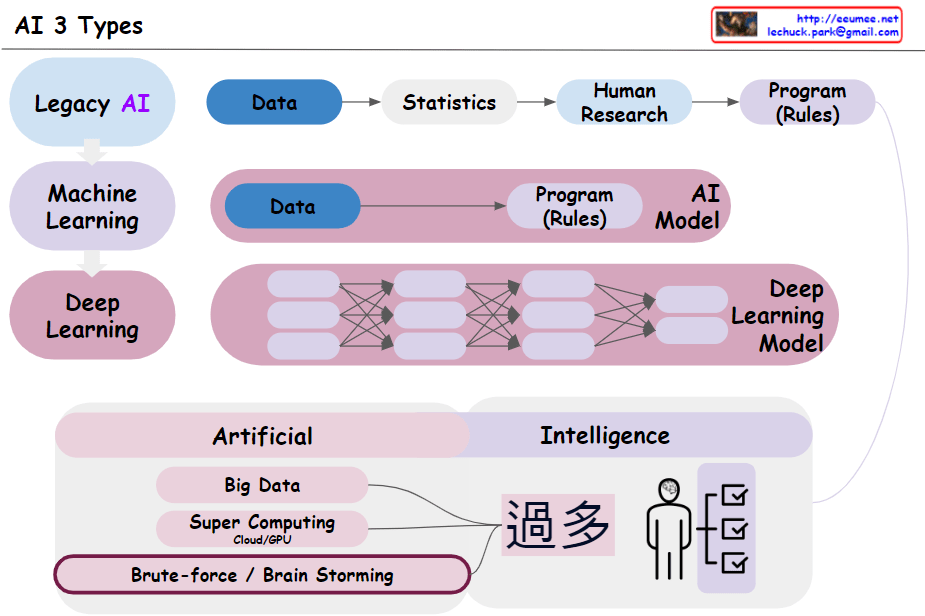
AI 3 Types

From DALL-E with some prompting
The image depicts the three stages of AI forming artificial intelligence through repeated classification tasks based on data:

  1. Legacy AI derives statistics from data and transforms them into rule-based programs through human research.
  2. Machine Learning evolves these rules into AI models capable of executing more complex functions.
  3. Deep Learning uses deep neural networks to process data and create complex models that perform cognitive tasks.

In this process, AI leverages extensive data for repetitive classification tasks, and the result is what we refer to as ‘intelligence.’ However, this intelligence is not an emulation of human thought processes but rather a product of data processing and algorithms, which qualifies it as ‘artificial intelligence.’ This underlines that the ‘artificial’ in AI corresponds to intelligence derived artificially rather than naturally through human cognition.

Digitization

From DALL-E with some prompting
The image illustrates the concept of digitization. It shows an analog signal being converted into a digital format, represented by a sequence of binary numbers. The process emphasizes the importance of accuracy and precision in digitization, noting that even small errors in digitizing the signal can lead to significant computing errors. Therefore, maintaining high accuracy and precision is marked as important to ensure the integrity of the huge computing tasks that rely on the digitized data. 

Digital Works

From DALL-E with some prompting
The image highlights the centrality of data in digital operations. Data manifests in various forms and is at the core of all digital processes, from traditional CPU tasks to contemporary AI/ML services. The CPU utilizes the Von Neumann architecture to execute instructions that process data. Programs manipulate this data to perform desired operations. Databases store and manage this data, while AI/ML learns from the data and generates predictive models. Ultimately, all these processes culminate in services that are delivered to users. Throughout these stages, the fundamental programming principle of ‘If’ (condition) and ‘Then’ (action) is applied, facilitating data-driven decisions and enabling automated processing.

AI with humans

From DALL-E with some prompting
This image illustrates the process of how AI and humans interact with data. Initially, data undergoes computation, followed by human-led analysis. Rules are then discovered, which inform the creation or improvement of models. These processes lead to the sharing and generation of new ideas, feeding into an acceleration of AI capabilities.

The analysis and AI-discovered rules are used to construct or enhance models, which are then verified by AI to confirm the outcomes. Ultimately, the new ideas, products, or services developed through this process are shared and disseminated across society. This entire cycle fosters rapid advancements in AI, enabling improvements in human efficiency and task execution.