Memory Control Unit

From Claude with some prompting
The image explains the memory management and access approaches in computing systems. Fundamentally, for any memory management approach, whether hardware or software, there needs to be a defined unit of operation.

At the hardware level, the physical Memory Access Unit is determined by the CPU’s bit width (32-bit or 64-bit).

At the software/operating system level, the Paging Unit, typically 4KB, is used for virtual memory management through the paging mechanism.

Building upon these foundational units, additional memory management techniques are employed to handle memory regions of varying sizes:

  • Smaller units: Byte-addressable memory, bit operations, etc.
  • Larger units: SLAB allocation, Buddy System, etc.

Essentially, the existence of well-defined units at the hardware and logical/software layers is a prerequisite that enables comprehensive and scalable memory management. These units serve as the basis for memory control mechanisms across different levels of abstraction and size requirements in computing systems.

New infra age

From Claude with some prompting
This image illustrates the surge in data and the advancement of AI technologies, particularly parallel processing techniques that efficiently handle massive amounts of data. As a result, there is a growing need for infrastructure technologies that can support such data processing capabilities. Technologies like big data processing, parallel processing, direct memory access, and GPU computing have evolved to meet this demand. The overall flow depicts the data explosion, the advancement of AI and parallel processing techniques, and the evolution of supporting infrastructure technologies.

CPU,FPGA,ASIC

From Claude with some prompting
The CPU is described as a central processing unit for general-purpose computing, handling diverse tasks with high performance but at a low cost/price ratio.

This image provides an overview of different types of processors and their key characteristics. It compares CPUs, ASICs (Application-Specific Integrated Circuits), FPGAs (Field-Programmable Gate Arrays), and GPUs (Graphics Processing Units).

The ASIC is an application-specific integrated circuit designed for specific tasks like cryptography and AI. It has low performance per price but is highly optimized for its intended use cases.

The FPGA is a reconfigurable processor that allows design changes and prototyping. It has medium performance per price and is suitable for data processing sequences.

The GPU is designed for graphic processing and parallel data processing. It excels at high-performance computing for graphics-intensive applications, but has a medium to high cost/price ratio.

The image highlights the key differences in terms of processing capability, specialization, reconfigurability, performance, and cost among these processor types.

Processing UNIT

From DALL-E With some prompting

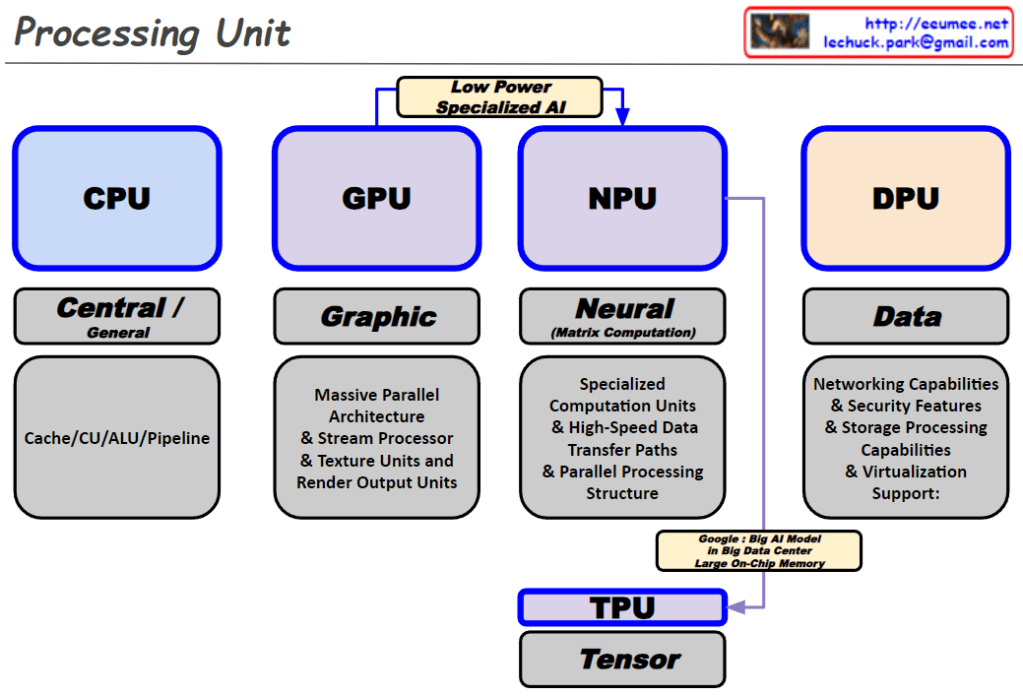
Processing Unit

  • CPU (Central Processing Unit): Central / General
    • Cache/Control Unit (CU)/Arithmetic Logic Unit (ALU)/Pipeline
  • GPU (Graphics Processing Unit): Graphic
    • Massive Parallel Architecture
    • Stream Processor & Texture Units and Render Output Units
  • NPU (Neural Processing Unit): Neural (Matrix Computation)
    • Specialized Computation Units
    • High-Speed Data Transfer Paths
    • Parallel Processing Structure
  • DPU (Data Processing Unit): Data
    • Networking Capabilities & Security Features
    • Storage Processing Capabilities
    • Virtualization Support
  • TPU (Tensor Processing Unit): Tensor
    • Tensor Cores
    • Large On-Chip Memory
    • Parallel Data Paths

Additional Information:

  • NPU and TPU are differentiated by their low power, specialized AI purpose.
  • TPU is developed by Google for large AI models in big data centers and features large on-chip memory.

The diagram emphasizes the specialized nature of NPU and TPU for AI tasks, highlighting their low power consumption and specialized computation capabilities, particularly for neural and tensor computations. It also contrasts these with the more general-purpose capabilities of CPUs and the graphic processing orientation of GPUs. DPU is presented as specialized for handling data-centric tasks involving networking, security, and storage in virtualized environments.

Non-Uniform Memory Access

From DALL-E with some prompting
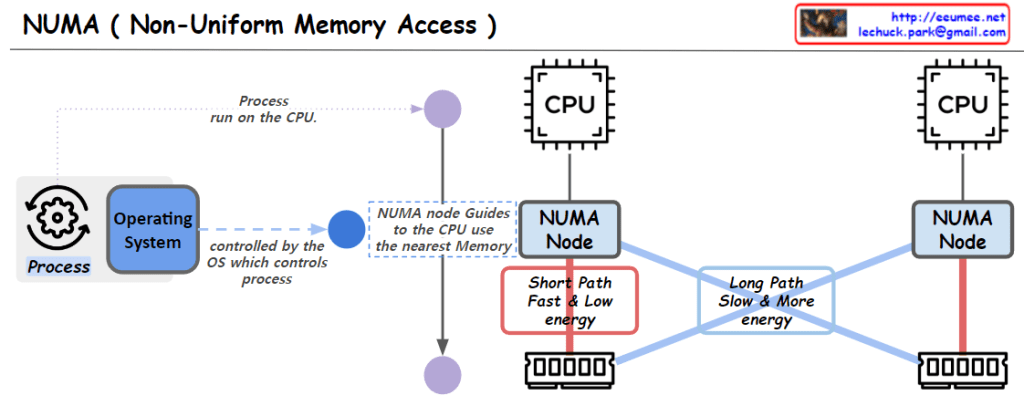
The image depicts the NUMA (Non-Uniform Memory Access) architecture in computer systems. Key elements include:

  1. Operating System: Manages and controls processes running on the CPU.
  2. CPU: Central Processing Units where computing tasks are executed.
  3. NUMA Nodes: Guide CPUs to use the nearest memory, with each NUMA node having memory areas closer to specific CPUs.
  4. Memory Access Paths: “Short Path” indicates a fast and low-energy memory access that is closer, while “Long Path” represents a slower and more energy-consuming memory access that is farther away.

The structure illustrates that memory access times in a NUMA system are not uniform across all memory, suggesting that memory access optimization can enhance overall system performance.


Spin lock

From DALL-E with some prompting
The image illustrates a comparison between the costs associated with spinlocks and context switching. It contrasts the ‘waiting cost’ incurred when a process is on hold while another process monopolizes a CPU core, with the ‘switching cost’ that arises from transitioning between processes. Spinlocks represent the waiting cost as a process continually attempts to access the CPU, thereby avoiding unnecessary context switches and increasing efficiency. Particularly in multi-CPU environments, the system underscores the ability to handle multiple processes efficiently without the need for operating system-induced switching.

Process scheduler

From DALL-E with some prompting
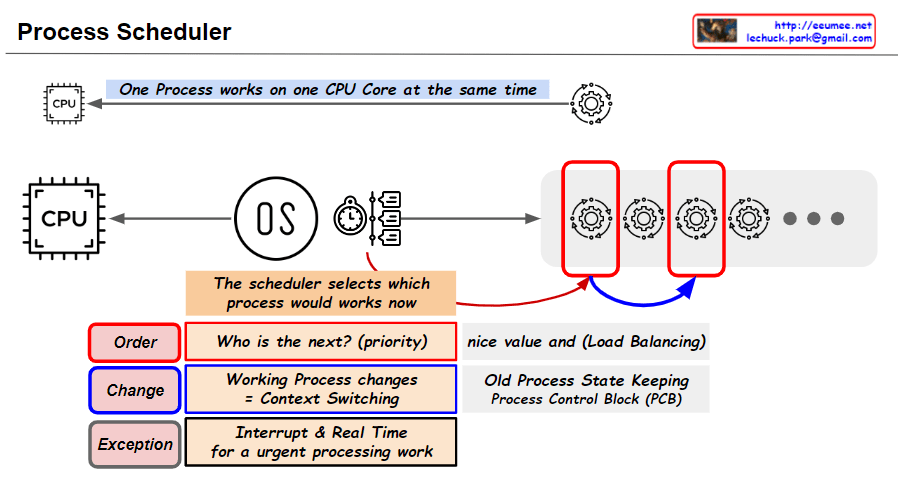
The image highlights the essential mechanisms of process scheduling to share a single CPU core resource among multiple processes. The scheduler determines the order of processes to be executed based on priority and changes the current running process through context switching. Additionally, it promptly addresses exceptions requiring urgent processing through interrupts and real-time handling. This scheduling approach ensures efficient allocation of CPU resources and stable operation of the system.