Temperate Prediction in DC (II) – The start and The Target

This image illustrates the purpose and outcomes of temperature prediction approaches in data centers, showing how each method serves different operational needs.

Purpose and Results Framework

CFD Approach – Validation and Design Purpose

Input:

  • Setup Data: Physical infrastructure definitions (100% RULES-based)
  • Pre-defined spatial, material, and boundary conditions

Process: Physics-based simulation through computational fluid dynamics

Results:

  • What-if (One Case) Simulation: Theoretical scenario testing
  • Checking a Limitation: Validates whether proposed configurations are “OK or not”
  • Used for design validation and capacity planning

ML Approach – Operational Monitoring Purpose

Input:

  • Relation (Extended) Data: Real-time operational data starting from workload metrics
  • Continuous data streams: Power, CPU, Temperature, LPM/RPM

Process: Data-driven pattern learning and prediction

Results:

  • Operating Data: Real-time operational insights
  • Anomaly Detection: Identifies unusual patterns or potential issues
  • Used for real-time monitoring and predictive maintenance

Key Distinction in Purpose

CFD: “Can we do this?” – Validates design feasibility and limits before implementation

  • Answers hypothetical scenarios
  • Provides go/no-go decisions for infrastructure changes
  • Design-time tool

ML: “What’s happening now?” – Monitors current operations and predicts immediate future

  • Provides real-time operational intelligence
  • Enables proactive issue detection
  • Runtime operational tool

The diagram shows these are complementary approaches: CFD for design validation and ML for operational excellence, each serving distinct phases of data center lifecycle management.

With Claude

Temperate Prediction in DC

Overall Structure

Top: CFD (Computational Fluid Dynamics) based approach Bottom: ML (Machine Learning) based approach

CFD Approach (Top)

  • Basic Setup:
    • Spatial Definition & Material Properties: Physical space definition of the data center and material characteristics (servers, walls, air, etc.)
    • Boundary Conditions: Setting boundary conditions (inlet/outlet temperatures, airflow rates, heat sources, etc.)
  • Processing:
    • Configuration + Physical Rules: Application of physical laws (heat transfer equations, fluid dynamics equations, etc.)
    • Heat Flow: Heat flow calculations based on defined conditions
  • Output: Heat + Air Flow Simulation (physics-based heat and airflow simulation)

ML Approach (Bottom)

  • Data Collection:
    • Real-time monitoring through Metrics/Data Sensing
    • Operational data: Power (Kw), CPU (%), Workload, etc.
    • Actual temperature measurements through Temperature Sensing
  • Processing: Pattern learning through Machine Learning algorithms
  • Output: Heat (with Location) Prediction (location-specific heat prediction)

Key Differences

CFD Method: Theoretical calculation through physical laws using physical space definitions, material properties, and boundary conditions as inputs ML Method: Data-driven approach that learns from actual operational data and sensor information for prediction

The key distinction is that CFD performs simulation from predefined physical conditions, while ML learns from actual operational data collected during runtime to make predictions.

With Claude

Prediction with data

This image illustrates a comparison between two approaches for Prediction with Data.

Left Side: Traditional Approach (Setup First Configuration)

The traditional method consists of:

  • Condition: 3D environment and object locations
  • Rules: Complex physics laws
  • Input: 1+ cases
  • Output: 1+ prediction results

This approach relies on pre-established rules and physical laws to make predictions.

Right Side: Modern AI/Machine Learning Approach

The modern method follows these steps:

  1. Huge Data: Massive datasets represented in binary code
  2. Machine Learning: Pattern learning from data
  3. AI Model: Trained artificial intelligence model
  4. Real-Time High Resolution Data: High-quality data streaming in real-time
  5. Prediction Anomaly: Final predictions and anomaly detection

Key Differences

The most significant difference is highlighted by the question “Believe first ??” at the bottom. This represents a fundamental philosophical difference: the traditional approach starts by “believing” in predefined rules, while the AI approach learns patterns from data to make predictions.

Additionally, the AI approach features “Longtime Learning Verification,” indicating continuous model improvement through ongoing learning and validation processes.

The diagram effectively contrasts rule-based prediction systems with data-driven machine learning approaches, showing the evolution from deterministic, physics-based models to adaptive, learning-based AI systems.

With Claude

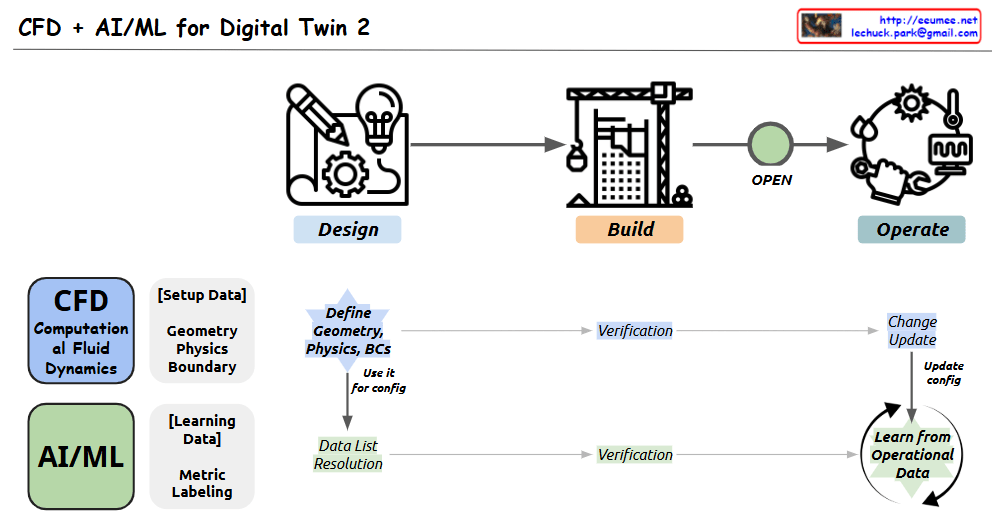
CFD + AI/ML for Digital Twin 2

Digital Twin System Using CFD and AI/ML

This diagram illustrates the complete lifecycle of a digital twin system, showing how CFD (Computational Fluid Dynamics) and AI/ML play crucial roles at different stages.

Key Stages

  1. Design:
    • CFD plays a critical role at this stage
    • Establishes the foundation through geometric modeling, physical property definition, and boundary condition setup
    • Accurate physical simulation at this stage forms the basis for future predictions
  2. Build:
    • Implementation stage for the designed model
    • Integration of both CFD models and AI/ML models
  3. Operate:
    • AI/ML plays a critical role at this stage
    • System performance prediction and optimization based on real-time data
    • Continuous model improvement by learning from operational data

Technology Integration Process

  • CFD Track:
    • Provides accurate physical modeling during the design phase
    • Defines geometry, physics, and boundary conditions to establish the basic structure
    • Verifies model accuracy through validation processes
    • Updates the model according to changes during operation
  • AI/ML Track:
    • Configures learning data and defines metrics
    • Sets up data lists and resolution
    • Provides predictive models using real-time data during the operation phase
    • Continuously improves prediction accuracy by learning from operational data

Cyclical Improvement System

The key to this system is that physical modeling (CFD) at the design stage and data-driven prediction (AI/ML) at the operation stage work complementarily to form a continuous improvement cycle. Real data collected during operation is used to update the AI/ML models, which in turn contributes to improving the accuracy of the CFD models.

With Claude

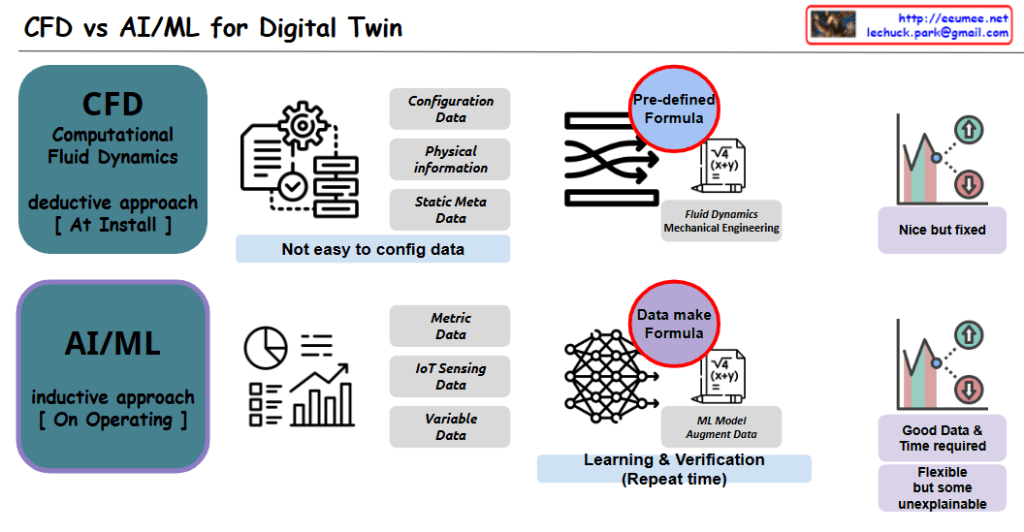
CFD & AI/ML

CFD (Computational Fluid Dynamics) – Deductive Approach [At Installation]

  • Data Characteristics
    • Configuration Data
    • Physical Information
    • Static Meta Data
  • Features
    • Complex data configuration
    • Predefined formula usage
    • Result: Fixed and limited
    • Stable from engineering perspective

AI/ML – Inductive Approach [During Operation]

  • Data Characteristics
    • Metric Data
    • IoT Sensing Data
    • Variable Data
  • Features
    • Data-driven formula generation
    • Continuous learning and verification
    • Result: Flexible but partially unexplainable
    • High real-time adaptability

Comprehensive Comparison

Harmonious integration of both approaches is key to future digital twin technologies

CFD: Precise but rigid modeling

AI/ML: Adaptive but complex modeling

The key insight here is that both CFD and AI/ML approaches have unique strengths. CFD provides a rigorous, physics-based model with predefined formulas, while AI/ML offers dynamic, adaptive learning capabilities. The future of digital twin technology likely lies in finding an optimal balance between these two methodologies, leveraging the precision of CFD with the flexibility of machine learning.

With Claude