Human Control

Human-Centered AI Decision-Making System

This diagram illustrates a human-in-the-loop AI system where humans maintain control over critical decision-making processes.

System Components

Top Process Flow:

  • Data QualityAnalysisDecision
  • Sequential workflow with human oversight at each stage

Bottom Control Layer:

  • AI Works in the central processing area
  • Ethics Human Rules (left side) – Human-defined ethical guidelines
  • Probability Control (right side) – Human oversight of AI confidence levels

Human Control Points:

  • Human Intent feeds into the system at the beginning
  • Final Decision remains with humans at the end
  • Human Control emphasized as the foundation of the entire system

Key Principles

  1. Human Agency: People retain ultimate decision-making authority
  2. AI as Tool: AI performs analysis but doesn’t make final decisions
  3. Ethical Oversight: Human-defined rules guide AI behavior
  4. Transparency: Probability controls allow humans to understand AI confidence
  5. Accountability: Clear human responsibility throughout the process

Summary: This represents a responsible AI framework where artificial intelligence enhances human decision-making capabilities while ensuring humans remain in control of critical choices and ethical considerations.

With Claude
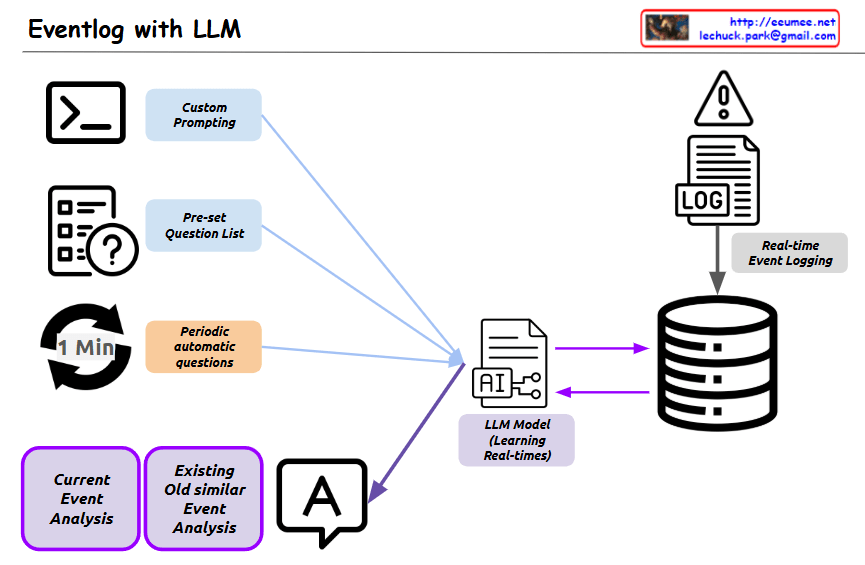
Eventlog with LLM

  1. Input methods (left side):
    • A command line/terminal icon with “Custom Prompting”
    • A questionnaire icon with “Pre-set Question List”
    • A timer icon (1 Min) with “Periodic automatic questions”
  2. Processing (center):
    • An “LLM Model” component labeled as “Learning Real-times”
    • Database/storage components for “Real-time Event Logging”
  3. Output/Analysis (bottom):
    • Two purple boxes for “Current Event Analysis” and “Existing Old similar Event Analysis”
    • A text/chat bubble showing output

This system collects and updates unstructured text-based event logs in real-time, which are then learned by the LLM. Through user-input questions, predefined question lists, or periodically auto-generated questions, the system analyzes current events and compares them with similar past cases to provide comprehensive analytical results.

The primary purpose of this system is to efficiently process large volumes of event logs from increasingly large and complex IT infrastructure or business systems. This helps operators easily identify important events, make quick judgments, and take appropriate actions. By leveraging the natural language processing capabilities of LLMs, the system transforms complex log data into meaningful insights, significantly simplifying system monitoring and troubleshooting processes.

With Claude

Traffic Control

This image shows a network traffic control system architecture. Here’s a detailed breakdown:

  1. At the top, several key technologies are listed:
  • P4 (Programming Protocol-Independent Packet Processors)
  • eBPF (Extended Berkeley Packet Filter)
  • SDN (Software-Defined Networking)
  • DPI (Deep Packet Inspection)
  • NetFlow/sFlow/IPFIX
  • AI/ML-Based Traffic Analysis
  1. The system architecture is divided into main sections:
  • Traffic flow through IN PORT and OUT PORT
  • Routing based on Destination IP address
  • Inside TCP/IP and over TCP/IP sections
  • Security-Related Conditions
  • Analysis
  • AI/ML-Based Traffic Analysis
  1. Detailed features:
  • Inside TCP/IP: TCP/UDP Flags, IP TOS (Type of Service), VLAN Tags, MPLS Labels
  • Over TCP/IP: HTTP/HTTPS Headers, DNS Queries, TLS/SSL Information, API Endpoints
  • Security-Related: Malicious Traffic Patterns, Encryption Status
  • Analysis: Time-Based Conditions, Traffic Patterns, Network State Information
  1. The AI/ML-Based Traffic Analysis section shows:
  • AI/ML technologies learn traffic patterns
  • Detection of anomalies
  • Traffic control based on specific conditions

This diagram represents a comprehensive approach to modern network monitoring and control, integrating traditional networking technologies with advanced AI/ML capabilities. The system shows a complete flow from packet ingress to analysis, incorporating various layers of inspection and control mechanisms.

with Claude

Analysis Evolutions and ..

With Claude
this image that shows the evolution of data analysis and its characteristics at each stage:

Analysis Evolution:

  1. 1-D (One Dimensional): Current Status analysis
  2. Time Series: Analysis of changes over time
  3. n-D Statistics: Multi-dimensional correlation analysis
  4. ML/DL (Machine Learning/Deep Learning): Huge-dimensional analysis including exceptions

Bottom Indicators’ Changes:

  1. Data/Computing/Complexity:
  • Marked as “Up and Up” and increases “Dramatically” towards the right
  1. Accuracy:
  • Left: “100% with no other external conditions”
  • Right: “not 100%, up to 99.99% from all data”
  1. Comprehensibility:
  • Left: “Understandable/Explainable”
  • Right: “Unexplainable”
  1. Actionability:
  • Left: “Easy to Action”
  • Right: “Difficult to Action require EXP” (requires expertise)

This diagram illustrates the trade-offs in the evolution of data analysis. As analysis methods progress from simple one-dimensional analysis to complex ML/DL, while the sophistication and complexity of analysis increase, there’s a decrease in comprehensibility and ease of implementation. It shows how more advanced analysis techniques, while powerful, require greater expertise and may be less transparent in their decision-making processes.

The progression also demonstrates how modern analysis methods can handle increasingly complex data but at the cost of reduced explainability and the need for specialized knowledge to implement them effectively.

One Value to Value(s)

With Claude
“A Framework for Value Analysis: From Single Value to Comprehensive Insights”

This diagram illustrates a sophisticated analytical framework that shows how a single value transforms through various analytical processes:

  1. Time Series Analysis Path:
    • A single value evolves over time
    • Changes occur through two mechanisms:
      • Self-generated changes (By oneself)
      • External influence-driven changes (By influence)
    • These changes are quantified through a mathematical function f(x)
    • Statistical measures (average, minimum, maximum, standard deviation) capture the characteristics of these changes
  2. Correlation Analysis Path:
    • The same value is analyzed for relationships with other relevant data
    • Weighted correlations indicate the strength and significance of relationships
    • These relationships are also expressed through a mathematical function f(x)
  3. Integration and Machine Learning Stage:
    • Both analyses (time series and correlation) feed into advanced analytics
    • Machine Learning and Deep Learning algorithms process this dual-perspective data
    • The final output produces either a single generalized value or multiple meaningful values

Core Purpose: The framework aims to take a single value and:

  • Track its temporal evolution within a network of influences
  • Analyze its statistical behavior through mathematical functions
  • Identify weighted correlational relationships with other variables
  • Ultimately synthesize these insights through ML/DL algorithms to generate either a unified understanding or multiple meaningful outputs

This systematic approach demonstrates how a single data point can be transformed into comprehensive insights by considering both its temporal dynamics and relational context, ultimately leveraging advanced analytics for meaningful interpretation.

The framework’s strength lies in its ability to combine temporal patterns, relational insights, and advanced analytics into a cohesive analytical approach, providing a more complete understanding of how values evolve and relate within a complex system.

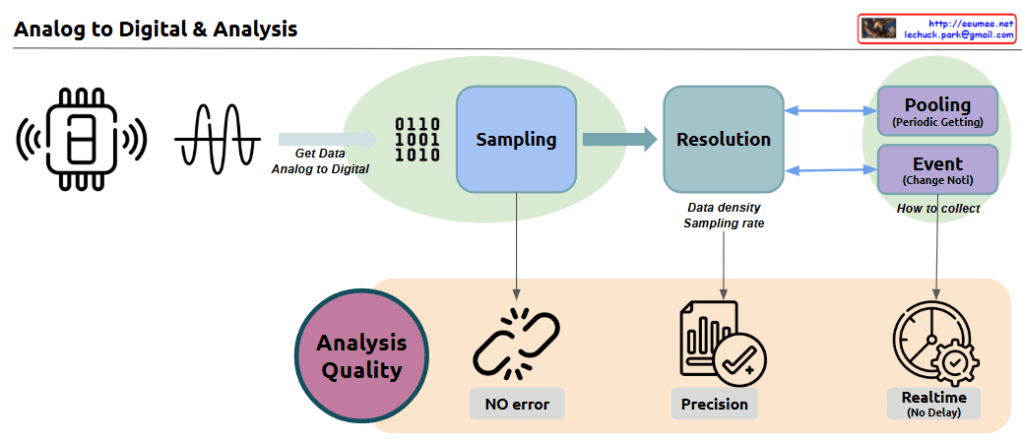
Analog to Digital & Analysis

With Claude
Here’s the analysis of the image and key elements :

  1. Sampling Stage
  • Initial stage of converting analog signals to digital values
  • Converts analog waveforms from sensors into digital data (0110 1001 1010)
  • Critical first step that determines data quality
  • Foundation for all subsequent processing
  1. Resolution Stage
  • Determines data quality through Data density and Sampling rate
  • Direct impact on data precision and accuracy
  • Establishes the foundation for data quality in subsequent analysis
  • Controls the granularity of digital conversion
  1. How to Collect
  • Pooling: Collecting data at predetermined periodic intervals
  • Event: Data collection triggered by detected changes
  • Provides efficient data collection strategies based on specific needs
  • Enables flexible data gathering approaches
  1. Analysis Quality
  • NO error: Ensures error-free data processing
  • Precision: Maintains high accuracy in data analysis
  • Realtime: Guarantees real-time processing capability
  • Comprehensive quality control throughout the process

Key Importance in Data Collection/Analysis:

  1. Accuracy: Essential for reliable data-driven decision making. The quality of input data directly affects the validity of results and conclusions.
  2. Real-time Processing: Critical for immediate response and monitoring, enabling quick decisions and timely interventions when needed.
  3. Efficiency: Proper selection of collection methods ensures optimal resource utilization and cost-effective data management.
  4. Quality Control: Consistent quality maintenance throughout the entire process determines the reliability of analytical results.

These elements work together to enable reliable data-driven decision-making and analysis. The success of any data analysis system depends on the careful implementation and monitoring of each component, from initial sampling to final analysis. When properly integrated, these components create a robust framework for accurate, efficient, and reliable data processing and analysis.

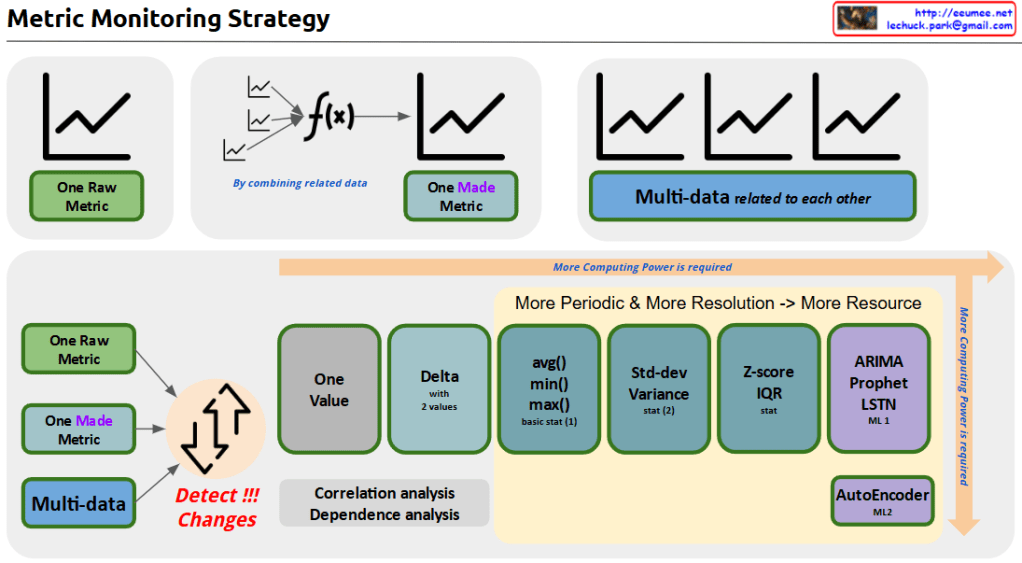
Metric Monitoring Strategy

With a Claude’s Help
the Metric Monitoring System diagram:

  1. Data Hierarchy (Top)
  • Raw Metric: Unprocessed source data
  • Made Metric: Combined metrics from related data
  • Multi-data: Interrelated metrics sets
  1. Analysis Pipeline (Bottom)

Progressive Stages:

  • Basic: Change detection, single value, delta analysis
  • Intermediate: Basic statistics (avg/min/max), standard deviation
  • Advanced: Z-score/IQR
  • ML-based: ARIMA/Prophet, LSTM, AutoEncoder

Key Features:

  • Computing power increases with complexity (left to right)
  • Correlation and dependency analysis integration
  • Two-tier ML approach: ML1 (prediction), ML2 (pattern recognition)

Implementation Benefits:

  • Resource optimization through staged processing
  • Scalable analysis from basic monitoring to predictive analytics
  • Comprehensive anomaly detection
  • Flexible system adaptable to different monitoring needs

The system provides a complete framework from simple metric tracking to advanced machine learning-based analysis, enabling both reactive and predictive monitoring capabilities.

Additional Values:

  • Early warning system potential
  • Root cause analysis support
  • Predictive maintenance enablement
  • Resource allocation optimization
  • System health forecasting

This architecture supports both operational monitoring and strategic analysis needs while maintaining resource efficiency through its graduated approach to data processing.Copy