Predictive 2 Reactions for AI HIGH Fluctuation

Image Interpretation: Predictive 2-Stage Reactions for AI Fluctuation

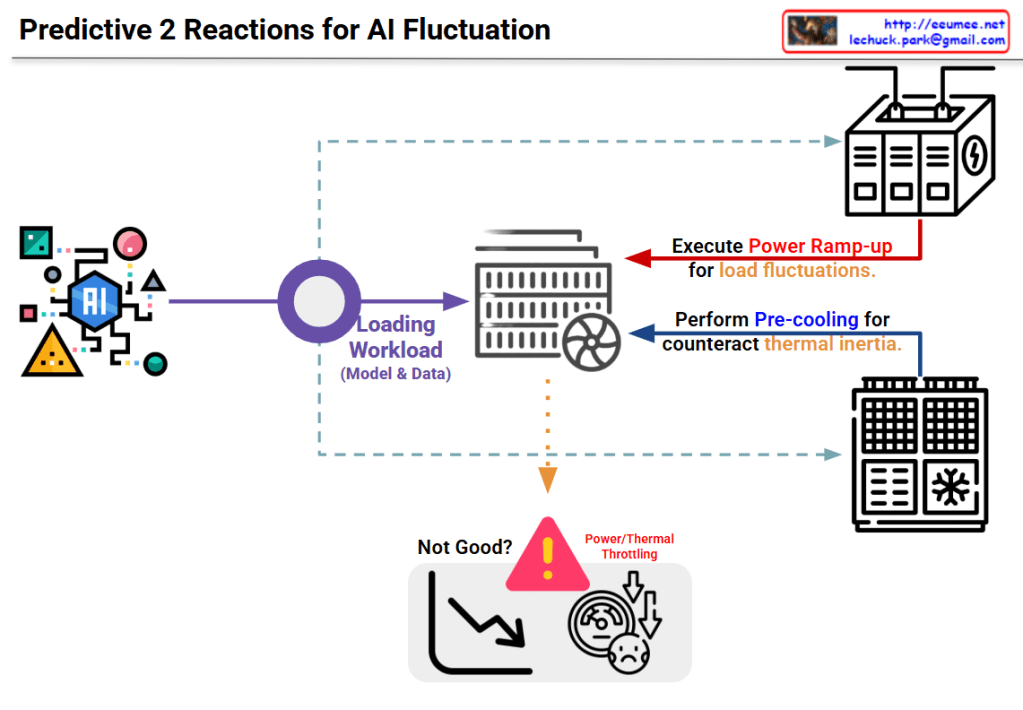
This diagram illustrates a two-stage predictive strategy to address load fluctuation issues in AI systems.

System Architecture

Input Stage:

  • The AI model on the left generates various workloads (model and data)

Processing Stage:

  • Generated workloads are transferred to the central server/computing system

Two-Stage Predictive Reaction Mechanism

Stage 1: Power Ramp-up

  • Purpose: Prepare for load fluctuations
  • Method: The power supply system at the top proactively increases power in advance
  • Preventive measure to secure power before the load increases

Stage 2: Pre-cooling

  • Purpose: Counteract thermal inertia
  • Method: The cooling system at the bottom performs cooling in advance
  • Proactive response to lower system temperature before heat generation

Problem Scenario

The warning area at the bottom center shows problems that occur without these responses:

  • Power/Thermal Throttling
  • Performance degradation (downward curve in the graph)
  • System dissatisfaction state

Key Concept

This system proposes an intelligent infrastructure management approach that predicts rapid fluctuations in AI workloads and proactively adjusts power and cooling before actual loads occur, thereby preventing performance degradation.


Summary

This diagram presents a predictive two-stage reaction system for AI workload management that combines proactive power ramp-up and pre-cooling to prevent thermal throttling. By anticipating load fluctuations before they occur, the system maintains optimal performance without degradation. The approach represents a shift from reactive to predictive infrastructure management in AI computing environments.


#AIInfrastructure #PredictiveComputing #ThermalManagement #PowerManagement #AIWorkload #DataCenterOptimization #ProactiveScaling #AIPerformance #ThermalThrottling #SmartCooling #MLOps #AIEfficiency #ComputeOptimization #InfrastructureAsCode #AIOperations

With Claude

Multi-Token Prediction (MTP) – Increasing Inference Speed

This image explains the Multi-Token Prediction (MTP) architecture that improves inference speed.

Overall Structure

Left: Main Model

  • Starts with an Embedding Layer that converts input tokens to vectors
  • Deep neural network composed of L Transformer Blocks
  • RMSNorm stabilizes the range of Transformer input/output values
  • Finally, the Output Head (BF16 precision) calculates the probability distribution for the next token

Right: MTP Module 1 (Speculative Decoding Module) + More MTP Modules

  • Maximizes efficiency by reusing the Main Model’s outputs
  • Two RMSNorms normalize the intermediate outputs from the Main Model
  • Performs lightweight operations using a single Transformer Block with FP8 Mixed Precision
  • Generates specialized vectors for future token prediction through Linear Projection and concatenation
  • Produces candidate tokens with BF16 precision

Key Features

  1. Two-stage processing: The Main Model accurately predicts the next token, while the MTP Module generates additional candidate tokens in advance
  2. Efficiency:
    • Shares the Embedding Layer with the Main Model to avoid recalculation
    • Reduces computational load with FP8 Mixed Precision
    • Uses only a single Transformer Block
  3. Stability: RMSNorm ensures stable processing of outputs that haven’t passed through the Main Model’s deep layers

Summary

MTP architecture accelerates inference by using a lightweight module alongside the main model to speculatively generate multiple future tokens in parallel. It achieves efficiency through shared embeddings, mixed precision operations, and a single transformer block while maintaining stability through normalization layers. This approach significantly reduces latency in large language model generation.

#MultiTokenPrediction #MTP #SpeculativeDecoding #LLM #TransformerOptimization #InferenceAcceleration #MixedPrecision #AIEfficiency #NeuralNetworks #DeepLearning

With Claude