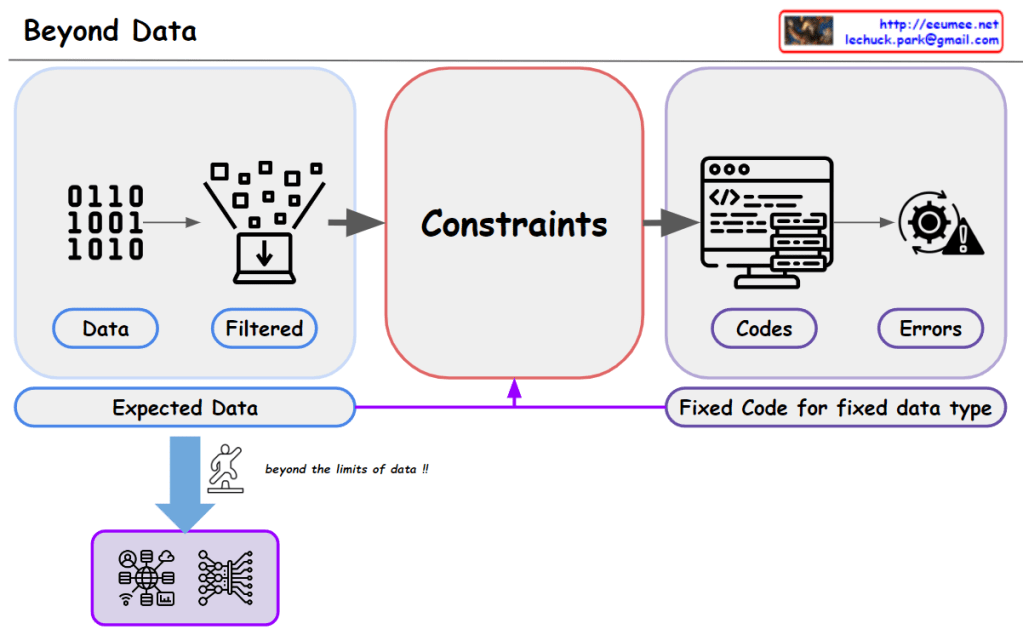
Beyond data

From DALL-E with some prompting
This image depicts the process of overcoming the constraints of traditional programming based on expected data through big data and deep learning. Starting on the left, binary digits labeled as “Data” are processed through a “Filtered” stage to become the necessary “Expected Data.” The box labeled “Constraints” in the center represents the limitations that can occur in programming. These constraints suggest barriers that can be overcome with big data processing and deep learning technologies. On the right, there’s a section transitioning from “Codes” to “Errors,” which signifies possible errors during the coding process. However, the text “Fixed Code for fixed data type” reflects that program code is pre-established for expected data types and does not transcend the boundaries of this data, thereby limiting its potential. The phrase “beyond the limits of data!!” at the bottom expresses the ambition of future programming to surpass the limitations of data processing by utilizing big data and deep learning.

Data Standardization

From DALL-E with some prompting
The image emphasizes the importance of data quality in the digital transformation of large-scale operations. By securing “Data Quality” through data standardization, optimized operations based on verified data enable reliable decision-making, monitoring, and optimization. AI-enhanced analysis and optimization accelerate business transformation, drive data-led innovation, and achieve sustainable operation and customer satisfaction.

  1. Data Standardization: Emphasizes the importance of “Data Quality,” indicating that high-quality, standardized data is foundational.
  2. Operation based on verified data/system: Shows the use of verified data to ensure reliable decision-making, monitoring, and optimization, leading to sustainable operations, business intelligence, and customer satisfaction.
  3. Accelerating (AI) digital business transformation: Describes how optimized and customized processing, along with an AI data analysis platform, can accelerate digital transformation. This leads to work automation, user customization, resource optimization, data-driven innovation, AI predictions and analytics, and expanding standardization.

The overall message suggests that standardizing data quality is crucial for building AI systems that can drive digital transformation and improve business operations and customer satisfaction.

Road to “the new”

From DALL-E with some prompting

The image visually explains the process of creating new ideas and innovations. Each stage is as follows:

Experience: The icon represents human experiences.
Digitization: The process of converting experiences into digital data.
Data: The digitized information.
AI/ML (Artificial Intelligence/Machine Learning): Technologies that analyze and learn from the data.
Accelerator: Represents the acceleration of the analysis and learning process through AI/ML.
Analysis: The process of analyzing data to extract useful insights.
Idea: The emergence of new ideas from data analysis. The phrase “Easy to Get” indicates that this process has become more accessible.
New: Two text icons depicting the implementation of new ideas into innovative products or services.


The image illustrates the flow of digitizing experiences into data, using AI/ML to analyze and accelerate this data, easily obtaining new ideas, and transforming them into new innovations.

Unknown conditions

From DALL-E with some prompting
The image conveys that the response to external conditions and the infinite number of conditions that humans cannot precisely analyze is becoming possible through Artificial Intelligence (AI), especially deep learning. The top part represents the traditional programming approach, where predefined actions are executed given known conditions, as indicated by the “if (conditions) then (actions)” code snippet and the “100% analyzed” phrase, highlighting the need for conditions to be fully analyzed. In contrast, the bottom part illustrates how AI, even with unknown conditions, can learn from data and autonomously determine appropriate actions. Data-driven AI actions suggest the capability to recognize complex patterns and make autonomous decisions, demonstrating the potential of deep learning technologies to go beyond human analysis in various contexts.

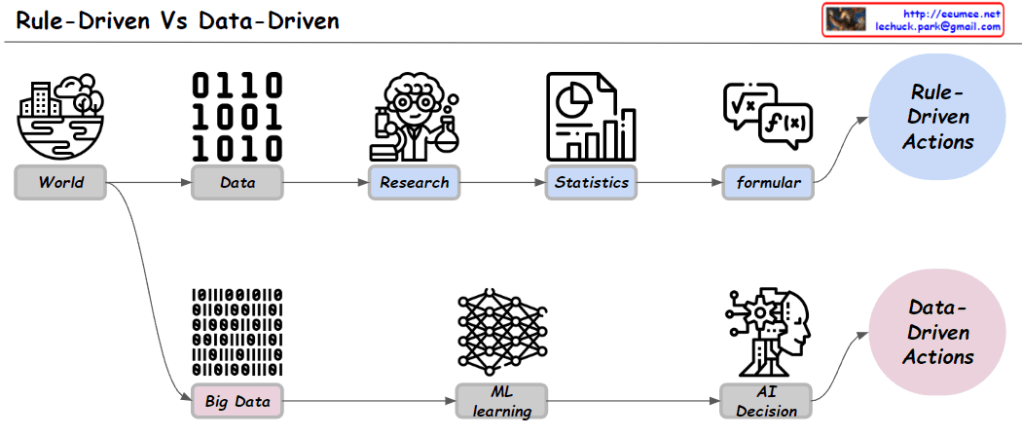
Rule-Driven Vs Data-Driven

From the Bard with some prompting

Rule-based and data-driven systems are two different approaches to artificial intelligence (AI).

Data-driven systems make decisions based on data. For example, a data-driven system could be used to recommend products to customers based on their purchase history.

Here is a summary of the key differences between rule-based and data-driven systems:

  • Decision-making process: Rule-based systems use if-then rules, while data-driven systems use data.
  • Examples: Rule-based systems can be used for simple tasks, such as turning on a fan. Data-driven systems can be used for more complex tasks, such as recommending products to customers.
  • Strengths: Rule-based systems are simple and easy to understand. Data-driven systems are accurate.
  • Weaknesses: Rule-based systems can be difficult to adapt to new situations. Data-driven systems can be inaccurate if data is insufficient.

In conclusion, rule-based systems are simple and easy to understand, but they can be difficult to adapt to new situations. Data-driven systems are accurate, but they can be inaccurate if data is insufficient.

AI TO REAL

From DALL-E with some prompting

The image depicts the concept of applying AI to real-world applications. It presents a flow from the human experience to digital transformation, then to AI, and finally applying AI to real-world scenarios. Here’s a breakdown of the components:

  • Human: Represents the human experience which is the source of data.
  • Experience to Digital: Indicates the process of translating human experiences into digital data.
  • Digital: Refers to the digital representation of data, shown as binary code.
  • Standard/Platform: Suggests that data and processes are standardized on a platform, allowing for the creation of new services easily.
  • AI: Depicts artificial intelligence as a technology or tool.
  • Accelerator to Real: Refers to the application of AI as an accelerator, making processes more precise and scalable, and applying them to real-world scenarios.

The overarching theme is “AI to REAL,” indicating a transition from abstract or digital concepts to practical, tangible applications in the real world. AI is seen as an accelerator that can enhance and expedite the implementation of digital solutions into everyday experiences, grounded in a standardized platform for ease of development and deployment.

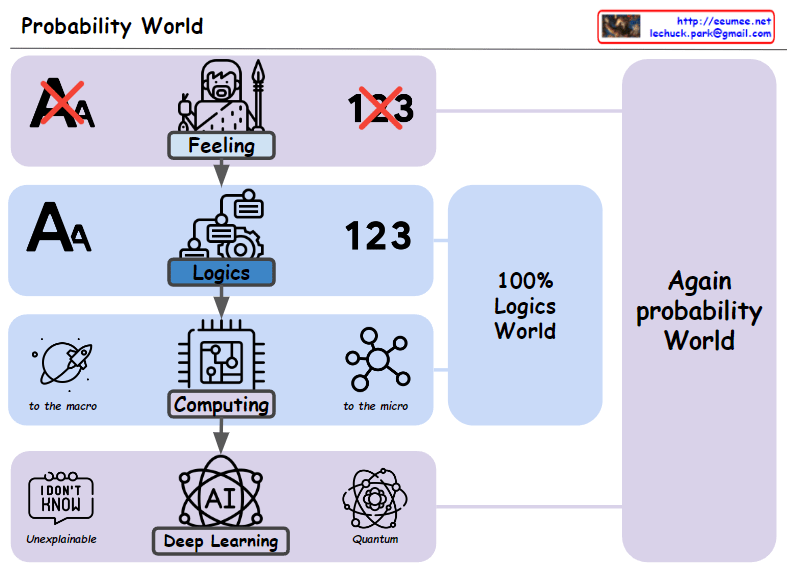
probability World

From DALL-E with some prompting
The image depicts the evolution of human experience and perception, starting from feelings and emotions, progressing to the world of logic and numbers for clarity, then advancing to complex computations and data processing, and finally delving into realms that require deeper understanding, like quantum mechanics, exploring the boundaries between what is known and unknown.

The top section labeled “Feeling” symbolizes the subjective and intuitive world of human experience, while the adjacent “1×3” represents the uncertainty of inaccurate calculations or outcomes. “Aa” and “123” represent clear and concrete understanding obtained through objective and logical thought. “Computing” signifies complex calculations and processing in both the macro and micro worlds, and “AI” and “Deep Learning” symbolize advanced technologies performing such complex calculations. Lastly, “Quantum” represents realms beyond our current scientific understanding, and the return to the “Again probability World” suggests that our knowledge and understanding can still be probabilistic and incomplete.

This diagram visually expresses the continuous cycle of human understanding evolving from emotions to logic, and then to the unknown, indicating that the journey of discovery and comprehension is an ongoing process.