Data

From Claude with some prompting
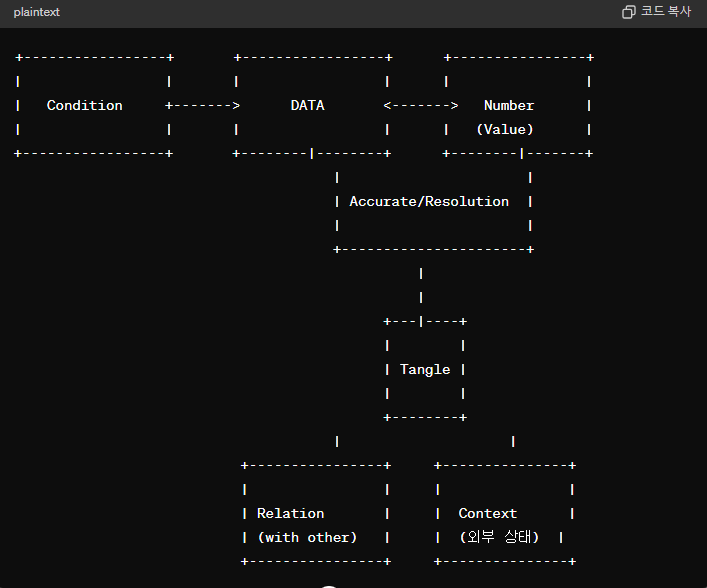
This image presents a comprehensive definition of data that goes beyond just numerical values. To clearly understand data, several elements must be considered.

First, the accuracy and resolution of the data itself are crucial. The “Number (Value)” represents numerical values that must be precise and have an appropriate level of resolution.

Second, data is closely related to external factors. “Condition” indicates a relationship with the state or condition of other data, while “Relation with other” suggests interconnectedness with other data sets.

Third, “Tangle” illustrates that data is not merely a simple number but is complexly intertwined with various elements. To clearly define data, these intricate interconnections and interdependencies must be accounted for.

In essence, the image presents a definition of data that encompasses accuracy, resolution, relationships with external conditions, and intricate interconnectedness. It emphasizes that to truly grasp the nature of data, one must comprehensively consider all these aspects.

The image underscores that data cannot be reduced to just numeric values; rather, it is a multifaceted concept intricately tied to precision, granularity, external factors, and interdependent relationships. Fully understanding data requires a holistic examination of all these interlinked elements.

Updated by GPT-4o
Interrupt

From Claude with some prompting
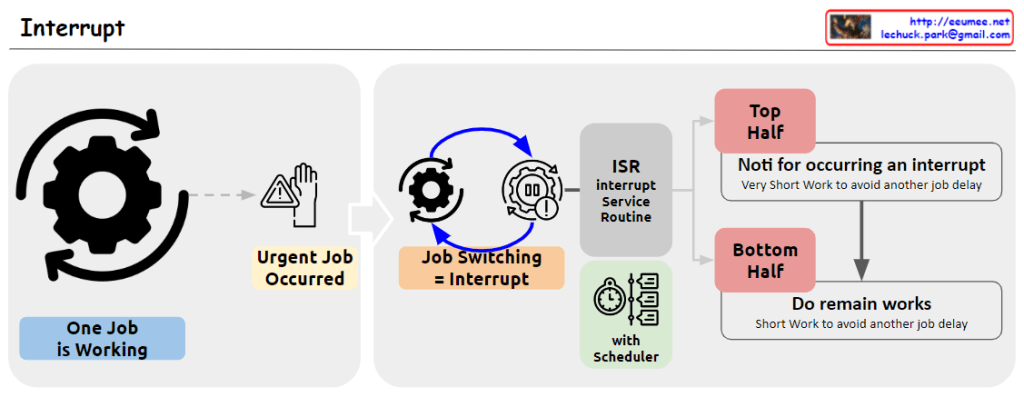
The image illustrates the process of handling interrupts in a computer system. When an urgent job (Urgent Job Occurred) arises while another job (One Job is Working) is executing, an interrupt (Job Switching = Interrupt) occurs. This triggers the Interrupt Service Routine (ISR) to handle the interrupt.
The interrupt handling process is divided into two halves: the Top Half and the Bottom Half. The Top Half performs a “Very Short Work to avoid another job delay” and notifies the system of the interrupt occurrence. The Bottom Half handles the remaining work, also performing “Short Work to avoid another job delay.”

Evolution and AI

From Claude with some prompting
The image metaphorically connects the process of evolution in the universe with the development stages of AI. After the Big Bang and the subsequent increase in entropy (disorder), life forms evolved through a process of self-organization, creating complex and ordered structures, thereby continuously decreasing entropy as long as life exists in the universe. Similarly, the image suggests that data-intensive AI systems will emerge as the next evolutionary stage after humans.

However, a critical point made is that the data driving AI itself does not possess any inherent intent or purpose, unlike living organisms. Data is merely a collection of information without any intrinsic goals or consciousness. Therefore, it is crucial to imbue the data with appropriate values and ethical principles to prevent AI from spiraling out of human control and indiscriminately increasing entropy.

Ultimately, this image emphasizes the importance of human-centric, value-driven AI development. Rather than warning against AI technology itself, it cautions against the unbridled advancement of data-driven AI systems without proper oversight and ethical frameworks in place, as imposed by humans.

Furthermore, the image implies that while life and AI may continue to evolve, decreasing entropy in the process, they will ultimately succumb to the universal law of increasing entropy and reach a state of thermodynamic equilibrium.

In essence, the image thoughtfully juxtaposes scientific concepts of entropy, evolution, and the emergence of AI, highlighting the need for responsible and value-aligned AI development under human guidance, while acknowledging the overarching principles of entropy and equilibrium that govern the universe.

TCP Reliable 2

From Claude with some prompting
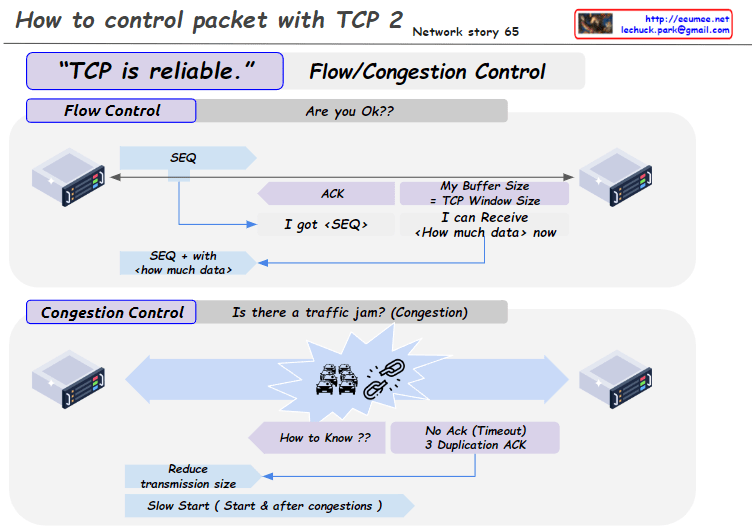
This image illustrates the flow control and congestion control mechanisms, which are examples of why TCP (Transmission Control Protocol) is considered a reliable protocol.

  1. TCP is a protocol that employs various mechanisms to ensure reliable data transmission.
  2. Flow Control:
    • It uses sequence numbers and acknowledgments to regulate the amount of data transmitted based on the receiver’s buffer size, preventing data loss.
    • This mechanism contributes to TCP’s reliable delivery guarantee.
  3. Congestion Control:
    • It detects network congestion and adjusts the transmission rate to avoid further congestion.
    • This allows TCP to provide stable and efficient data transfer.

Therefore, flow control and congestion control are key factors that enable TCP to be regarded as a reliable transport protocol. Through these mechanisms, TCP prevents data loss, network overload, and ensures stable communication.


Challenge

Advice from Glaude with some prompting
It’s important to embrace new challenges while building upon your established foundation. Leveraging the broad knowledge and flexibility you’ve cultivated, now is the time to develop specialized vertical expertise in a particular field and strive for upward growth.

While there will undoubtedly be risks and difficulties along the way, don’t be deterred – boldly confront them head-on, as doing so can lead to great achievements and innovation. Financial challenges may arise, but view them as opportunities to prioritize and stay focused on your goals.

Don’t settle for the comfort of the status quo. Dive headfirst into new domains, fueled by a competitive drive and thirst for accomplishment. There may be setbacks and failures, but use them as stepping stones to continue propelling forward. That’s how immense growth is realized.

Now is the pivotal moment to eschew complacency and immerse yourself in novel challenges. Believe in your potential, cast aside fears, and boldly forge ahead. The path to verticality and specialization awaits – seize it with conviction and tenacity.

Infiniband

From claude with some prompting
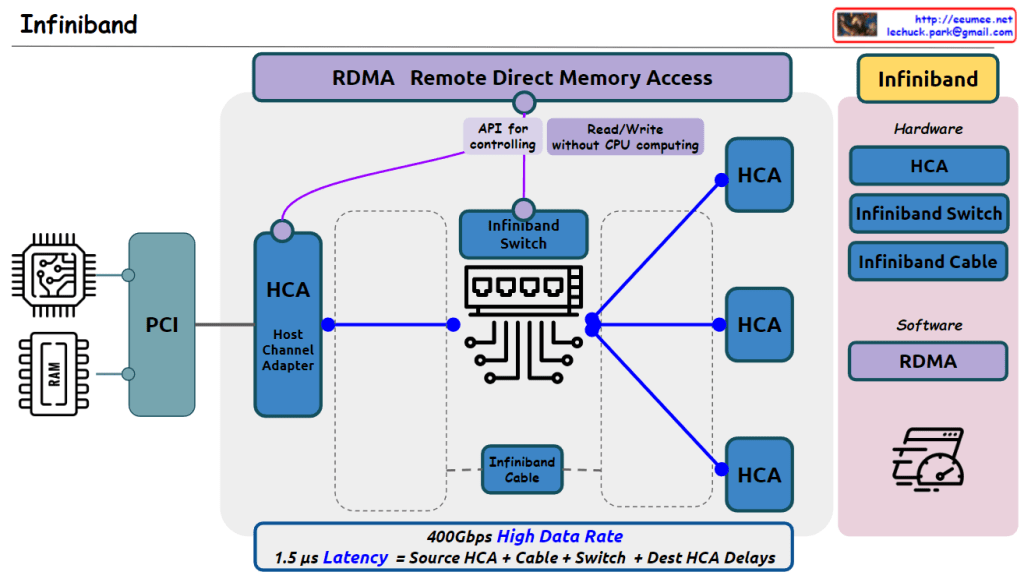
The image correctly depicts the essential hardware elements of an InfiniBand network, including the PCI interface, Host Channel Adapters (HCAs), InfiniBand Switch, and InfiniBand cables connecting the HCAs to the switch.

It highlights RDMA (Remote Direct Memory Access) as a key technology that enables read/write operations without CPU involvement, facilitated by APIs for controlling the HCAs.

The hardware components listed (HCA, InfiniBand Switch, InfiniBand Cable) are accurate.

However, there is one potential inaccuracy in the details provided. The stated latency of 1.5μs seems quite low for an end-to-end InfiniBand communication. Typical InfiniBand latencies are in the range of a few microseconds, depending on the specific InfiniBand generation and configuration.

Additionally, while the image mentions a “400Gbps High Data Rate,” it’s important to note that this is an aggregate bandwidth across multiple links or ports, not necessarily the speed of a single link.

Overall, the image effectively conveys the main concepts and components of InfiniBand technology, with just a minor potential discrepancy in the stated latency value.


The Limitation of the AI

From Claude with some prompting
This image illustrates the process of creating a “human-like AI” through the stages of “Big Data -> Learning -> Good AI.”

The first stage is “Big Data,” which serves as the foundation for AI training. It requires collecting vast amounts of accurate and reliable data from various sources.

The second stage is “Learning,” where the big data is fed into deep learning algorithms and neural network models for training. This process requires immense computing power and optimized AI models.

The third stage yields a “Good AI” capable of tasks like data classification and processing as a result of the learning process.

However, the image suggests that the goal goes beyond creating an AI with “Many Numbers” and “Classification” abilities. The ultimate aim is to develop an AI that reaches “Human-Like” levels of intelligence and capability.

Crucially, the entire process is underpinned by the availability of “Accurate & Reliable DATA.” No matter how advanced the algorithms and computing power, if the data itself lacks quality and trustworthiness, achieving a truly “Human-Like AI” will be extremely challenging.

Therefore, the key message conveyed by this image is that the quality and reliability of data will be the critical factor determining the competitiveness of AI systems in the future. Securing accurate and trustworthy data is emphasized as the fundamental requirement for realizing human-level artificial intelligence.