Works with data

From DALL-E with some prompting
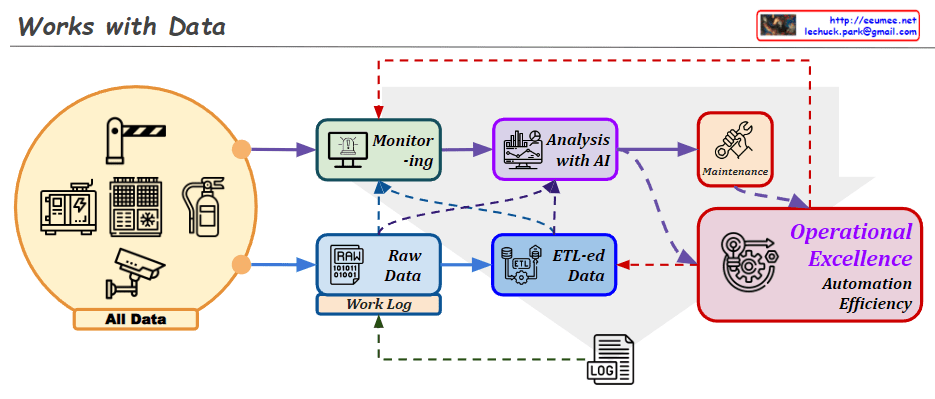
The image describes a data workflow process that involves various stages of data handling and utilization for operational excellence. “All Data” from diverse sources feeds into a monitoring system, which then processes raw data, including work logs. This raw data undergoes ETL (Extract, Transform, Load) procedures to become structured “ETL-ed Data.” Following ETL, the data is analyzed with AI to extract insights and inform decisions, which can lead to actions such as maintenance. The ultimate goal of this process is to achieve operational excellence, automation, and efficiency.
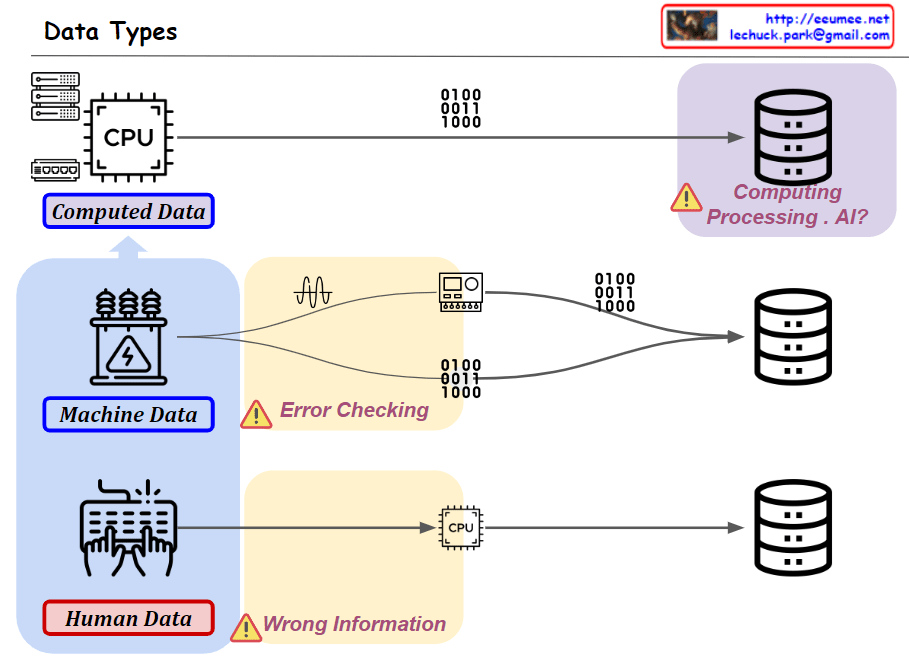
Data types

From DALL-E with some prompting
The image classifies data types and emphasizes the need for verification and response to potential errors for each type.

Computed Data: Processed by the CPU, with an implication of potential issues during computing or AI processing before storage.
Machine Data: Originating from machines or sensors, requiring error checking before storage, and awareness of possible errors.
Human Data: Entered by humans, needing verification due to the potential inclusion of wrong information, and awareness of errors.
This classification underlines the importance of ensuring accuracy in data processing and the need to be aware of and respond to potential errors.

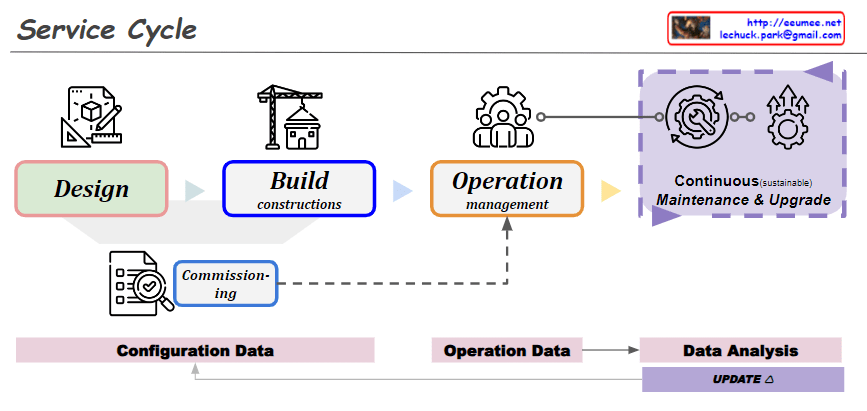
Service cycle

From DALL-E with some prompting
The image depicts a “Service Cycle” comprising several phases in a service’s lifecycle. These phases are visually represented and include “Design,” “Build constructions,” and “Operation management.” Additionally, the cycle includes “Commissioning” and “Continuous (sustainable) Maintenance & Upgrade” stages, emphasizing the ongoing process of maintaining and upgrading services. The flow of information through “Configuration Data,” “Operation Data,” and “Data Analysis” is also presented, highlighting the importance of data in managing and improving service operations.

Statistics ?

From DALL-E with some prompting
The image presents an exploration of perspectives in the context of big data and AI. “Subjective” reflects personal perception, while “Objective” shows a fact-based approach, though limited. “Statistics” introduces a big data-based AI perspective, offering a nearly complete yet unlimited framework for interpretation and judgment. This new perspective highlights the need for fresh terminology and concepts to navigate the advanced analytical landscape shaped by AI, suggesting an evolution from traditional subjective and objective paradigms to a more nuanced, data-centric approach.

IP & Domain address

From DALL-E with some prompting
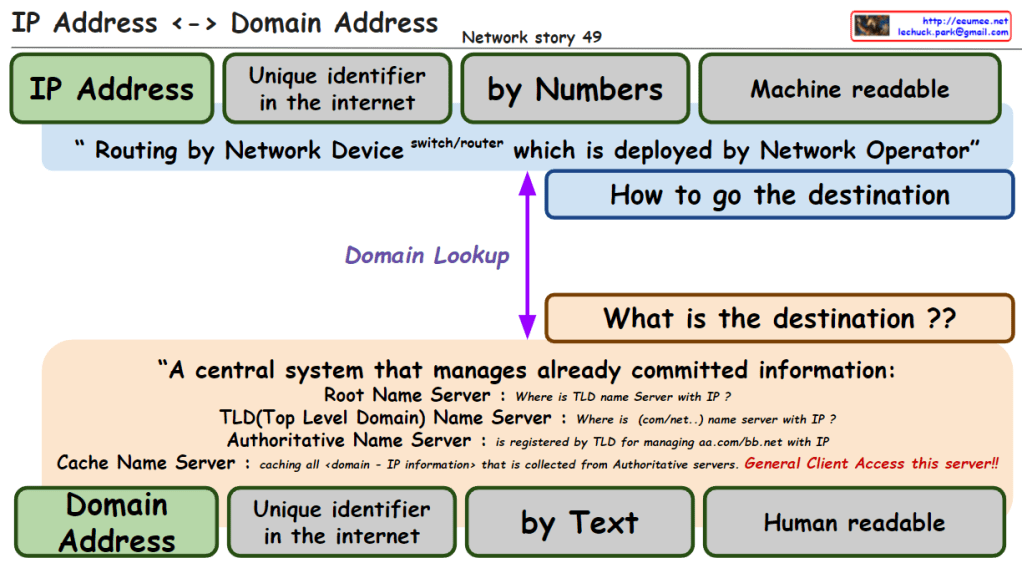
The image explains the relationship between IP addresses and domain addresses within the context of the internet and network infrastructure. Here’s a breakdown of the components:

  1. IP Address: Identified as a unique identifier in the internet by numbers, which is machine-readable. It is used for routing by network devices like switches and routers, deployed by network operators.
  2. Domain Lookup: The process that determines how to get the destination, asking “what is the destination?”
  3. Domain Address: Also a unique identifier on the internet, represented by text, which is human-readable.
  4. Central System of Name Servers:
    • Root Name Server: Answers queries about the location of the Top-Level Domain (TLD) name server associated with an IP.
    • TLD Name Server: Provides information about the domain’s name server associated with certain domain extensions like .com or .net.
    • Authoritative Name Server: Holds the definitive records for domains within its TLD.
    • Cache Name Server: Caches all domain-to-IP information collected from authoritative servers, accessible to general clients.

The overall message emphasizes the conversion between IP addresses (numeric form) and domain addresses (text form), which is crucial for navigating the internet and finding the correct destination for data packets. It also highlights the significance of the Domain Name System (DNS) in translating between human-readable domain names and machine-readable IP addresses.

Difference

From DALL-E with some prompting
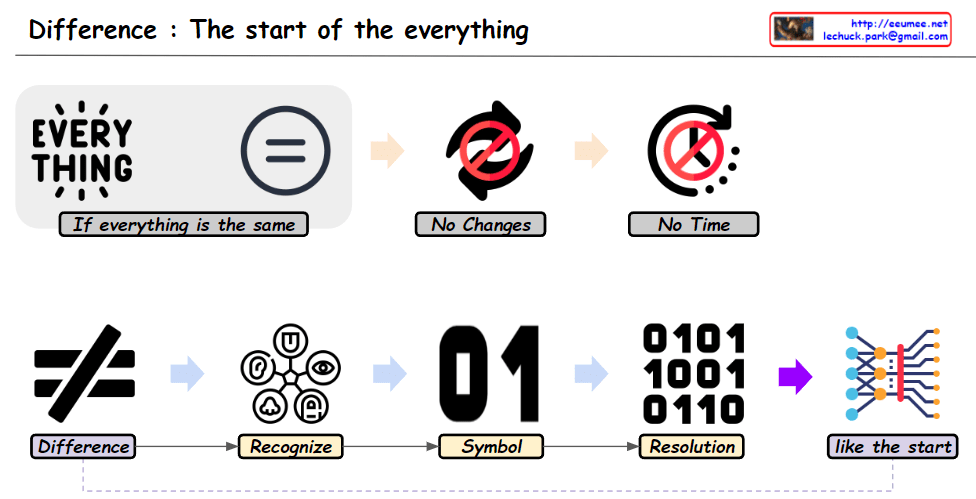
The image represents how AI approaches differences using infinite computing power, akin to recognizing the initial differences that sparked evolution. It shows that without variation (“EVERYTHING” icon), there is no concept of change or time, but differences lead to recognition (“Recognition”), which evolves into symbolization (“Symbol”) and understanding through resolution (“Resolution”). As complexities grow, so does our interpretative capacity, and now AI retraces the evolutionary journey back to the beginning. Through the human process of creating numbers and adding complex interpretations, AI now comprehends the initial differences that started it all.