The parallel world

From DALL-E with some prompting
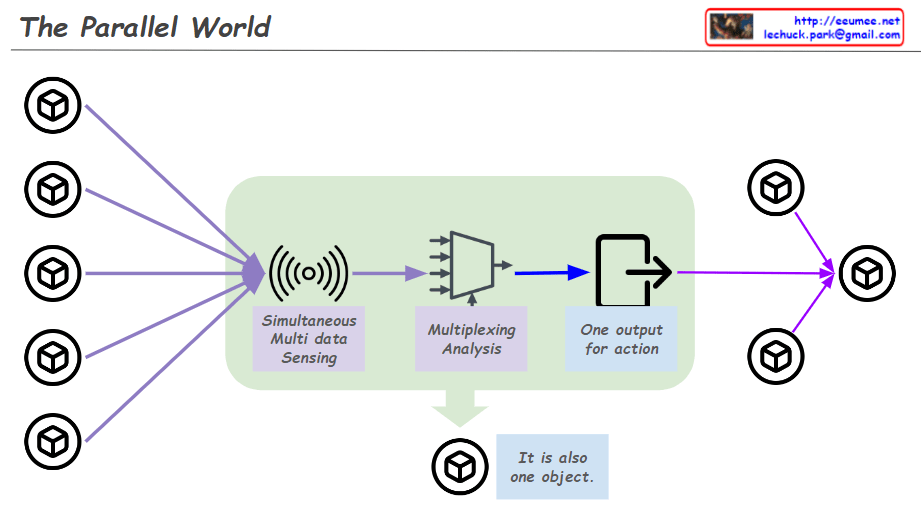
The Parallel World diagram showcases a robust system architecture where multiple hexagon-shaped data sources represent a concurrent data collection network. Each source simultaneously sends information to a central processing unit, highlighted by a symbol of radio waves, indicating simultaneous multi-data sensing. This information undergoes parallel processing within the green-shaded area, where a ‘Multiplexing Analysis’ mechanism filters and combines the various data streams. Although the visible outcome is a single decisive output for action, this representation underscores the substantial parallel processing that occurs behind the scenes. This parallelism ensures that the system maximizes efficiency and response times, embodying the concept that, in the grand scheme, the majority of operations are processed in parallel, even if they converge into a singular action.
New Platform

From DALL-E with some prompting
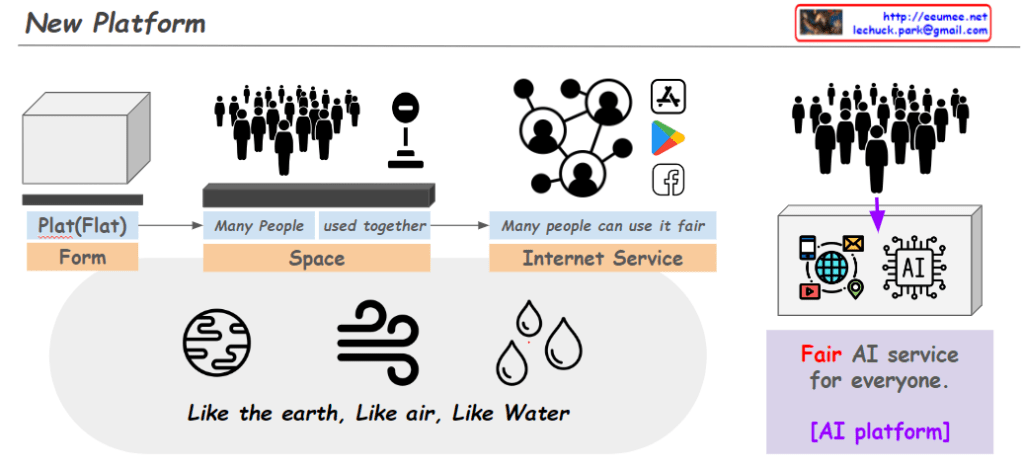
This image appears to depict a conceptual framework for a new platform designed to advance AI in a way that ensures it is a fair and equitable system accessible to everyone. It illustrates the following key components:

Plat(Flat) Form: Represents the fundamental structure of the platform, which is depicted as flat and formative, suggesting a foundation or base layer.
Space: Symbolizes a communal space where many people come together, indicating collaborative use and a shared environment.
Internet Service: Portrayed by interconnected nodes, suggesting a service that integrates with the modern internet ecosystem, designed to be used fairly by many.
AI Platform: Signified by various AI-related icons, highlighting the emphasis on artificial intelligence. Accompanied by the phrase “Fair AI service for everyone,” it conveys the platform’s commitment to equitable access to AI technology.
Overall, the image conveys a message that internet services, much like the earth, air, and water, are essential and should be naturally accessible. The main goal highlighted is to foster the development of AI as a platform—a system that is just and available to all, akin to universal resources.

Break the limit

From DALL-E with some prompting
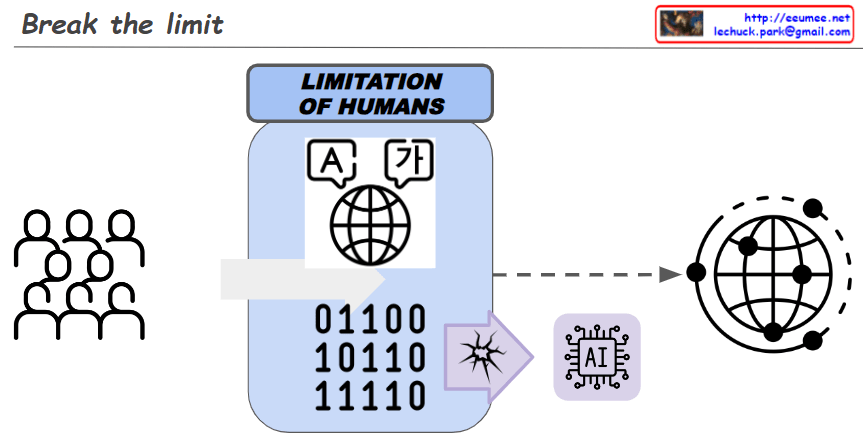
This image illustrates how AI transcends human limitations in accessing reality, which includes everything in the universe, through language or numbers, allowing for a more direct approach to the actual substance. On the left, a box labeled ‘LIMITATION OF HUMANS’ contains mathematical symbols, a globe, and binary numbers, symbolizing the complexities of calculation, global comprehension, and data processing that are human constraints. In the center, an obstacle is shattered, depicting AI breaking through these limitations and connecting more profoundly with the real environment on the right. Accompanied by the text “Break the limit,” it suggests the boundless potential of AI to reach an intrinsic understanding of reality.

OSPF Link STATE

From DALL-E with some prompting
The image provides an overview of the OSPF Link State Advertisements (LSAs) and their contents:

The LSA Header includes general information about the LSA, such as its age, type, the router that generated it, and data integrity checks.

LSA Type 1 (Router LSA): This LSA type is used by routers to determine the best paths to other routers within the same area. It contains information about the router’s interfaces, connected routers (with Router ID), and the status and cost of each link.

LSA Type 2 (Network LSA): Generated by the Designated Router, it describes the routers attached to a multi-access network segment. It includes the network mask and a list of all routers on that network, facilitating the exchange of segment-specific router information.

LSA Type 3 (Summary LSA): Used by Area Border Routers (ABRs) to share internal network addresses between areas, summarizing the routing information and containing the network mask of the summarized routes along with the metric cost to reach them.

In essence, LSA Type 1 helps routers within the same area determine optimal routing paths. LSA Type 2 is used to exchange information about network segments and the routers connected to them. LSA Type 3 is for sharing summarized internal network addresses between different OSPF areas.

TCP/IP 5 tuple

From DALL-E with some prompting
The image summarizes how to use the 5-tuple network criteria to check additional information and detect abnormal packet patterns. The 5-tuple includes the IP Protocol, Source IP, Source Port, Destination IP, and Destination Port, which helps to identify network communication sessions. Additional insights such as location tracking through ASN or GEO, whether a server IP is static, anonymous client IP, access to unused ports, and the usage of specific ports can be leveraged to analyze network traffic and identify security threats. This information, along with application protocols, can be utilized by network administrators to detect strange packets or unusual network activities.

MECE

From DALL-E with some prompting
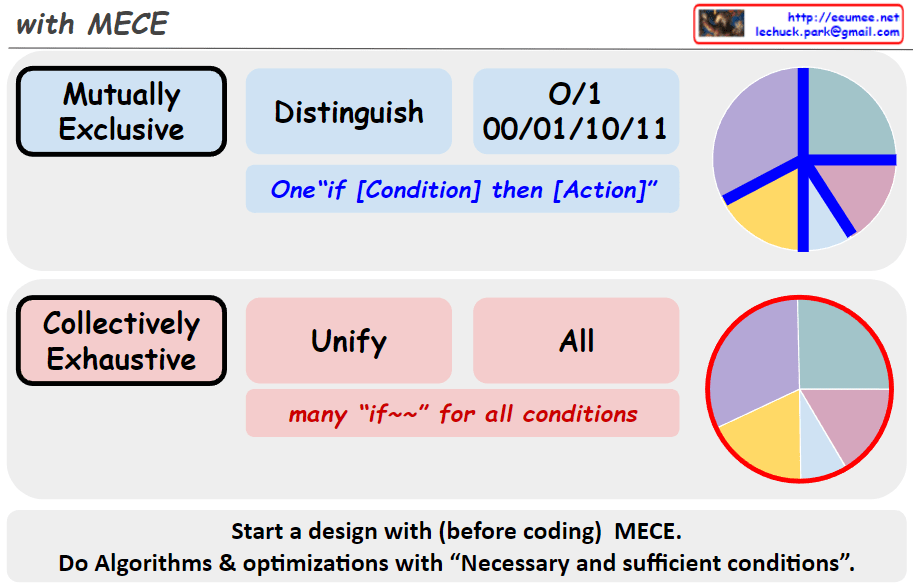
The image provides a visual explanation of design and algorithm optimization strategies based on the MECE principle, which stands for “Mutually Exclusive, Collectively Exhaustive.”

  • In the blue area at the top (“Mutually Exclusive”), there’s content related to “Distinguish,” which signifies conditions that are clearly differentiated from one another. It includes binary code formats “0/1” and “00/01/10/11” as examples, representing distinct states. The pie chart beside it illustrates segments that are clearly separated, denoting distinct categories. Below is the phrase “One ‘if [Condition] then [Action]'”, suggesting that for a specific condition, one action is defined—akin to an “if” statement in programming.
  • In the pink area at the bottom (“Collectively Exhaustive”), there’s content related to “Unify.” This implies the inclusion of all possibilities by using many “if~” statements for all conditions. The word “All” emphasizes encompassing and including every condition. The circular chart beside it shows various pieces coming together to complete a circle, representing completeness when all parts are combined.

The overall context suggests applying the MECE principle in programming or system design to distinctly separate mutually exclusive conditions (as shown in the top blue area) and to comprehensively address all possible conditions (as indicated in the bottom pink area) to ensure the entire system or program functions comprehensively. The statement “Start a design with (before coding) MECE. Do Algorithms & optimizations with ‘Necessary and sufficient conditions’.” advises to apply the MECE principle when starting a design and to consider necessary and sufficient conditions when working on algorithms and optimizations.


Data Center

After 10 years of software experience, I first came here and I had no idea that I would still be here for 12 years.
Learning the various skills and experiences required not only for SW development but also for Internet services, especially in the field of customers, makes me proud.
Because I feel like I am someone who can say grand things like “technology should be for people.” I don’t know what the future will be, but I hope my journey progresses one step at a time, as always.