
From DALL-E with some prompting
The image displays a programming challenge titled “1464. Maximum Product of Two Elements in an Array”. The task is to choose two different indices i and j from an array of integers to maximize the value of (nums[i]-1)*(nums[j]-1).
Example 1 gives the array [3,4,5,2], selecting indices i=1 and j=2 yields the maximum value (4-1)(5-1) = 12. In Example 2, the array [1,5,4,5] yields a maximum value of (5-1)(5-1) = 16 when indices i=1 and j=3 are chosen. For Example 3, with the array [3,7], any selection of indices results in (3-1)*(7-1) = 12.
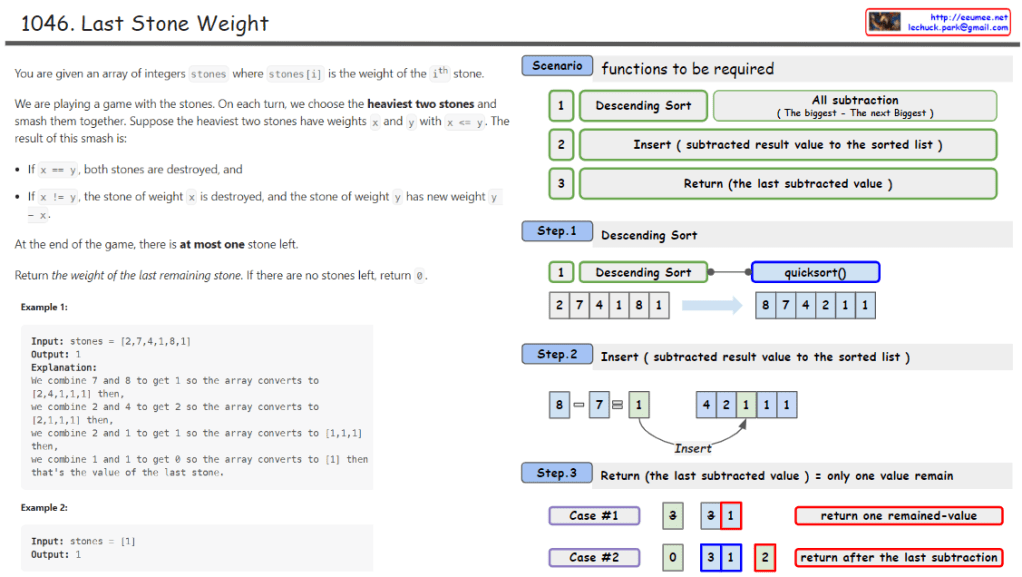
The suggested solution involves sorting the array in descending order and then selecting the first two numbers. Alternatively, while quicksort could be used, it is noted that a more efficient O(1) method exists for directly finding the first and second largest numbers. Code snippets are provided, demonstrating the iteration over the array to find the largest and second-largest numbers.
The constraints specify that the length of the nums array is between 2 and 500 and each element in the array is less than or equal to 10^3.



 Lechuck Park