Tahoe & Reno

From Claude with some prompting
This image is a diagram explaining the TCP Congestion Control mechanisms, particularly comparing the congestion control algorithms of two TCP versions: Tahoe and Reno.

Key points:

  1. Both algorithms use a Slow Start Threshold (ssthresh) to determine the initial congestion window size.
  2. The congestion window grows exponentially (2^n) at first, then switches to linear growth (+1) once it reaches ssthresh.
  3. Both algorithms reduce the congestion window to 1 and adjust ssthresh to half of the current size upon a timeout.
  4. When receiving 3 duplicate ACKs (3 DUP ACK), both algorithms halve their ssthresh.

Difference:

  • On 3 DUP ACK:
    • Tahoe: Reduces congestion window to 1
    • Reno: Multiplicatively decreases congestion window

There doesn’t appear to be any incorrect information in this image. It accurately shows the key difference between Tahoe and Reno in their response to 3 DUP ACK situations, and correctly explains other aspects of congestion control as well.

Traceroute

From Claude with some prompting
This image explains the concept of “Traceroute: First Send, First Return?” for the traceroute utility in computer networking. Traceroute sends IP packets with increasing Time-to-Live (TTL) values, starting from TTL=1, 2, 3, and so on. When the TTL reaches 0 at a network hop, that hop returns an ICMP (Internet Control Message Protocol) message back to the source.

However, the order in which the response packets are received at the source may differ from the order in which they were sent, primarily due to two reasons:

  1. Generation of ICMP response packets is a CPU task, and it can be delayed due to CPU settings or other processing priorities, causing a delay in the response.
  2. The ICMP response packets can take multiple paths to return to the source, as indicated by the text “Packet replies can use multiple paths” in the image. This means that responses can arrive at different times depending on the route taken.

As a result, when analyzing traceroute results, it is essential to consider not only the TTL sequence to determine the network hops but also factors like response times and paths taken by the responses.

The potential delay in ICMP packet generation by the CPU and the use of multiple return paths can cause the actual response order to differ from the sending order in traceroute.

Understanding that the response order may not strictly follow the sending order due to CPU processing delays and the use of multiple return paths is crucial when interpreting traceroute results.

TCP Reliable 3

From Claude with some prompting
RTT is measured by sending a packet (SEQ=A) and receiving an acknowledgment (ACK), providing insights into network latency. Bandwidth is measured by sending a sequence of packets (SEQ A to Z) and observing the amount of data transferred based on the acknowledgment of the last packet.

This image explains how to measure round-trip time (RTT) and bandwidth utilization to control and optimize TCP (Transmission Control Protocol) communications. The measured metrics are leveraged by various mechanisms to improve the reliability and efficiency of TCP.

These measured metrics are utilized by several mechanisms to enhance TCP performance. TCP Timeout sets appropriate timeout values by considering RTT variation. TIMELY provides delay information to the transport layer based on RTT measurements.

Furthermore, TCP BBR (Bottleneck Bandwidth and Round-trip propagation time) models the bottleneck bandwidth and RTT propagation time to determine the optimal sending rate according to network conditions.

In summary, this image illustrates how measuring RTT and bandwidth serves as the foundation for various mechanisms that improve the reliability and efficiency of the TCP protocol by adapting to real-time network conditions.

TCP Reliable 2

From Claude with some prompting
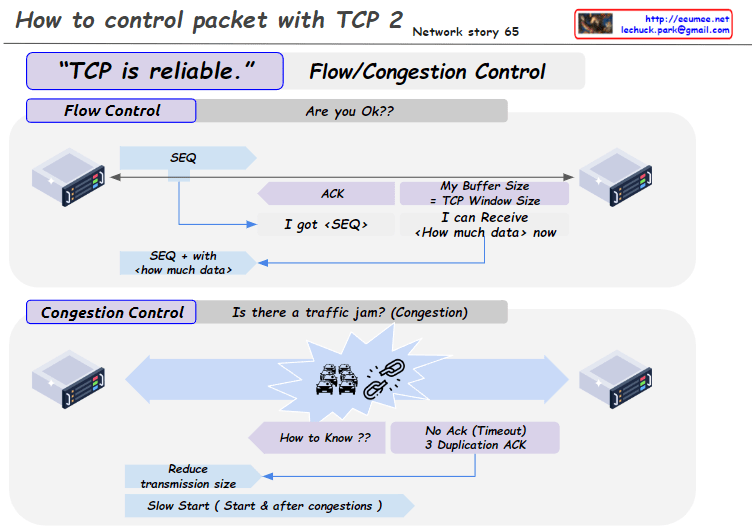
This image illustrates the flow control and congestion control mechanisms, which are examples of why TCP (Transmission Control Protocol) is considered a reliable protocol.

  1. TCP is a protocol that employs various mechanisms to ensure reliable data transmission.
  2. Flow Control:
    • It uses sequence numbers and acknowledgments to regulate the amount of data transmitted based on the receiver’s buffer size, preventing data loss.
    • This mechanism contributes to TCP’s reliable delivery guarantee.
  3. Congestion Control:
    • It detects network congestion and adjusts the transmission rate to avoid further congestion.
    • This allows TCP to provide stable and efficient data transfer.

Therefore, flow control and congestion control are key factors that enable TCP to be regarded as a reliable transport protocol. Through these mechanisms, TCP prevents data loss, network overload, and ensures stable communication.


Infiniband

From claude with some prompting
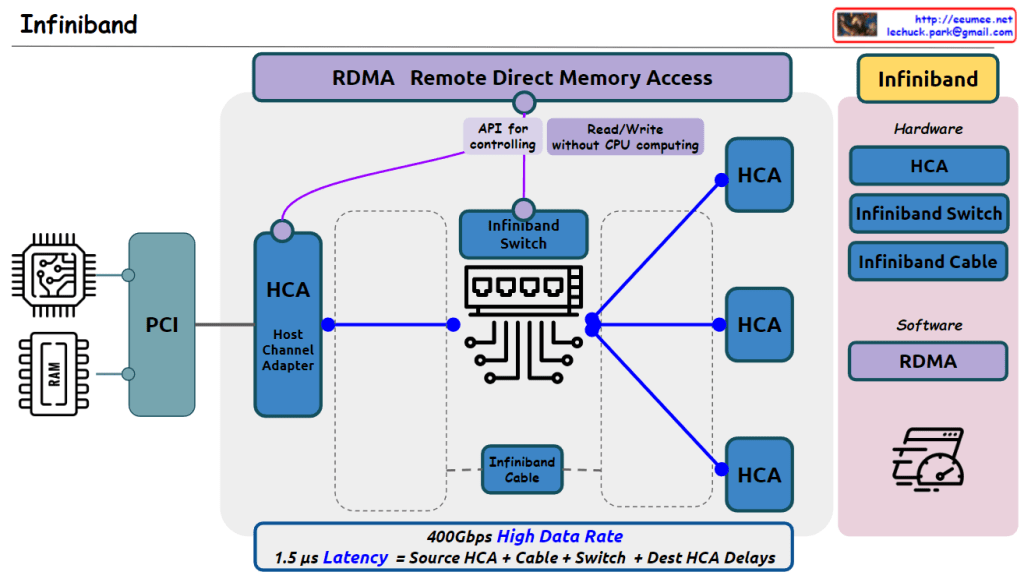
The image correctly depicts the essential hardware elements of an InfiniBand network, including the PCI interface, Host Channel Adapters (HCAs), InfiniBand Switch, and InfiniBand cables connecting the HCAs to the switch.

It highlights RDMA (Remote Direct Memory Access) as a key technology that enables read/write operations without CPU involvement, facilitated by APIs for controlling the HCAs.

The hardware components listed (HCA, InfiniBand Switch, InfiniBand Cable) are accurate.

However, there is one potential inaccuracy in the details provided. The stated latency of 1.5μs seems quite low for an end-to-end InfiniBand communication. Typical InfiniBand latencies are in the range of a few microseconds, depending on the specific InfiniBand generation and configuration.

Additionally, while the image mentions a “400Gbps High Data Rate,” it’s important to note that this is an aggregate bandwidth across multiple links or ports, not necessarily the speed of a single link.

Overall, the image effectively conveys the main concepts and components of InfiniBand technology, with just a minor potential discrepancy in the stated latency value.


TCP Reliable 1

From Claude with some prompting
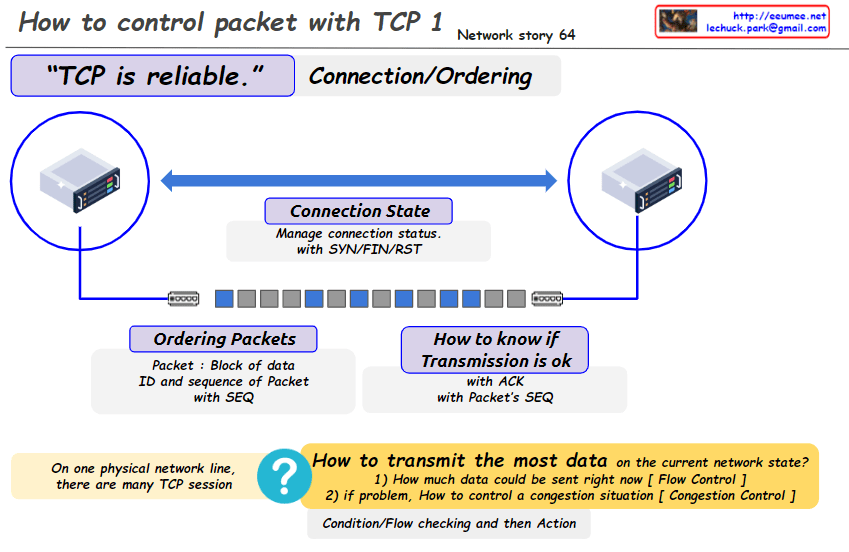
This image explains how packets are controlled and transmitted using TCP (Transmission Control Protocol), which is a reliable communication protocol.

The key points are:

  1. TCP is reliable and provides connection/ordering of packets.
  2. Connection state is managed using SYN/FIN/RST packets to establish, maintain, and tear down connections.
  3. Packets are organized into an ordered sequence using sequence numbers (SEQ).
  4. Acknowledgments (ACK) with the packet’s SEQ number indicate successful transmission.

The image also raises two main questions:

  1. How much data can be sent right now based on the current network state? (Flow Control)
  2. If there is a problem, how to control congestion? (Congestion Control)

The image suggests that condition/flow checking should be performed, and then appropriate action taken for transmitting the most data possible on the current network state while handling potential congestion situations.

MSS

From Claude with some prompting
This image explains the concept of Maximum Segment Size (MSS) in computer networking. MSS refers to the maximum size of the data payload that can be transmitted in a single TCP segment. The main points illustrated are:

  1. The TCP header and IP header each have a fixed size of 20 bytes.
  2. MSS is defined as the maximum size of the TCP payload within a single packet.
  3. MSS is used for TCP communication to control congestion and prevent large TCP packets at the application level.
  4. This is contrasted with the Maximum Transmission Unit (MTU) which limits packet size at the physical layer, such as in Ethernet switches.
  5. The image depicts a concept called “One Time Transfer Data Size” with 1 MTU packet being sent, followed by acknowledgment (3 DUP ACK), and then a timeout period.

The overall purpose of MSS is to manage and optimize data transmission by limiting the segment size, thereby facilitating better congestion control and efficient network performance.