Infiniband

From claude with some prompting
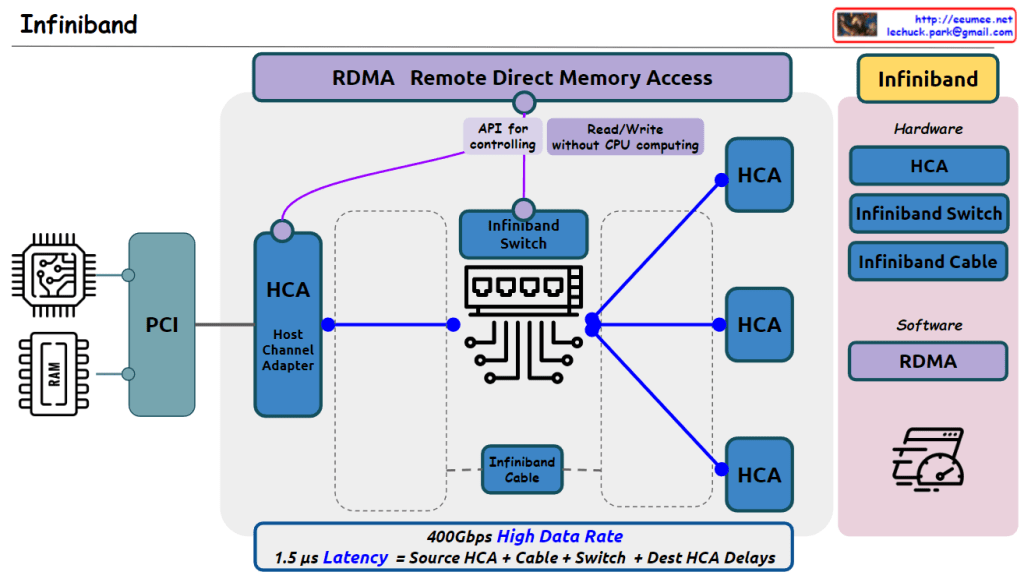
The image correctly depicts the essential hardware elements of an InfiniBand network, including the PCI interface, Host Channel Adapters (HCAs), InfiniBand Switch, and InfiniBand cables connecting the HCAs to the switch.

It highlights RDMA (Remote Direct Memory Access) as a key technology that enables read/write operations without CPU involvement, facilitated by APIs for controlling the HCAs.

The hardware components listed (HCA, InfiniBand Switch, InfiniBand Cable) are accurate.

However, there is one potential inaccuracy in the details provided. The stated latency of 1.5μs seems quite low for an end-to-end InfiniBand communication. Typical InfiniBand latencies are in the range of a few microseconds, depending on the specific InfiniBand generation and configuration.

Additionally, while the image mentions a “400Gbps High Data Rate,” it’s important to note that this is an aggregate bandwidth across multiple links or ports, not necessarily the speed of a single link.

Overall, the image effectively conveys the main concepts and components of InfiniBand technology, with just a minor potential discrepancy in the stated latency value.


TCP Reliable 1

From Claude with some prompting
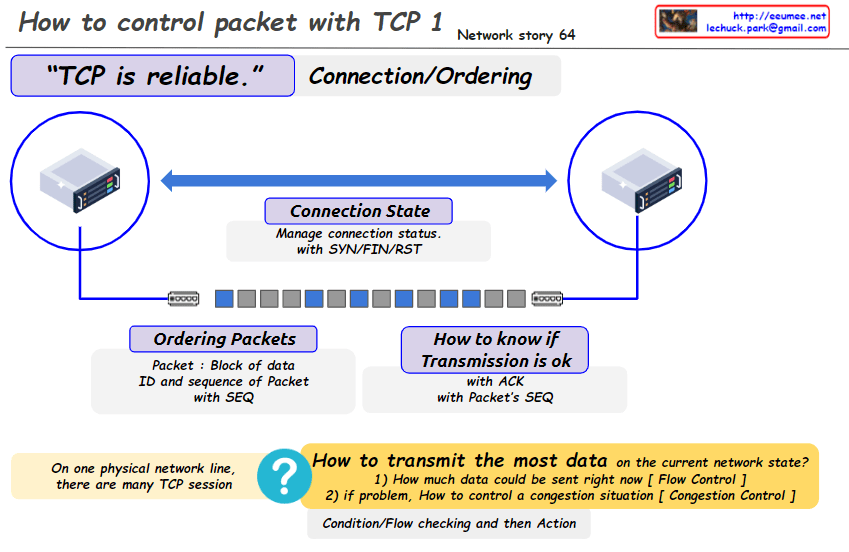
This image explains how packets are controlled and transmitted using TCP (Transmission Control Protocol), which is a reliable communication protocol.

The key points are:

  1. TCP is reliable and provides connection/ordering of packets.
  2. Connection state is managed using SYN/FIN/RST packets to establish, maintain, and tear down connections.
  3. Packets are organized into an ordered sequence using sequence numbers (SEQ).
  4. Acknowledgments (ACK) with the packet’s SEQ number indicate successful transmission.

The image also raises two main questions:

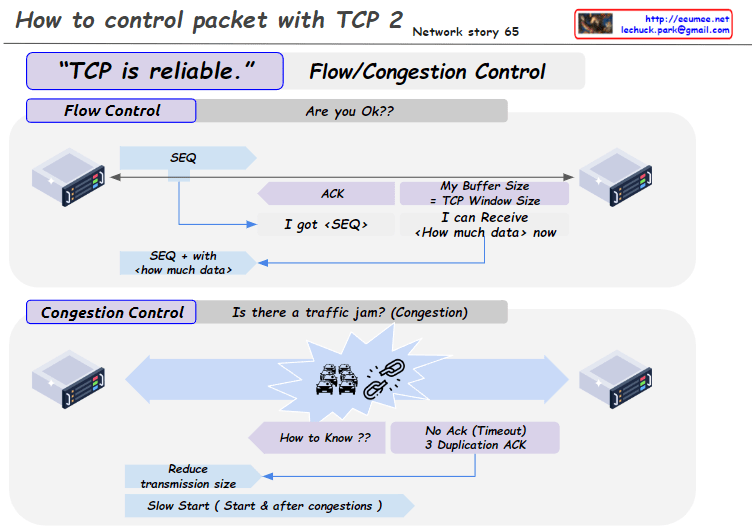
  1. How much data can be sent right now based on the current network state? (Flow Control)
  2. If there is a problem, how to control congestion? (Congestion Control)

The image suggests that condition/flow checking should be performed, and then appropriate action taken for transmitting the most data possible on the current network state while handling potential congestion situations.

MSS

From Claude with some prompting
This image explains the concept of Maximum Segment Size (MSS) in computer networking. MSS refers to the maximum size of the data payload that can be transmitted in a single TCP segment. The main points illustrated are:

  1. The TCP header and IP header each have a fixed size of 20 bytes.
  2. MSS is defined as the maximum size of the TCP payload within a single packet.
  3. MSS is used for TCP communication to control congestion and prevent large TCP packets at the application level.
  4. This is contrasted with the Maximum Transmission Unit (MTU) which limits packet size at the physical layer, such as in Ethernet switches.
  5. The image depicts a concept called “One Time Transfer Data Size” with 1 MTU packet being sent, followed by acknowledgment (3 DUP ACK), and then a timeout period.

The overall purpose of MSS is to manage and optimize data transmission by limiting the segment size, thereby facilitating better congestion control and efficient network performance.

Reverse Path Forwarding

From Claude with some prompting
The image explains the two main modes of Reverse Path Forwarding (RPF): Strict RPF and Loose RPF.

At the top left, three hosts are sending packets to a router. The router is determining which port to use for forwarding based on the source IP address during the routing process.

The top right explains the operation of Strict RPF. In Strict RPF, all packets are validated. It compares the port used for routing the source IP with the actual receiving port, and allows the packet only if they match.

The note under Strict RPF mentions that it prevents “No Looping (primarily for multicast)” and “No Spoofing (primarily for unicast)”. Both Strict RPF and Loose RPF can help prevent looping and spoofing to some extent.

No Looping is primarily important for multicast routing. RPF is used in multicast protocols to prevent packet loops. Both Strict RPF and Loose RPF aid in loop prevention.

No Spoofing is primarily related to security issues with unicast IP traffic. IP spoofing involves an attacker using a forged source IP address to launch network attacks. Both Strict RPF and Loose RPF are effective in mitigating IP spoofing attacks.

The bottom right explains Loose RPF. In Loose RPF, an RPF interface list for the source address is configured for each port. If the receiving port is in the RPF list for that source IP, the packet is allowed.

Therefore, while Strict RPF provides more comprehensive packet checking, Loose RPF can also help prevent looping (mainly in multicast) and spoofing (mainly in unicast) by referring to the pre-configured RPF interface lists for each port and source address.


MTU concepts

From Claude with some prompting
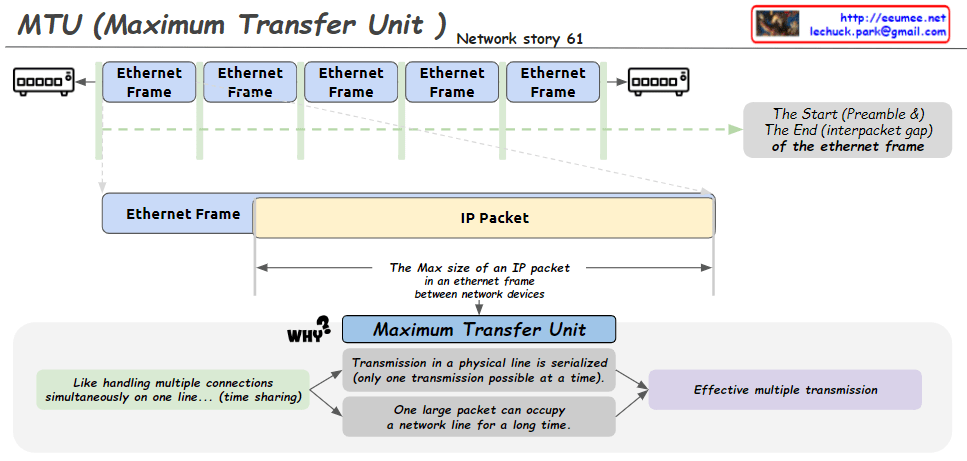
This image explains the concept of Maximum Transfer Unit (MTU) in Ethernet networks. MTU refers to the largest size of an IP packet that can be transmitted in an Ethernet frame between network devices.

The image shows multiple Ethernet frames containing an IP packet inside. The MTU determines the maximum size of this IP packet that can fit within an Ethernet frame. Having a proper MTU size is important for efficient data transmission and avoiding fragmentation.

Some key points from the image:

  1. Ethernet frames encapsulate IP packets for transmission over the network.
  2. The MTU size represents the maximum IP packet size that can be carried in an Ethernet frame between devices.
  3. Serialized transmission occurs, allowing only one transmission at a time on the physical line.
  4. Large packets occupying the line for long periods can impact effective multiple transmissions (time-sharing).

Casting packet

from Claude with some prompting
This image illustrates the different types of network communication methods: Unicast, Multicast, Broadcast, and Anycast. Each method is represented by a visual diagram showing how data is transmitted from a source to specific targets or groups of targets within a network.

Unicast targets a specific IP address, sending data to a single destination. Multicast targets a specific IP group within one network, allowing data to be sent to multiple recipients simultaneously. Broadcast targets all IP addresses within a specific network, essentially sending data to every device on that network.

Anycast is slightly different, targeting a specific address but sending the data to the closest/nearest device with that address, as determined by the routing protocols and BGP (Border Gateway Protocol) peering.

The image provides a clear visual representation of these communication methods and their differences in terms of targeting and data distribution within networks.


Switching/Routing L2-L7

From Gemini with some prompting
The image illustrates how network switches differentiate packets from Layer 2 (L2) to Layer 7 (L7) based on the OSI model. The central image depicts a switch or router forwarding a specific packet, highlighting the criteria used for identification at each layer.

Layer-by-Layer Explanation:

L2 Switch:

  • Distinguishing criteria: MAC address
  • Function: Frame switching
  • Key feature: Uses hardware-based switching for fast performance
  • Limitation: Does not consider network layer information

L3 Switch:

  • Distinguishing criteria: IP address
  • Function: Packet switching, routing
  • Key feature: Supports inter-VLAN routing and network segmentation
  • Limitation: Does not utilize L4 and L7 information

L4 Switch:

  • Distinguishing criteria: TCP/UDP port number
  • Function: Packet switching, load balancing
  • Key feature: Facilitates application-specific traffic control and load balancing
  • Limitation: Disregards L7 information

L7 Switch:

  • Distinguishing criteria: HTTP URL, payload
  • Function: Application gateway, content filtering
  • Key feature: Offers granular control over application-level traffic and security
  • Complexity: Requires more complex configuration and management