TCP fast open

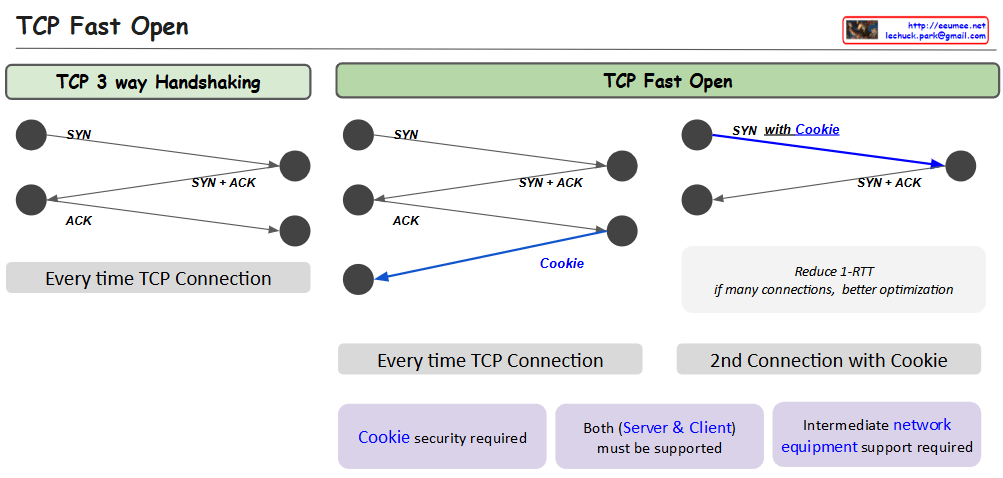
The image compares two TCP connection establishment methods:

  1. TCP 3-Way Handshaking (Traditional Method):
  • Shows a standard connection process with three steps:
    1. SYN (Synchronize) packet sent
    2. SYN + ACK (Synchronize + Acknowledge) packet returned
    3. ACK (Acknowledge) packet sent back
  • This happens every time a new TCP connection is established
  • Requires a full round-trip time (RTT) for connection setup
  1. TCP Fast Open:
  • Introduces a “Cookie” mechanism to optimize connection establishment
  • First connection follows the traditional 3-way handshake
  • Subsequent connections can use the stored cookie to reduce connection time
  • Benefits:
    • Reduces Round-Trip Time (1-RTT)
    • Better optimization for multiple connections
  • Requirements for TCP Fast Open:
    • Cookie security must be implemented
    • Both server and client must support the method
    • Intermediate network equipment must support the technique

The blue arrows in the TCP Fast Open diagram represent the cookie exchange and optimized connection process, highlighting the key difference from the traditional method.

With Claude

TCP/IP Better

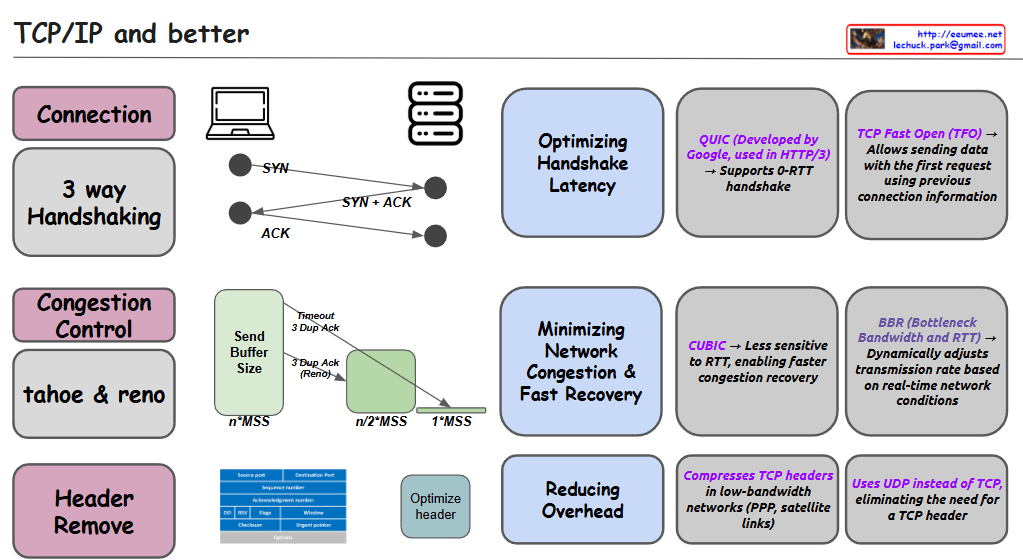
This image is an informational diagram titled “TCP/IP and better” that explains various aspects of network protocols and optimizations.

The diagram is organized into three main sections:

  1. Connection
    • Shows “3 way Handshaking” with a visual representation of the SYN, SYN+ACK, ACK sequence
    • “Optimizing Handshake Latency” section mentions:
      • QUIC (Developed by Google, used in HTTP/3) → Supports 0-RTT handshake
      • TCP Fast Open (TFO) → Allows sending data with the first request using previous connection information
  2. Congestion Control
    • Lists “tahoe & reno” congestion control algorithms
    • Shows diagrams of Send Buffer Size with concepts like “Timeout 3-Dup-Ack” and “3-Dup Ack (Reno)”
    • “Minimizing Network Congestion & Fast Recovery” section mentions:
      • CUBIC → Less sensitive to RTT, enabling faster congestion recovery
      • BBR (Bottleneck Bandwidth and RTT) → Dynamically adjusts transmission rate based on real-time network conditions
  3. Header Remove
    • Shows TCP header structure diagram and “Optimize header” section
    • “Reducing Overhead” section mentions:
      • Compresses TCP headers in low-bandwidth networks (PPP, satellite links)
      • Uses UDP instead of TCP, eliminating the need for a TCP header

The diagram appears to be an educational resource about TCP/IP protocols and various optimizations that have been developed to improve network performance, particularly focused on connection establishment, congestion control, and overhead reduction.

With Claude

NAPI

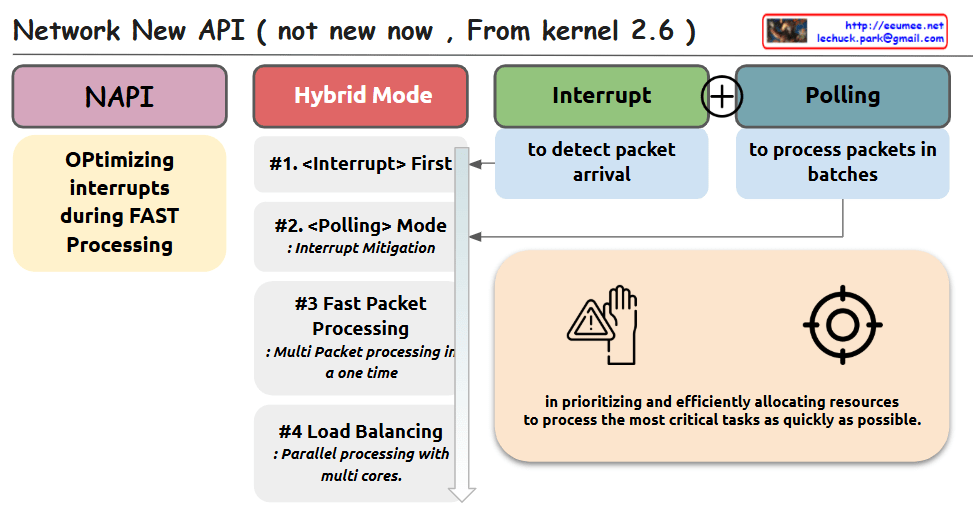
This image shows a diagram of the Network New API (NAPI) introduced in Linux kernel 2.6. The diagram outlines the key components and concepts of NAPI with the following elements:

The diagram is organized into several sections:

  1. NAPI – The main concept is highlighted in a purple box
  2. Hybrid Mode – In a red box, showing the combination of interrupt and polling mechanisms
  3. Interrupt – In a green box, described as “to detect packet arrival”
  4. Polling – In a blue box, described as “to process packets in batches”

The Hybrid Mode section details four key features:

  1. <Interrupt> First – For initial packet detection
  2. <Polling> Mode – For interrupt mitigation
  3. Fast Packet Processing – For multi-packet processing in one time
  4. Load Balancing – For parallel processing with multiple cores

On the left, there’s a yellow box explaining “Optimizing interrupts during FAST Processing”

The bottom right contains additional information about prioritizing and efficiently allocating resources to process critical tasks quickly, accompanied by warning/hand and target icons.

The diagram illustrates how NAPI combines interrupt-driven and polling mechanisms to efficiently handle network packet processing in Linux.

With Claude

Traffic Control

This image shows a network traffic control system architecture. Here’s a detailed breakdown:

  1. At the top, several key technologies are listed:
  • P4 (Programming Protocol-Independent Packet Processors)
  • eBPF (Extended Berkeley Packet Filter)
  • SDN (Software-Defined Networking)
  • DPI (Deep Packet Inspection)
  • NetFlow/sFlow/IPFIX
  • AI/ML-Based Traffic Analysis
  1. The system architecture is divided into main sections:
  • Traffic flow through IN PORT and OUT PORT
  • Routing based on Destination IP address
  • Inside TCP/IP and over TCP/IP sections
  • Security-Related Conditions
  • Analysis
  • AI/ML-Based Traffic Analysis
  1. Detailed features:
  • Inside TCP/IP: TCP/UDP Flags, IP TOS (Type of Service), VLAN Tags, MPLS Labels
  • Over TCP/IP: HTTP/HTTPS Headers, DNS Queries, TLS/SSL Information, API Endpoints
  • Security-Related: Malicious Traffic Patterns, Encryption Status
  • Analysis: Time-Based Conditions, Traffic Patterns, Network State Information
  1. The AI/ML-Based Traffic Analysis section shows:
  • AI/ML technologies learn traffic patterns
  • Detection of anomalies
  • Traffic control based on specific conditions

This diagram represents a comprehensive approach to modern network monitoring and control, integrating traditional networking technologies with advanced AI/ML capabilities. The system shows a complete flow from packet ingress to analysis, incorporating various layers of inspection and control mechanisms.

with Claude

TIMELY

With Claude
TIMELY (Transport Informed by MEasurement of LatencY)

  1. System Architecture
  • Cloud/Data Center to External Network Connection
  • TIMELY Module Process at Kernel Level
  • Bidirectional Operation Support
  • TCP Protocol Based
  1. RTT-based Traffic Control Components
  • RTT Monitoring
    • 5-tuple monitoring (Src/Dst IP, Src/Dst Port, Protocol)
    • Real-time latency measurement
  • Congestion Detection
    • Network congestion detection through RTT increases
  • Congestion Window Adjustment
    • Control of send buffer size
  • MSS-based Adjustments
    • Congestion window adjustments in MSS units
  1. Related RTT-based Technologies
  • TCP BBR
  • TCP Vegas
  • CUBIC TCP
  1. Advantages of RTT-based Control
  • Proactive congestion detection before packet loss
  • Real-time network state awareness
  • Efficient buffer management
  • Lower latency in data transmission
  • Effective bandwidth utilization
  • Better performance in high-speed networks
  1. Disadvantages of RTT-based Control
  • RTT measurement accuracy dependency
  • Complex implementation at kernel level
  • Potential overhead in RTT monitoring
  • Need for continuous RTT measurement
  • Sensitivity to network jitter
  • May require adjustments for different network environments

The TIMELY system demonstrates an efficient approach to network congestion control using RTT measurements, particularly suitable for cloud and data center environments where latency and efficient data transmission are critical. The system’s kernel-level implementation and MSS-based adjustments provide fine-grained control over network traffic, though success heavily depends on accurate RTT measurements and proper environment calibration.

DAS / NAS / SAN

With a Claude
This image is a diagram comparing three major storage systems – DAS (Direct Access Storage), NAS (Network Access Storage), and SAN (Storage Network Array).

Let’s examine each system in detail:

  1. DAS (Direct Access Storage):
  • Direct storage system connected to the CPU
  • Shows direct connections between RAM and disk drives
  • Most basic storage architecture
  • Connected directly to the computer system
  1. NAS (Network Access Storage):
  • Storage accessible through the network
  • Marked with “Over The Network” indicating network connectivity
  • Consists of standalone storage units
  • Provides shared storage access through network
  1. SAN (Storage Network Array):
  • Most sophisticated and complex storage system
  • Features shown include:
    • High Speed Dedicated Network
    • Centralization Control
    • Block Storage
    • HA with RAID (High Availability with RAID)
    • Scale-out capabilities

The diagram effectively illustrates the evolution and increasing complexity of storage systems. It shows the progression from the simple direct-attached storage (DAS) through network-attached storage (NAS) to the more complex storage area network (SAN), with each iteration adding more sophisticated features and capabilities.

The layout of the diagram moves from left to right, demonstrating how each storage solution becomes more complex but also more capable, with SAN offering the most advanced features for enterprise-level storage needs.

Fast Copy over network

With a Claude
This image illustrates a system architecture diagram for “Fast Copy over network”. Here’s a detailed breakdown:

  1. Main Sections:
  • Fast Copy over network
  • Minimize Copy stacks
  • Minimize Computing
  • API optimization for read/write
  1. System Components:
  • Basic computing layer including OS (Operating System) and CPU
  • RAM (memory) layer
  • Hardware device layer
  1. Key Features:
  • The purple area on the left focuses on minimizing Count & Copy with API
  • The blue center area represents minimized computing works (Program Code)
  • The orange area on the right shows programmable API implementation
  1. Data Flow:
  • Arrows indicating bi-directional communication between systems
  • Vertical data flow from OS to RAM to hardware
  • Horizontal data exchange between systems

The architecture demonstrates a design aimed at optimizing data copying operations over networks while efficiently utilizing system resources.