ICMP overall

From DALL-E with some prompting
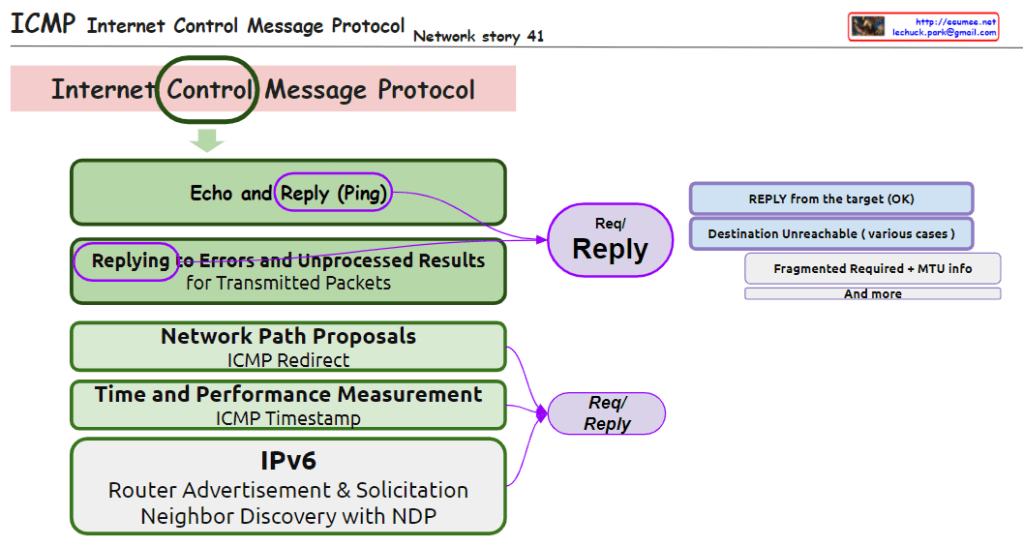
This image succinctly demonstrates the essential functions of the Internet Control Message Protocol (ICMP), emphasizing the protocol’s ability to check network paths and status through simple request and response actions. This includes echo (ping) operations, error messages, network path change suggestions, timing measurements, and IPv6 functionalities, all contributing to the efficiency and performance enhancement of network operations.

TCP vs UDP

From DALL-E with some prompting
This image explains how TCP provides reliable data transmission compared to UDP and underscores the reasons for this reliability. While UDP has a simple header structure utilizing basic port numbers and checksums, TCP includes additional fields in its header to ensure reliability. These supplementary fields encompass sequence and acknowledgment numbers for confirming data transmission and ordering, flags for connection state management, window size for flow control, and mechanisms for congestion control. The reliability of TCP is enabled through this complex header structure, with each field playing an essential role in ensuring accurate and dependable data transfer. Therefore, the reliability of all TCP communications is established through these specific fields in the header, emphasizing that TCP not just ‘enables’ reliability but ‘implements’ it in practice.

6G

From DALL-E with some prompting
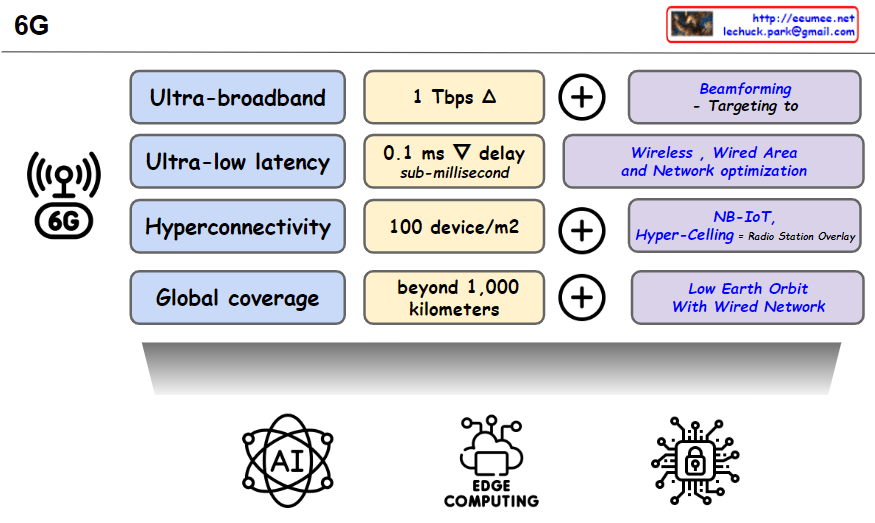
The infographic details the characteristics and components of 6G wireless communication technology. It highlights key features such as Ultra-broadband with speeds up to 1 Tbps, Ultra-low latency with sub-millisecond delays, and Hyperconnectivity supporting 100 devices per square meter. It also covers Global coverage, Beamforming, network optimization, NB-IoT, and Hyper-Celling for enhanced network efficiency. Additionally, it showcases the use of Low Earth Orbit networks and the integration with AI and Edge Computing technologies.