Kernel Same-page Merging

From DALL-E with some prompting
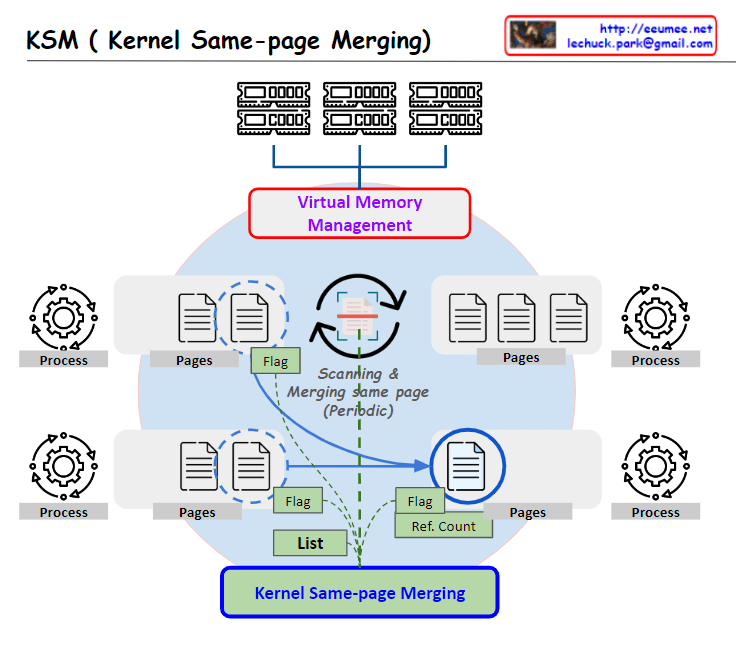
Kernel Same-page Merging (KSM) is a feature within an operating system’s kernel that enhances memory efficiency by identifying and merging identical memory pages. Typically, this process is beneficial for duplicated pages from executable files and shared libraries, which are common across different processes. KSM is also advantageous in environments where there is a significant amount of shared data and memory-mapped files, such as virtualization systems where multiple virtual machines may be running the same operating system or similar applications. By merging these pages, KSM allows for a reduction in physical memory usage, leading to better memory management and potentially improved performance for the system.

Switching & Routing (Origin)

From DALL-E with some prompting
The image delineates the foundational aspects of network switching and routing based on their origins. Switching, historically in LANs, involved the broadcasting of packets, which modern switches now intelligently direct or block based on MAC addresses and VLAN information. Routing originally functioned to determine packet pathways over networks using IP address information. While these were once discrete tasks performed by separate devices, contemporary network technology often integrates both functions within the same hardware, allowing switches to perform some routing tasks and vice versa, reflecting the evolution and convergence of networking equipment.

Works with data

From DALL-E with some prompting
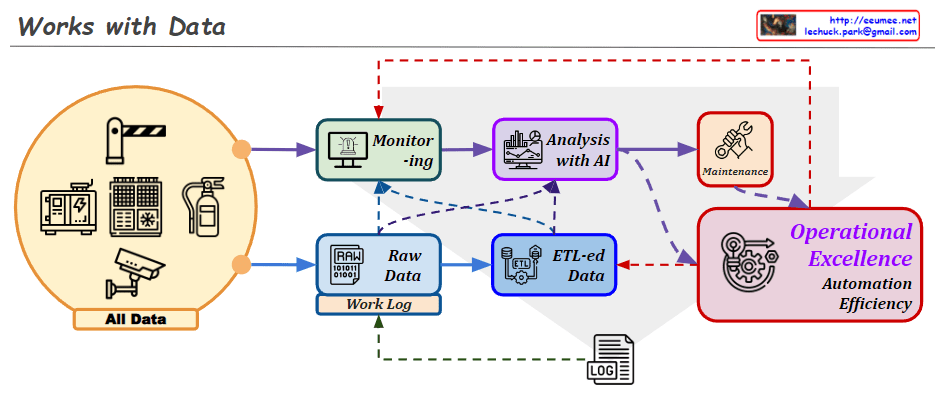
The image describes a data workflow process that involves various stages of data handling and utilization for operational excellence. “All Data” from diverse sources feeds into a monitoring system, which then processes raw data, including work logs. This raw data undergoes ETL (Extract, Transform, Load) procedures to become structured “ETL-ed Data.” Following ETL, the data is analyzed with AI to extract insights and inform decisions, which can lead to actions such as maintenance. The ultimate goal of this process is to achieve operational excellence, automation, and efficiency.

Service cycle

From DALL-E with some prompting
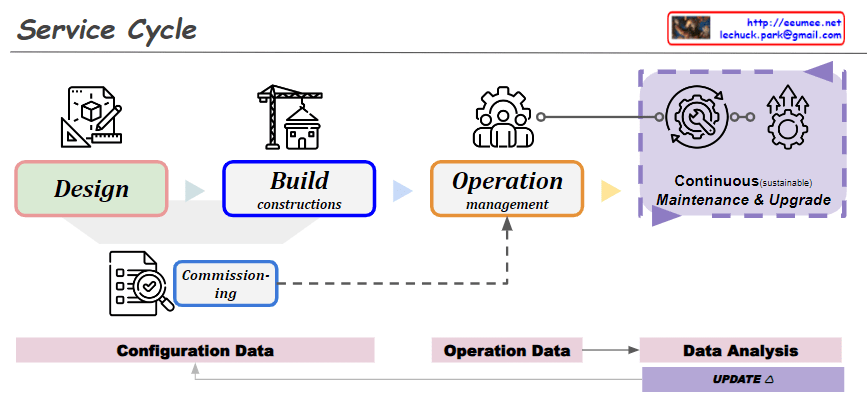
The image depicts a “Service Cycle” comprising several phases in a service’s lifecycle. These phases are visually represented and include “Design,” “Build constructions,” and “Operation management.” Additionally, the cycle includes “Commissioning” and “Continuous (sustainable) Maintenance & Upgrade” stages, emphasizing the ongoing process of maintaining and upgrading services. The flow of information through “Configuration Data,” “Operation Data,” and “Data Analysis” is also presented, highlighting the importance of data in managing and improving service operations.

Difference

From DALL-E with some prompting
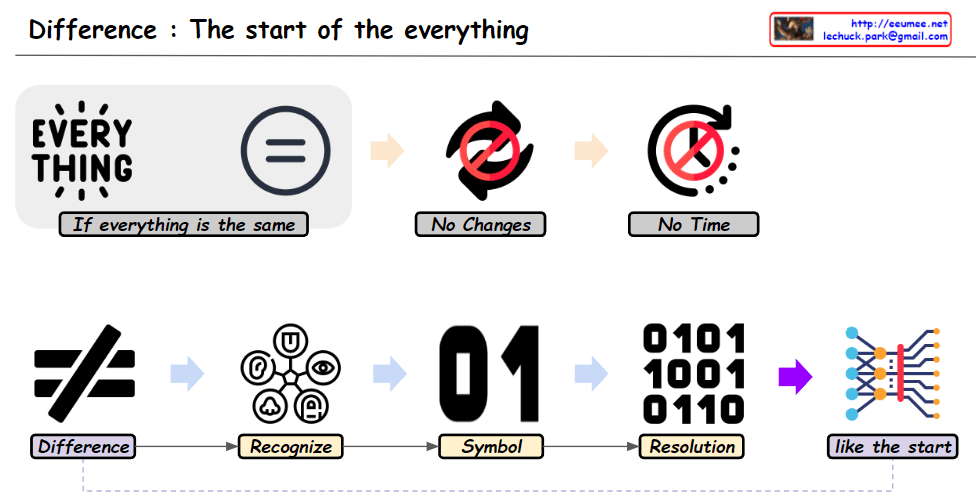
The image represents how AI approaches differences using infinite computing power, akin to recognizing the initial differences that sparked evolution. It shows that without variation (“EVERYTHING” icon), there is no concept of change or time, but differences lead to recognition (“Recognition”), which evolves into symbolization (“Symbol”) and understanding through resolution (“Resolution”). As complexities grow, so does our interpretative capacity, and now AI retraces the evolutionary journey back to the beginning. Through the human process of creating numbers and adding complex interpretations, AI now comprehends the initial differences that started it all.

Beyond data

From DALL-E with some prompting
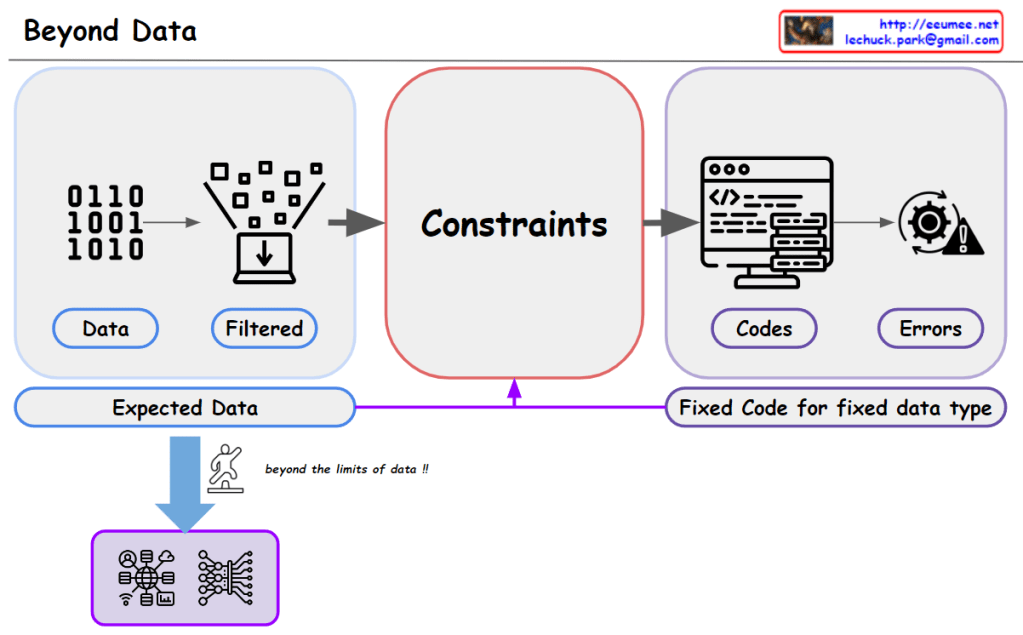
This image depicts the process of overcoming the constraints of traditional programming based on expected data through big data and deep learning. Starting on the left, binary digits labeled as “Data” are processed through a “Filtered” stage to become the necessary “Expected Data.” The box labeled “Constraints” in the center represents the limitations that can occur in programming. These constraints suggest barriers that can be overcome with big data processing and deep learning technologies. On the right, there’s a section transitioning from “Codes” to “Errors,” which signifies possible errors during the coding process. However, the text “Fixed Code for fixed data type” reflects that program code is pre-established for expected data types and does not transcend the boundaries of this data, thereby limiting its potential. The phrase “beyond the limits of data!!” at the bottom expresses the ambition of future programming to surpass the limitations of data processing by utilizing big data and deep learning.