EXP with AI

From Claude with some prompting
Here’s the analysis of the AI Experience (EXP) curve:

  1. Three-Phase Structure

Initial Phase

  • Slow cost increase period
  • Efficient progress relative to investment
  • Importance of clear goals and scope setting

Middle Phase

  • Steeper cost increase progression
  • Critical focus on ROI and resource allocation
  • Need for continuous cost-benefit monitoring

Final Phase

  • Exponential cost increase occurs
  • Practical goal setting rather than perfection
  • Importance of determining optimal investment timing
  1. Unreachable Area Complementary Factors and Implications

Key Complementary Elements

  • Human Decision
  • Experience Know-How
  • AI/ML Integration

Practical Implications

  • Setting realistic goals at 80-90% rather than pursuing 100% perfection
  • Balanced utilization of human expertise and AI technology
  • Development of phase-specific management strategies

This analysis demonstrates that AI projects require strategic approaches considering cost efficiency and practicality, rather than mere technology implementation.

The graph illustrates that as AI project completion approaches 100%, costs increase exponentially, and beyond a certain point, success depends on the integration of human judgment, experience, and AI/ML capabilities.


Vector

From Claude with some prompting
This image illustrates the vectorization process in three key stages.

  1. Input Data Characteristics (Left):
  • Feature: Original data characteristics
  • Numbers: Quantified information
  • countable: Discrete and clearly distinguishable data → This stage represents observable data from the real world.
  1. Transformation Process (Center):
  • Pattern: Captures regularities and recurring characteristics in data
  • Changes: Dynamic aspects and transformation of data → This represents the intermediate processing stage where raw data is transformed into vectors.
  1. Output (Right):
  • Vector: Final form transformed into a mathematical representation
  • math formula: Mathematically formalized expression
  • uncountable: State transformed into continuous space → Shown in 3D coordinate system, demonstrating the possibility of abstract data representation.

Key Insights:

  1. Data Abstraction:
  • Shows the process of converting concrete, countable data into abstract, continuous forms
  • Demonstrates the transition from discrete to continuous representation
  1. Dimensional Transformation:
  • Explains how individual features are integrated and mapped into a vector space
  • Shows the unification of separate characteristics into a cohesive mathematical form
  1. Application Areas:
  • Feature extraction in machine learning
  • Data dimensionality reduction
  • Pattern recognition
  • Word embeddings in Natural Language Processing
  • Image processing in Computer Vision
  1. Benefits:
  • Efficient processing of complex data
  • Easy application of mathematical operations
  • Discovery of relationships and patterns between data points
  • Direct applicability to machine learning algorithms
  1. Technical Implications:
  • Enables mathematical manipulation of real-world data
  • Facilitates computational processing
  • Supports advanced analytical methods
  • Enables similarity measurements between data points

This vectorization process serves as a fundamental preprocessing step in modern data science and artificial intelligence, transforming raw, observable features into mathematically tractable forms that algorithms can effectively process.

The progression from countable features to uncountable vector representations demonstrates the power of mathematical abstraction in handling complex, real-world data structures.

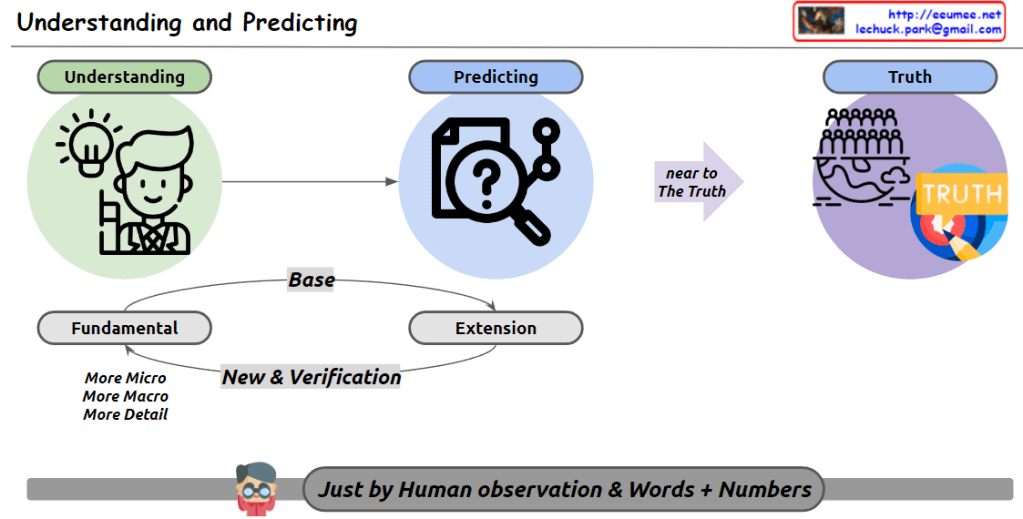
Understanding and Predicting

From Claude with some prompting
This image illustrates the human process of approaching truth through understanding and prediction. The key components are:

  1. Understanding: Represented by a lightbulb and a human icon, signifying the acquisition of basic knowledge.
  2. Predicting: Symbolized by a magnifying glass with a question mark, indicating the stage where understanding is used to make predictions.
  3. Truth: Depicted by a group of people and a “TRUTH” label, representing the ultimate goal.

These elements are connected sequentially, with prediction aiming to get “near to the Truth.”

The process is built on two foundational concepts:

  • Fundamental
  • Extension

These concepts interact through “New & Verification,” with the fundamental aspect encompassing “More Micro, More Macro, More Detail.”

Key Insights:

  1. Continuous Approach to Truth: Humans are constantly moving towards truth through understanding and prediction. This is a dynamic process, not a static one.
  2. Knowledge Expansion and Refinement: We expand our knowledge by exploring fundamental concepts more microscopically, macroscopically, and in greater detail. This represents growth in both depth and breadth of human knowledge.
  3. Limitations of Human Perception: The phrase “Just by Human observation & Words” at the bottom of the image highlights a fundamental limitation. We can only understand and express the world through our observations and language, not through direct access to matter itself.
  4. Role and Limitations of Numbers: While mathematical expressions can help overcome some linguistic limitations, they too face boundaries when confronting the infinite complexity of the microscopic and macroscopic worlds.
  5. Infinite Nature of Knowledge: As we learn more, we discover there is even more to learn. This paradox suggests an endless journey of discovery and understanding.
  6. Dynamic Process: The pursuit of knowledge is ongoing and ever-evolving, constantly expanding and becoming more refined.

In conclusion, this image portrays the continuous human quest for knowledge and truth, acknowledging our perceptual and expressive limitations while emphasizing our persistent efforts to expand and deepen our understanding of the world around us.

Lechuck History

From Claude with some prompting
“Lechuck History” diagram demonstrates the following technical career progression:

  1. “with Computer” section:
    • Advanced from C-based programming to system programming, O&M solutions, and network programming
    • Possess deep understanding of Linux kernel, RTOS, and TCP/IP stack
    • Performed “Single-Handedly A to Z” tasks in web service analysis/monitoring
    • Grew into the role of a software engineer
  2. “with People” section:
    • Gained experience in large ISP data centers, system management, large-scale network operations management, and CDN development/management
    • Developed skills to optimize and maximize existing system infrastructure
    • Created new service solutions including D/C business web portals, NMS big-data, DCIM, packet analysis customer solutions, and data analysis platforms
    • Managed “Big DC Op. System Design & DevOps”, demonstrating ability to handle customer-facing roles and collaborate with various partners

Additional key competencies:

  1. Maintain continuous interest in new technologies
  2. Possess the ability to quickly learn based on a solid understanding of fundamentals
  3. Currently enjoy learning cutting-edge technologies including AI and Quantum computing

This career path and skill set demonstrate the profile of a professional who continuously grows and pursues innovation in a rapidly changing technological environment.