Time Series Data ETL

From Claude with some prompting
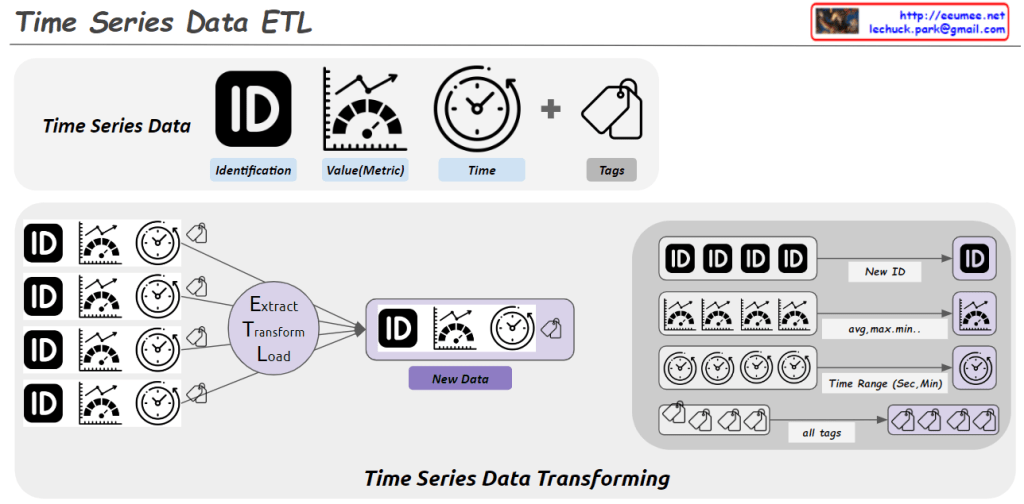
This image illustrates the “Time Series Data ETL” (Extract, Transform, Load) process.

Key components of the image:

  1. Time Series Data structure:
    • Identification (ID): Data identifier
    • Value (Metric): Measured value
    • Time: Timestamp
    • Tags: Additional metadata
  2. ETL Process:
    • Multiple source data points go through the Extract, Transform, Load process to create new transformed data.
  3. Data Transformation:
    • New ID: Generation of a new identifier
    • avg, max, min…: Statistical calculations on values (average, maximum, minimum, etc.)
    • Time Range (Sec, Min): Time range adjustment (in seconds, minutes)
    • all tags: Combination of all tag information

This process demonstrates how raw time series data is collected, transformed as needed, and prepared into a format suitable for analysis or storage. This is a crucial step in large-scale data processing and analysis.

The diagram effectively shows how multiple data points with IDs, values, timestamps, and tags are consolidated and transformed into a new data structure with aggregated information and adjusted time ranges.

Anomaly Detection,Pre-Maintenance,Planning

From Claude with some prompting
This image illustrates the concepts of Anomaly Detection, Pre-Maintenance, and Planning in system or equipment management.

Top section:

  1. “Normal Works”: Shows a graph representing normal operational state.
  2. “Threshold Detection”: Depicts the stage where anomalies exceeding a threshold are detected.
  3. “Anomaly Pre-Detection”: Illustrates the stage of detecting anomalies before they reach the threshold.

Bottom section:

  1. “Threshold Detection Anomaly Pre-Detection”: A graph showing both threshold detection and pre-detection of anomalies. It captures anomalies before a real error occurs.
  2. “Pre-Maintenance”: Represents the pre-maintenance stage, where maintenance work is performed after anomalies are detected.
  3. “Maintenance Planning”: Shows the maintenance planning stage, indicating continuous monitoring and scheduled maintenance activities.

The image demonstrates the process of:

  • Detecting anomalies early in normal system operations
  • Implementing pre-maintenance to prevent actual errors
  • Developing systematic maintenance plans

This visual explanation emphasizes the importance of proactive monitoring and maintenance to prevent failures and optimize system performance.

Standardization for DCIM

From Claude with some prompting
Data Standardization:

  • Defined a clear process for systematically collecting data from equipment.
  • Proposed an integrated data management approach, including network topology and interfacing between various systems.
  • Emphasized data quality management as a key factor to establish a reliable data foundation.

Service Standardization:

  • Structured the process of connecting data to actual services.
  • Highlighted practical service implementation, including monitoring services and automation tasks.
  • Specified AI service requirements, showing a forward-looking approach.
  • Established a foundation for continuous service improvement by including service analysis and development processes.

Commissioning Standardization:

  • Emphasized verification plans and documentation of results at each stage of design, construction, and operation to enable quality management throughout the entire lifecycle.
  • Prepared an immediate response system for potential operational issues by including real-time data error verification.
  • Considered system scalability and flexibility by incorporating processes for adding facilities and data configurations.

Overall Evaluation:

This DCIM standardization approach comprehensively addresses the core elements of data center infrastructure management. The structured process, from data collection to service delivery and continuous verification, is particularly noteworthy. By emphasizing fundamental data quality management and system stability while considering advanced technologies like AI, the approach is both practical and future-oriented. This comprehensive framework will be a valuable guideline for the implementation and operation of DCIM.

Data Life

From ChatGPT with some prompting
reflecting the roles of human research and AI/machine learning in the data process:

Diagram Explanation :

  1. World:
    • Data is collected from the real world. This could be information from the web, sensor data, or other sources.
  2. Raw Data:
    • The collected data is in its raw, unprocessed form. It is prepared for analysis and processing.
  3. Analysis:
    • The data is analyzed to extract important information and patterns. During this process, rules are created.
  4. Rules Creation:
    • This step is driven by human research.
    • The human research process aims for logical and 100% accurate rules.
    • These rules are critical for processing and analyzing data with complete accuracy. For example, creating clear criteria for classifying or making decisions based on the data.
  5. New Data Generation:
    • New data is generated during the analysis process, which can be used for further analysis or to update existing rules.
  6. Machine Learning:
    • In this phase, AI models (rules) are trained using the data.
    • AI/machine learning goes beyond human-defined rules by utilizing vast amounts of data through computing power to achieve over 99% accuracy in predictions.
    • This process relies heavily on computational resources and energy, using probabilistic models to derive results from the data.
    • For instance, AI can identify whether an image contains a cat or a dog with over 99% accuracy based on the data it has learned from.

Overall Flow Summary :

  • Human research establishes logical rules that are 100% accurate, and these rules are essential for precise data processing and analysis.
  • AI/machine learning complements these rules by leveraging massive amounts of data and computing power to find high-probability results. This is done through probabilistic models that continuously improve and refine predictions over time.
  • Together, these two approaches enhance the effectiveness and accuracy of data processing and prediction.

This diagram effectively illustrates how human logical research and AI-driven data learning work together in the data processing lifecycle.

Time Series Data

From Claude with some prompting
This image outlines the process of generating time series data:

  1. Signal Generation: A device produces the raw signal.
  2. Sampling: Converts continuous signal into discrete points.
  3. Digitization: Transforms sampled signal into binary code.
  4. Time Information Addition: Combines digital data with time information.
  5. Labeling/Tagging: Attaches additional descriptive information (e.g., point name, generating equipment, location) to each data point.

The final output is time series data in the format (Point label info, Value, Time), including descriptive information, measured value, and time for each data point. This process creates a comprehensive time series dataset that goes beyond simple numerical data, incorporating rich contextual information for each point.

Optimization 2

From Claude with some prompting
This image titled “Optimization II” illustrates the process of optimization between Supply and Usage. Here’s a comprehensive interpretation:

  1. The top shows a simple diagram depicting the basic relationship between Supply and Usage.
  2. The middle section presents graphs showing the fluctuations of Supply and Usage over time, comparing the states before and after optimization.
  3. The equation “Supply – Usage = Optimization Target” is provided, clearly defining the optimization goal.
  4. The bottom diagram illustrates the optimization process. It shows that optimization continues until the ‘Optimization Target Cost’ is less than the ‘Supply – Usage Cost’. This is to ensure that the cost of optimization doesn’t exceed the cost difference between supply and usage.
  5. The right-side graphs and explanation demonstrate that as the rate of change in usage increases (with high and low frequency), the need for optimization work becomes greater.
  6. The question “By What? By Manual? Software system?” is posed, prompting consideration of how to address this increased need for optimization – whether through manual processes or software systems.

Overall, this diagram emphasizes the importance of the optimization process between supply and usage, the efficiency of optimization costs, the increased need for optimization as usage patterns change, and the necessity to consider practical solutions for implementing these optimizations.

Time Series Data

From Claude with some prompting

  1. Raw Time Series Data:
    • Data Source: Sensors or meters operating 24/7, 365 days a year
    • Components: a. Point: The data point being measured b. Metric: The measurement value for each point c. Time: When the data was recorded
    • Format: (Point, Value, Time)
    • Additional Information: a. Config Data: Device name, location, and other setup information b. Tag Info: Additional metadata or classification information for the data
    • Characteristics:
      • Continuously updated based on status changes
      • Automatically changes over time
  2. Processed Time Series Data (2nd logical Data):
    • Processing Steps: a. ETL (Extract, Transform, Load) operations b. Analysis of correlations between data points (Point A and Point B) c. Data processing through f(x) function
      • Creating formulas through correlations using experience and AI learning
    • Result:
      • Generation of new data points
      • Includes original point, related metric, and time information
    • Characteristics:
      • Provides more meaningful and correlated information than raw data
      • Reflects relationships and influences between data points
      • Usable for more complex analysis and predictions

Through this process, Raw Time Series Data is transformed into more useful and insightful Processed Time Series Data. This aids in understanding data patterns and predicting future trends.