From Claude with some prompting Here’s the interpretation of the image explaining CDC (Change Data Capture) and ETL (Extract, Transform, Load) processes. The diagram is divided into three main sections:
Top Section:
Shows CDC/ETL process from “For Operating” database to “For Analysis” database.
Middle Section (CDC):
Illustrates the Change Data Capture process
Shows how changes C1 through C5 are detected and captured
Key features:
Realtime processing
Sync Duplication
Efficiency
Bottom Section (ETL):
Demonstrates traditional ETL process:
Extract
Transform
Load
Processing characteristics:
Batch process
Data Transform
Data Integrate
The diagram contrasts two main approaches to data integration:
CDC: Real-time approach that detects and synchronizes changes as they occur
ETL: Traditional batch approach that extracts, transforms, and loads data
This visualization effectively shows how CDC provides real-time data synchronization while ETL handles data in batches, each serving different use cases in data integration strategies.
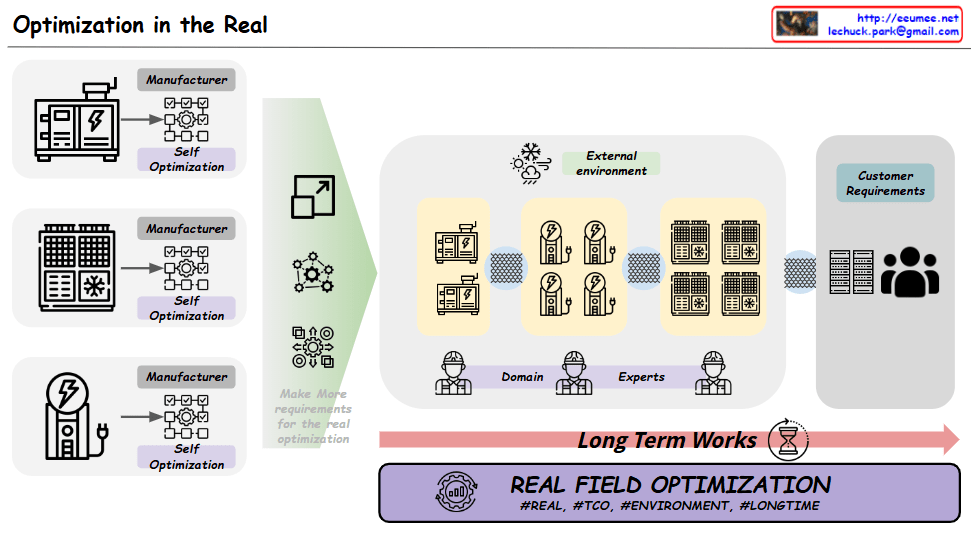
From Claude with some prompting The Real Field Optimization diagram and its extended implications:
Extended Scope of Optimization:
Begins with equipment Self-Optimization but extends far beyond
Increasing complexity in real operating environments:
Equipment/system interactions
Operational scale expansion
Service quality requirements
Various stakeholder requirements
Real Operating Environment Considerations:
Domain Experts’ practical experience and knowledge
Customer requirements and feedback
External Environment impacts
Variables emerging from Long Term operations
TCO (Total Cost of Ownership) Perspective:
Beyond initial installation/deployment costs
Operation/maintenance costs
Energy efficiency
Lifecycle cost optimization
Data-Driven Optimization Necessity:
Collection and analysis of actual operational data
Understanding operational patterns
Predictive maintenance
Performance/efficiency monitoring
Data-driven decision making for continuous improvement
Long-Term Perspective Importance:
Performance change management over time
Scalability considerations
Sustainable operation model establishment
Adaptability to changing requirements
Real Field Integration:
Interaction between manufacturers, operators, and customers
Environmental factor considerations
Complex system interdependencies
Real-world constraint management
This comprehensive optimization approach goes beyond individual equipment efficiency, aiming for sustainable operation and value creation of the entire system. This can be achieved through continuous improvement activities based on real operational environment data. This represents the true meaning of “Real Field Optimization” with its hashtags #REAL, #TCO, #ENVIRONMENT, #LONGTIME.
The diagram effectively illustrates that while equipment-level optimization is fundamental, the real challenge and opportunity lie in optimizing the entire operational ecosystem over time, considering all stakeholders, environmental factors, and long-term sustainability. The implicit need for data-driven optimization in real operating environments becomes crucial for achieving these comprehensive optimization goals.
From Claude with some prompting the key points from the diagram:
Reality of Internet Open Data:
Vast amount of open data exists on the internet including:
Mobile device data
Email communications
Video content
Location data
This open data is utilized by major AI companies for LLM training
Key players:
OpenAI’s ChatGPT
Anthropic’s Claude
Google’s Gemini
Meta’s LLaMA
Competition Implications:
Competition between LLMs trained on similar internet data
“Who Winner?” and “A Winner Takes ALL?” suggests potential monopoly in the base LLM market
This refers specifically to models trained on public internet data
Market Outlook:
While the base LLM market might be dominated by a few players
Private enterprise data remains a key differentiator
“Still Differentiated and Competitive” indicates ongoing competition through enterprise-specific data
Companies can leverage RAG-like technology to combine their private data with LLMs for unique solutions
Key Implications:
Base LLM market (trained on internet data) may be dominated by few winners
Enterprise competition remains vibrant through:
Unique private data assets
RAG integration with base LLMs
Company-specific implementations
Market likely to evolve into dual structure:
Foundation LLMs (based on internet data)
Enterprise-specific AI services (leveraging private data)
This structure suggests that while base LLM technology might be dominated by a few players, enterprises can maintain competitive advantage through their unique private data assets and specialized implementations using RAG-like technologies.
This creates a market where companies can differentiate themselves even while using the same foundation models, by leveraging their proprietary data and specific use-case implementations.
From Claude with some prompting explain this diagram of RAID 0 (Striping):
Write Process:
A single file is divided into sequential data blocks labeled A, B, C, D, E, F
These data blocks are written parallelly across three disks:
Disk 1: Blocks A, D
Disk 2: Blocks B, E
Disk 3: Blocks C, F
Read Process:
Data is read parallelly from all three disks
The blocks are then reassembled into a single file
The process goes through memory (RAM) as shown in the loading indicator
Characteristics of RAID 0:
As indicated by “Fast but Loss Risky (no copy, no recovery)”:
Advantage: High performance due to parallel data processing
Disadvantage: No data redundancy – if any disk fails, all data is lost
Key Points:
“Striping only = RAID 0” indicates this is pure striping without any redundancy
Data is distributed evenly across all disks for maximum performance
This configuration prioritizes speed over data safety
RAID 0 is best suited for situations where high performance is crucial but data safety is less critical, such as temporary work files, cache storage, or environments where data can be easily recreated or restored from another source.
From Claude with some prompting This diagram illustrates different types of synchronization methods. It presents 4 main types:
Copy
A simple method where data from one side is made identical to the other
Characterized by “Make same thing”
One-directional data transfer
Replications
A method that detects (“All Changes Sensing”) and reflects all changes
Continuous data replication occurs
Changes are sensed and reflected to maintain consistency
Synchronization
A bi-directional method where both sides “Keep the Same”
Synchronization occurs through a central data repository
Both sides maintain identical states through mutual updates
Process Synchronization
Synchronization between processes (represented by gear icons)
Features “Noti & Detect All Changes” mechanism
Uses a central repository for process synchronization
Ensures coordination between different processes
The diagram progressively shows how each synchronization method operates, from simple unidirectional copying to more complex bidirectional process synchronization. Each method is designed to maintain consistency of data or processes, but with different levels of complexity and functionality. The visual representation effectively demonstrates the flow and relationship between different components in each synchronization type.
The image effectively uses icons and arrows to show the direction and nature of data/process flow, making it easy to understand the different levels of synchronization complexity and their specific purposes in system design.
From Claude with some prompting This image illustrates the vectorization process in three key stages.
Input Data Characteristics (Left):
Feature: Original data characteristics
Numbers: Quantified information
countable: Discrete and clearly distinguishable data → This stage represents observable data from the real world.
Transformation Process (Center):
Pattern: Captures regularities and recurring characteristics in data
Changes: Dynamic aspects and transformation of data → This represents the intermediate processing stage where raw data is transformed into vectors.
Output (Right):
Vector: Final form transformed into a mathematical representation
math formula: Mathematically formalized expression
uncountable: State transformed into continuous space → Shown in 3D coordinate system, demonstrating the possibility of abstract data representation.
Key Insights:
Data Abstraction:
Shows the process of converting concrete, countable data into abstract, continuous forms
Demonstrates the transition from discrete to continuous representation
Dimensional Transformation:
Explains how individual features are integrated and mapped into a vector space
Shows the unification of separate characteristics into a cohesive mathematical form
Application Areas:
Feature extraction in machine learning
Data dimensionality reduction
Pattern recognition
Word embeddings in Natural Language Processing
Image processing in Computer Vision
Benefits:
Efficient processing of complex data
Easy application of mathematical operations
Discovery of relationships and patterns between data points
Direct applicability to machine learning algorithms
Technical Implications:
Enables mathematical manipulation of real-world data
Facilitates computational processing
Supports advanced analytical methods
Enables similarity measurements between data points
This vectorization process serves as a fundamental preprocessing step in modern data science and artificial intelligence, transforming raw, observable features into mathematically tractable forms that algorithms can effectively process.
The progression from countable features to uncountable vector representations demonstrates the power of mathematical abstraction in handling complex, real-world data structures.



 Lechuck Park