MPLS

From Claude with some prompting
Let me explain this MPLS (Multiprotocol Label Switching) diagram:

  1. Left Section – Network Stack:
  • Application layer
  • TCP/UDP layer
  • IP layer
  • Ethernet layer
  1. Middle Section – MPLS Label Structure:
  • Label (20 bits): Used for routing
  • Experimental (3 bits): For QoS (Quality of Service) priority
  • Bottom of Stack (1 bit): Indicates if it’s the last label (Not Bottom: 0)
  • TTL (8 bits): Time to Live, prevents looping
  1. Right Section – MPLS Network Operation:
  • Label Edge Router (LER): Adds/removes labels at network boundaries
  • Label Switching Router (LSR): Performs label-based switching
  • Packets expire when TTL reaches 0
  • Routing based on priority using Experimental (QoS) bits

Operational Flow:

  1. Add Label Header: When packets enter MPLS network
  2. Routing by Label: Packet forwarding based on labels with Priority by Exp(QoS)
  3. Remove Label Header: When packets exit MPLS network

Key Benefits of MPLS:

  • Fast packet forwarding (label-based switching)
  • QoS support
  • Efficient traffic engineering
  • Support for multiple network protocols

The diagram shows how MPLS creates a more efficient and manageable network by using label-based forwarding instead of traditional IP routing. Labels can be stacked (Label Stack-able) for more complex routing scenarios, and the TTL field helps prevent infinite routing loops.

CDC & ETL

From Claude with some prompting
Here’s the interpretation of the image explaining CDC (Change Data Capture) and ETL (Extract, Transform, Load) processes. The diagram is divided into three main sections:

  1. Top Section:
  • Shows CDC/ETL process from “For Operating” database to “For Analysis” database.
  1. Middle Section (CDC):
  • Illustrates the Change Data Capture process
  • Shows how changes C1 through C5 are detected and captured
  • Key features:
    • Realtime processing
    • Sync Duplication
    • Efficiency
  1. Bottom Section (ETL):
  • Demonstrates traditional ETL process:
    • Extract
    • Transform
    • Load
  • Processing characteristics:
    • Batch process
    • Data Transform
    • Data Integrate

The diagram contrasts two main approaches to data integration:

  1. CDC: Real-time approach that detects and synchronizes changes as they occur
  2. ETL: Traditional batch approach that extracts, transforms, and loads data

This visualization effectively shows how CDC provides real-time data synchronization while ETL handles data in batches, each serving different use cases in data integration strategies.

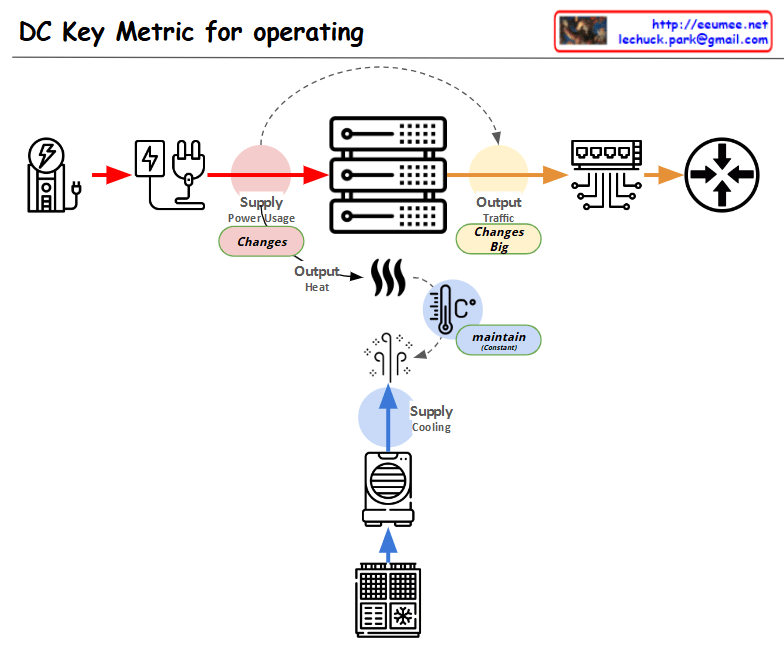
DC Key metrics for operating

From Claude with some prompting
This diagram showing the key metrics for Data Center (DC) operations:

  1. Power Supply Chain:
  • Power input → Power conversion/distribution → Server equipment
  • Marked as “Supply Power Usage” with a note indicating “Changes” in variability
  1. Server Operations:
  • Server racks shown in the center
  • Two main outputs:
    • Top: “Output Traffic” with a note “Changes Big” indicating high variability
    • Bottom: “Output Heat” generation
  1. Cooling System:
  • Cooling equipment shown at the bottom
  • Marked as “Supply Cooling”
  • Temperature icon with “maintain” indicator showing the need to maintain consistent temperature
  1. Overall Flow:
  • Power input → Server operations → Network output
  • Separate cooling circulation system for heat management

The diagram illustrates the interconnection between three critical elements of data center operations:

  • Power supply management
  • Server operations
  • Cooling system

Each component shows potential variability points (marked as “Changes”) and management requirements, with special attention to:

  • Power usage monitoring
  • Traffic output management
  • Heat dissipation and temperature control

This visualization effectively demonstrates how these systems work together in a data center environment, highlighting the key areas that require monitoring and management for optimal operation.

WEB SERVICE 3-TIERS

From Claude with some prompting
WEB(Front) Layer

  • Primary Components:
    • Static Data: HTML, CSS, JavaScript files
    • Storage: Browser-based storage solutions
  • Performance Optimization:
    • CDN: Global content delivery
    • Caching: Response time improvement
  • Enhanced Custom Experience:
    • Optimized user interface
    • Client-side performance enhancements
  1. WAS(Back) Layer
  • Core Functions:
    • Program Code: Server-side application logic
    • Computing: Business process handling
  • Development Features:
    • Enhanced Development Environment (CI/CD):
      • Continuous Integration for automated testing
      • Continuous Deployment for automated delivery
      • Automated build and release processes
      • Development workflow optimization
    • Biz Logic: Business rules implementation
    • Microservices: Modular service architecture
  1. DB Layer
  • Data Management:
    • Dynamic Data: Real-time data processing
    • Variable(Memory): Memory-based data handling
  • Business Data:
    • Biz Data Scheme & ACID:
      • Data structure and relationships
      • Transaction integrity
      • Data consistency
    • RDBMS/NoSQL: Flexible database solutions
  1. Infrastructure Characteristics
  • High Availability (Biz Continues):
    • Uninterrupted service operation
    • Fault tolerance
    • Business continuity
  • Scalability (Biz Changes):
    • System expansion capability
    • Business growth support
    • Flexible architecture
  1. Key Integration Points
  • WEB ↔ WAS: Static data and program code interaction
  • WAS ↔ DB: Dynamic data and business logic connection
  • Biz Logic ↔ Biz Data: Direct business data operations

This architecture demonstrates a modern, well-structured web service that emphasizes:

Robust business logic handling
Efficient data management
Clear separation of concerns
Automated development processes
Scalable infrastructure
High availability
Enhanced user experience

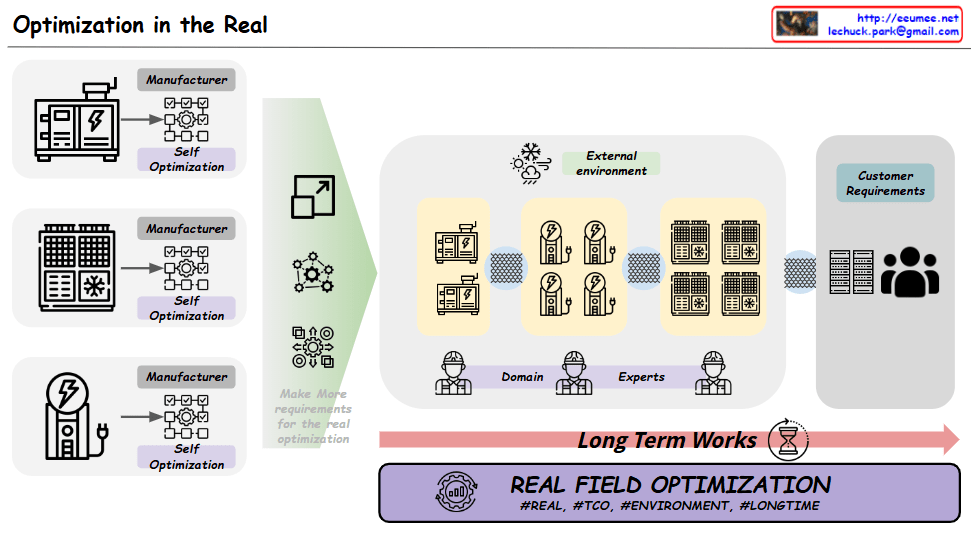
Optimization in the Real

From Claude with some prompting
The Real Field Optimization diagram and its extended implications:

  1. Extended Scope of Optimization:
  • Begins with equipment Self-Optimization but extends far beyond
  • Increasing complexity in real operating environments:
    • Equipment/system interactions
    • Operational scale expansion
    • Service quality requirements
    • Various stakeholder requirements
  1. Real Operating Environment Considerations:
  • Domain Experts’ practical experience and knowledge
  • Customer requirements and feedback
  • External Environment impacts
  • Variables emerging from Long Term operations
  1. TCO (Total Cost of Ownership) Perspective:
  • Beyond initial installation/deployment costs
  • Operation/maintenance costs
  • Energy efficiency
  • Lifecycle cost optimization
  1. Data-Driven Optimization Necessity:
  • Collection and analysis of actual operational data
  • Understanding operational patterns
  • Predictive maintenance
  • Performance/efficiency monitoring
  • Data-driven decision making for continuous improvement
  1. Long-Term Perspective Importance:
  • Performance change management over time
  • Scalability considerations
  • Sustainable operation model establishment
  • Adaptability to changing requirements
  1. Real Field Integration:
  • Interaction between manufacturers, operators, and customers
  • Environmental factor considerations
  • Complex system interdependencies
  • Real-world constraint management

This comprehensive optimization approach goes beyond individual equipment efficiency, aiming for sustainable operation and value creation of the entire system. This can be achieved through continuous improvement activities based on real operational environment data. This represents the true meaning of “Real Field Optimization” with its hashtags #REAL, #TCO, #ENVIRONMENT, #LONGTIME.

The diagram effectively illustrates that while equipment-level optimization is fundamental, the real challenge and opportunity lie in optimizing the entire operational ecosystem over time, considering all stakeholders, environmental factors, and long-term sustainability. The implicit need for data-driven optimization in real operating environments becomes crucial for achieving these comprehensive optimization goals.