AI LLM Co-Evolutions

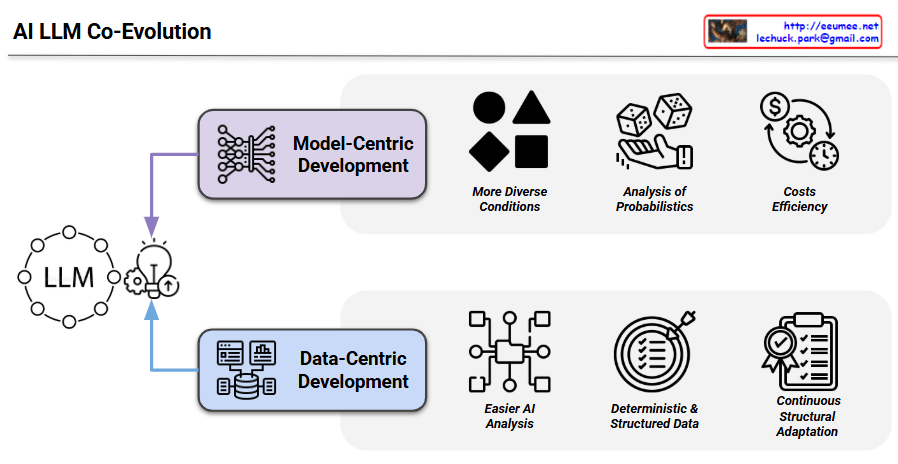
This image illustrates the AI LLM Co-Evolution process, showing how Large Language Models develop through two complementary approaches.

The diagram centers around LLM with two main development pathways:

1. Model-Centric Development

  • More Diverse Conditions: Handling various data types and scenarios (represented by geometric shapes)
  • Analysis of Probabilities: Probabilistic approaches to model behavior (shown with dice icons)
  • Costs Efficiency: Economic optimization in model development (depicted with dollar sign and gear)

2. Data-Centric Development

  • Easier AI Analysis: Simplified analytical processes (represented by network diagrams)
  • Deterministic Data: Predictable and structured data patterns (shown with concentric circles)
  • Continuous Structural Adaptation: Ongoing improvements and adjustments (illustrated with checklist icon)

The diagram demonstrates that modern AI development requires both model-focused and data-focused approaches to work synergistically. Each pathway offers distinct advantages:

  • Model-centric focuses on architectural improvements, probabilistic reasoning, and computational efficiency
  • Data-centric emphasizes data quality, deterministic processes, and adaptive structures

This co-evolutionary framework suggests that the most effective LLM development occurs when both approaches are integrated, allowing for comprehensive advancement in AI system capabilities through their complementary strengths.

With Claude

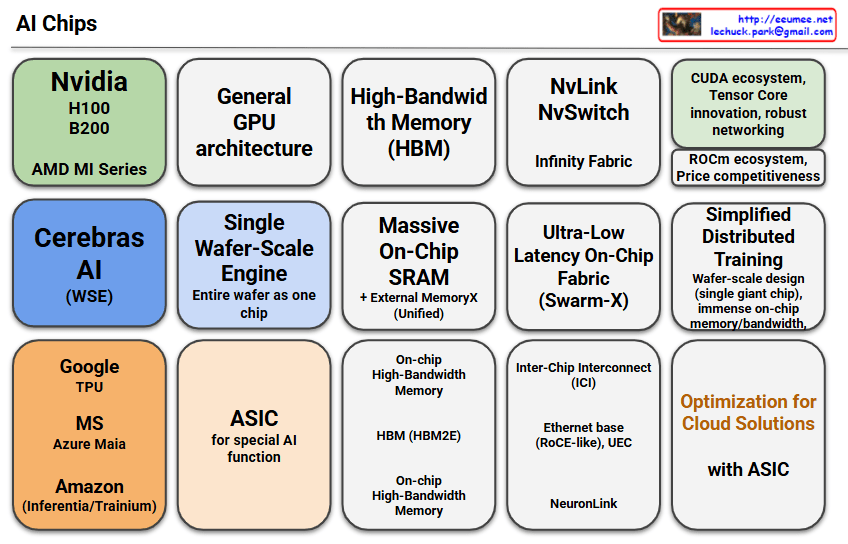
AI Chips

This image presents a comprehensive overview of the AI chip ecosystem, categorizing different approaches and technologies:

Major AI Chip Categories

GPU-Based Solutions:

  • Nvidia H100/B200 (AMD MI Series): Currently the most widely used GPUs for AI training and inference
  • General GPU architecture: Traditional general-purpose GPU architectures

Specialized AI Chips:

  • Cerebras AI (WSE): Wafer-Scale Engine where the entire wafer functions as one chip
  • Google TPU: Google’s Tensor Processing Unit
  • MS Azure Maia: Microsoft’s cloud-optimized AI chip
  • Amazon (Inferentia/Trainium): Amazon’s dedicated inference and training chips

Technical Features

Memory Technologies:

  • High-Bandwidth Memory (HBM): Advanced memory technology including HBM2E
  • Massive On-Chip SRAM: Large-capacity on-chip memory with external MemoryX
  • Ultra-Low Latency On-Chip Fabric (SwarmX): High-speed on-chip interconnect

Networking Technologies:

  • NvLink/NvSwitch: Nvidia’s high-speed interconnect with Infinity Fabric
  • Inter-Chip Interconnect (ICI): Ethernet-based connections including RoCE-like and UEC protocols
  • NeuroLink: Advanced chip-to-chip communication

Design Approaches:

  • Single Wafer-Scale Engine: Entire wafer as one chip with immense on-chip memory/bandwidth
  • Simplified Distributed Training: Wafer-scale design enabling simplified distributed training
  • ASIC for special AI function: Application-specific integrated circuits optimized for AI workloads
  • Optimization for Cloud Solutions with ASIC: Cloud-optimized ASIC implementations

This diagram effectively illustrates the evolution from general-purpose GPUs to specialized AI chips, showcasing how different companies are pursuing distinct technological approaches to meet the demanding requirements of AI workloads. The ecosystem demonstrates various strategies including memory optimization, interconnect technologies, and architectural innovations.

With Claude

Digital Twin with LLM

This image demonstrates the revolutionary applicability of Digital Twin enhanced by LLM integration.

Three Core Components of Digital Twin

Digital Twin consists of three essential elements:

  1. Modeling – Creating digital replicas of physical objects
  2. Data – Real-time sensor data and operational information collection
  3. Simulation – Predictive analysis and scenario testing

Traditional Limitations and LLM’s Revolutionary Solution

Previous Challenges: Modeling results were expressed only through abstract concepts like “Visual Effect” and “Easy to view of complex,” making practical interpretation difficult.

LLM as a Game Changer:

  • Multimodal Interpretation: Transforms complex 3D models, data patterns, and simulation results into intuitive natural language explanations
  • Retrieval Interpretation: Instantly extracts key insights from vast datasets and converts them into human-understandable formats
  • Human Interpretation Resource Replacement: LLM provides expert-level analytical capabilities, enabling continuous 24/7 monitoring

Future Value of Digital Twin

With LLM integration, Digital Twin evolves from a simple visualization tool into an intelligent decision-making partner. This becomes the core driver for maximizing operational efficiency and continuous innovation, accelerating digital transformation across industries.

Ultimately, this diagram emphasizes that LLM is the key technology that unlocks the true potential of Digital Twin, demonstrating its necessity and serving as the foundation for sustained operational improvement and future development.

With Claude

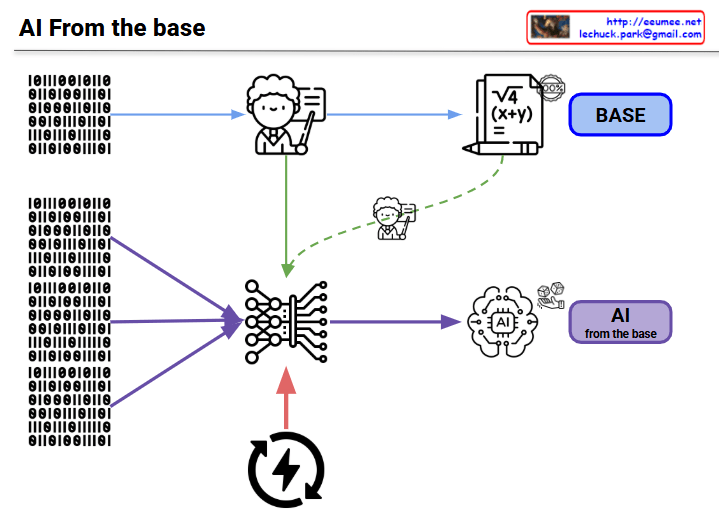
AI from the base

This diagram contrasts two approaches: traditional rule-based systems that achieve 100% accuracy within limited scope using human-designed logic, versus AI systems that handle massive datasets through neural networks with probabilistic reasoning. While traditional methods guarantee perfect results in narrow domains, AI offers scalable, adaptive solutions for complex real-world problems despite requiring significant energy and operating with uncertainty rather than absolute certainty

Upper Process (Traditional Approach):

  • Data → Human Rule Creation: Based on binary data, humans design clear logical rules
  • Mathematical Operations (√(x+y)): Precise and deterministic calculations
  • “BASE”: Foundation system with 100% certainty
  • Human-created rules guarantee complete accuracy (100%) but operate only within limited scope

Lower Process (AI-Based Approach):

  • Large-Scale Data Processing: Capable of handling vastly more extensive and complex data than traditional methods
  • Neural Network Pattern Learning: Discovers complex patterns and relationships that are difficult for humans to explicitly define
  • Adaptive Learning: The circular arrow (⚡) represents continuous improvement and adaptability to new situations
  • Advantages of Probabilistic Reasoning: Flexibility to handle uncertain and complex real-world problems

Key Advantages:

  • Traditional Approach: Clear and predictable but limited for complex real-world problems
  • AI Approach: While probabilistic, provides scalability and adaptability to solve complex problems that are difficult for humans to design solutions for. Though imperfect, it offers practical solutions that can respond to diverse and unpredictable real-world situations

AI may not be perfect, but it opens up innovative possibilities in areas that are difficult to approach with traditional methods, serving as a powerful tool for tackling previously intractable problems.

With Claude

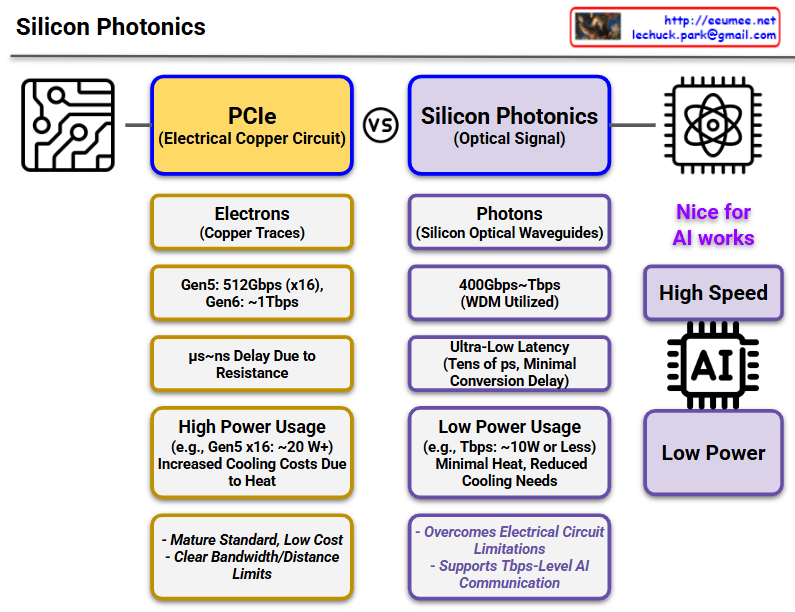
Silicon Photonics

This diagram compares PCIe (Electrical Copper Circuit) and Silicon Photonics (Optical Signal) technologies.

PCIe (Left, Yellow Boxes)

  • Signal Transmission: Uses electrons (copper traces)
  • Speed: Gen5 512Gbps (x16), Gen6 ~1Tbps expected
  • Latency: μs~ns level delay due to resistance
  • Power Consumption: High (e.g., Gen5 x16 ~20W), increased cooling costs due to heat generation
  • Pros/Cons: Mature standard with low cost, but clear bandwidth/distance limitations

Silicon Photonics (Right, Purple Boxes)

  • Signal Transmission: Uses photons (silicon optical waveguides)
  • Speed: 400Gbps~7Tbps (utilizing WDM technology)
  • Latency: Ultra-low latency (tens of ps, minimal conversion delay)
  • Power Consumption: Low (e.g., 7Tbps ~10W or less), minimal heat with reduced cooling needs
  • Key Benefits:
    • Overcomes electrical circuit limitations
    • Supports 7Tbps-level AI communication
    • Optimized for AI workloads (high speed, low power)

Key Message

Silicon Photonics overcomes the limitations of existing PCIe technology (high power consumption, heat generation, speed limitations), making it a next-generation technology particularly well-suited for AI workloads requiring high-speed data processing.

With Claude