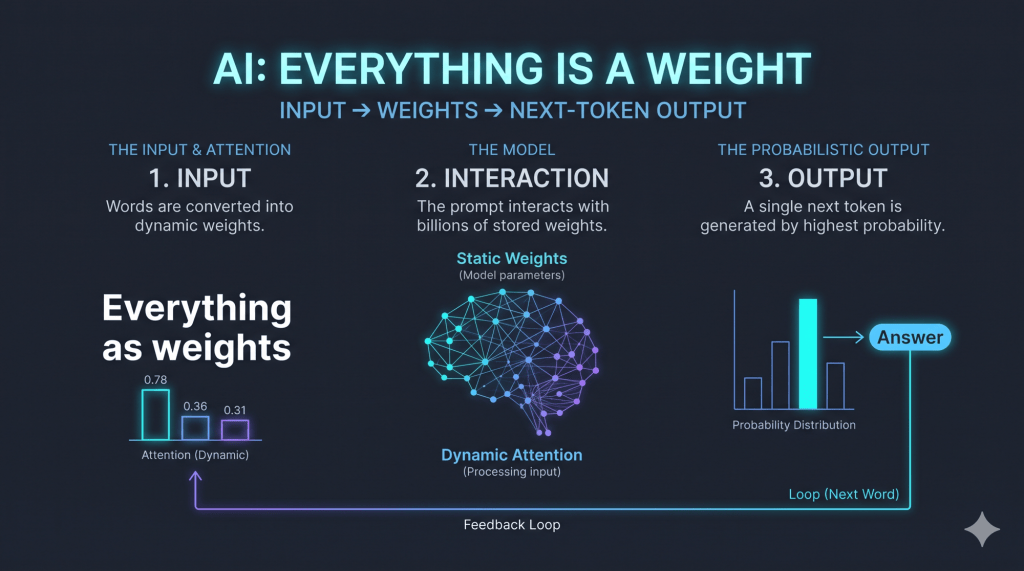
This infographic visually deconstructs the core operating principle of modern Large Language Models (LLMs) under the overarching theme, “AI: EVERYTHING IS A WEIGHT”. Against a sleek, dark-mode background with glowing cyan and purple neon accents, the diagram maps out the linear and cyclical pipeline of how an AI processes information: INPUT > WEIGHTS > NEXT-TOKEN OUTPUT.
Visual Walkthrough of the Pipeline
- 1. INPUT (The Input & Attention): On the left side of the diagram, the process begins when a user’s prompt is fed into the system. Using the phrase “Everything as weights” as a visual example, the graphic illustrates how raw text is tokenized and converted into numerical values. Directly beneath the text, a glowing three-bar chart displays specific numerical values (0.78, 0.36, 0.31) labeled “Attention (Dynamic)”. This visually represents the self-attention mechanism, where the model dynamically calculates the contextual importance and relationship of each word within the prompt in real time.
- 2. INTERACTION (The Model): Moving to the center, the dynamically weighted input flows into a glowing, wireframe digital brain composed of interconnected nodes and synapses. This central graphic highlights the crucial duality of weights in an AI architecture:
- Static Weights (Model parameters): Positioned at the top of the brain in cyan, representing the billions of pre-trained, fixed parameters where the model’s general knowledge and linguistic patterns are stored.
- Dynamic Attention (Processing input): Positioned at the bottom in purple, showing how the real-time context of the prompt actively interacts with the static neural network through massive matrix multiplications.
- 3. OUTPUT (The Probabilistic Output): On the right side, the neural network’s calculations converge into a vertical bar chart labeled “Probability Distribution”. Instead of retrieving a pre-written sentence from a database, the model calculates the statistical likelihood of every possible next word. One tall, brightly illuminated cyan bar stands out among the rest, pointing directly to a glowing pill-shaped button containing the word “Answer”. This signifies that the model selects a single next token based on the highest calculated probability.
- The Feedback Loop (Autoregressive Generation): At the very bottom of the image, a glowing gradient arrow labeled “Loop (Next Word)” and “Feedback Loop” drops down from the generated “Answer” token, travels across the bottom of the canvas, and feeds right back into the “1. INPUT” stage. This illustrates the autoregressive nature of LLMs: the newly generated word is appended to the original input, and the entire weight calculation process repeats over and over, generating the final response one token at a time.
Ultimately, this diagram strips away the mystique of artificial intelligence to reveal its mathematical foundation. An LLM does not “think” or “look up” answers in a traditional sense; rather, it operates as a continuous mathematical loop. It converts input words into dynamic attention weights, multiplies them against billions of static parameter weights, selects a single next token based on the highest probability, and feeds that token back into the input to build a response word by word.
#AIArchitecture #LargeLanguageModels #LLM #TransformerModel #AttentionMechanism #NeuralNetworks #MachineLearning #DeepLearning #Autoregressive #NextTokenPrediction #ArtificialIntelligence #TechInfographic
With Gemini


