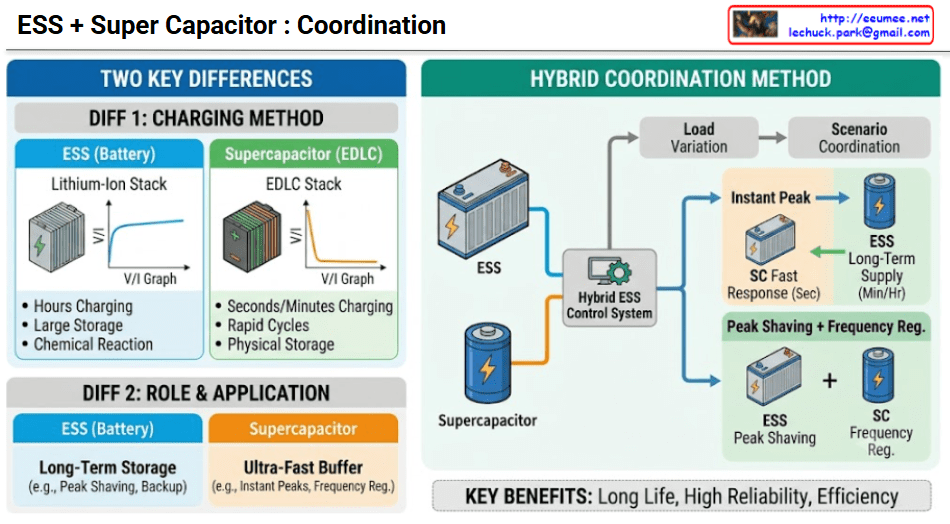
This infographic serves as a technical resource comparing the characteristics of Energy Storage Systems (ESS) and Supercapacitors, and explaining how a ‘Hybrid Coordination Method’ that combines these two technologies operates. The chart is primarily divided into ‘Two Key Differences’ on the left and ‘Hybrid Coordination Method’ on the right.
1. Left Section: Two Key Differences
This section highlights the fundamental technical distinctions between the two storage devices.
- Diff 1: Charging Method
- ESS (Battery): Utilizes a Lithium-Ion Stack. It stores energy via a Chemical Reaction, so as shown in the V/I graph, voltage and current rise gradually, taking hours for a full charge. However, it excels at large storage.
- Supercapacitor (EDLC): Utilizes an EDLC (Electric Double-Layer Capacitor) Stack. It uses a Physical Storage method to store charge, resulting in a very steep rise in voltage and current in the graph, with charging complete in seconds or minutes. It can withstand repeated rapid cycles.
- Diff 2: Role & Application
- ESS (Battery): Functions as a long-term storage device. For example, it is used for Peak Shaving to reduce load during high-demand periods or as a backup power source.
- Supercapacitor: Functions as an ultra-fast buffer. It is deployed where immediate and powerful responses are required, such as responding to instant peaks in power demand or for power grid Frequency Regulation.
2. Right Section: Hybrid Coordination Method
This section demonstrates how the two devices work together when combined into a single system.
- System Configuration: The central ‘Hybrid ESS Control System’ is the brain. This controller detects external ‘Load Variation’ and executes the appropriate ‘Scenario Coordination’. The system consists of a blue, battery-shaped ESS unit and a blue, cylindrical Supercapacitor unit.
- Coordination Scenario 1: Instant Peak
- When an instant peak occurs (a sudden surge in load), the controller first commands the fast-responding Supercapacitor (SC) to provide a fast response in seconds, absorbing the initial power shock.
- Subsequently, the controller hands over power supply to the ESS, which provides long-term supply in minutes or hours. This prevents rapid battery discharge and ensures the stability of the overall power supply.
- Coordination Scenario 2: Peak Shaving + Frequency Reg.
- The two devices simultaneously perform different roles to stabilize the power grid.
- The ESS is responsible for peak shaving, reducing large and sustained load peaks.
- Simultaneously, the Supercapacitor handles fine-tuned frequency regulation, adjusting for small, rapid frequency fluctuations. This combination of “ESS + SC” addresses both needs.
3. Bottom Section: Key Benefits
The major advantages achieved through this hybrid coordination are:
- Long Life: By having the Supercapacitor absorb initial power shocks, the stress on the battery is reduced, thereby extending its lifespan.
- High Reliability: Leveraging the strengths of both devices allows for a stable and reliable response to various power grid changes.
- Efficiency: Each device takes on the role it does best, resulting in higher overall energy management efficiency for the system.
Summary: This infographic compares ESS (Batteries), which excel at bulk storage but have slower response times, with Supercapacitors, which have smaller storage capacity but offer ultra-fast response times. It explains a coordinated operation method that combines these two devices using a hybrid control system to effectively address both instantaneous power peaks and sustained energy demands. This combined approach achieves the key benefits of long life, high reliability, and efficiency.
#ESS #Supercapacitor #EnergyStorageSystem #HybridEnergySystem #GridStabilization #PeakShaving #FrequencyRegulation #EnergyTech #Infographic #EcoTech
With Gemini

 Lechuck Park