From RNN to Transformer

Visual Analysis: RNN vs Transformer

Visual Structure Comparison

RNN (Top): Sequential Chain

  • Linear flow: Circular nodes connected left-to-right
  • Hidden states: Each node processes sequentially
  • Attention weights: Numbers (2,5,11,4,2) show token importance
  • Bottleneck: Must process one token at a time

Transformer (Bottom): Parallel Grid

  • Matrix layout: 5×5 grid of interconnected nodes
  • Self-attention: All tokens connect to all others simultaneously
  • Multi-head: 5 parallel attention heads working together
  • Position encoding: Separate blue boxes handle sequence order

Key Visual Insights

Processing Pattern

  • RNN: Linear chain → Sequential dependency
  • Transformer: Interconnected grid → Parallel freedom

Information Flow

  • RNN: Single path with accumulating states
  • Transformer: Multiple simultaneous pathways

Attention Mechanism

  • RNN: Weights applied to existing sequence
  • Transformer: Direct connections between all elements

Design Effectiveness

The diagram succeeds by using:

  • Contrasting layouts to show architectural differences
  • Color coding to highlight attention mechanisms
  • Clear labels (“Sequential” vs “Parallel Processing”)
  • Visual metaphors that make complex concepts intuitive

The grid vs chain visualization immediately conveys why Transformers enable faster, more scalable processing than RNNs.

Summary

This diagram effectively illustrates the fundamental shift from sequential to parallel processing in neural architecture. The visual contrast between RNN’s linear chain and Transformer’s interconnected grid clearly demonstrates why Transformers revolutionized AI by enabling massive parallelization and better long-range dependencies.

With Claude
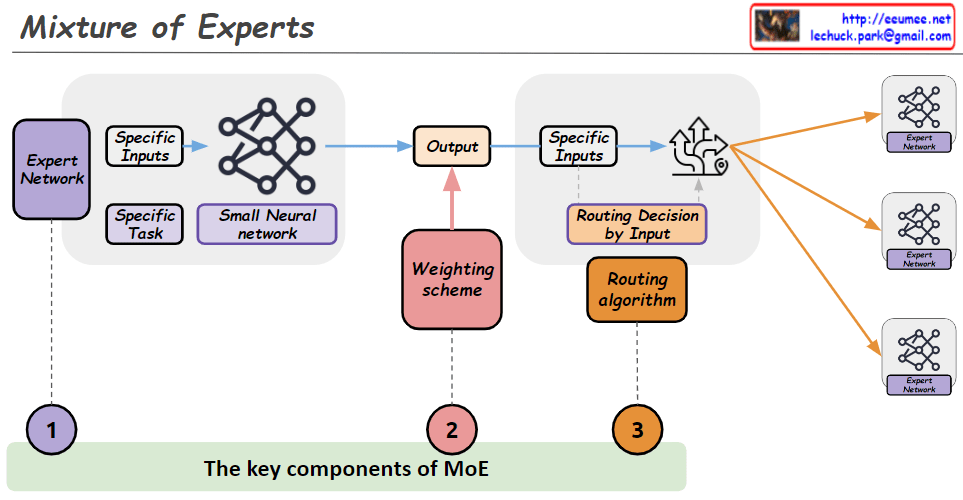
the key components of a Mixture of Experts

From Claude with some prompting
This image illustrates the key components of a Mixture of Experts (MoE) model architecture. An MoE model combines the outputs of multiple expert networks to produce a final output.

The main components are:

  1. Expert Network: This represents a specialized neural network trained for a specific task or inputs. Multiple expert networks can exist in the architecture.
  2. Weighting Scheme: This component determines how to weight and combine the outputs from the different expert networks based on the input data.
  3. Routing Algorithm: This algorithm decides which expert network(s) should handle a given input based on the specific inputs. It essentially routes the input data to the appropriate expert(s).

The workflow is as follows: The specific inputs are fed into the routing algorithm (3), which decides which expert network(s) should process those inputs. The selected expert network(s) (1) process the inputs and generate outputs. The weighting scheme (2) then combines these expert outputs into a final output based on a small neural network.

The key idea is that different expert networks can specialize in different types of inputs or tasks, and the MoE architecture can leverage their collective expertise by routing inputs to the appropriate experts and combining their outputs intelligently.

Foundation Model

From Claude with some prompting
This image depicts a high-level overview of a foundation model architecture. It consists of various components including a knowledge base, weight database (parameters), vector database (relative data), tuning module for making answers, inference module for generating answers, prompt tools, and an evaluation component for benchmarking.

The knowledge base stores structured information, while the weight and vector databases hold learnable parameters and relative data representations, respectively. The tuning and inference modules utilize these components to generate responses or make predictions. Prompt tools assist in forming inputs, and the evaluation component assesses the model’s performance.

This architectural diagram illustrates the core building blocks and data flow of a foundation model system, likely used for language modeling, knowledge representation, or other AI applications that require integrating diverse data sources and capabilities.

Attention in a LLM

From Copilot with some prompting
Certainly! Let’s discuss the concept of multi-head attention in the context of a Language Learning Model (LLM).

Input Sentence: The sentence “Seagulls fly over the ocean.”
Attention Weight Visualization: The image illustrates how different words in the sentence attend to each other. For instance, if the attention weight between “seagulls” and “ocean” is high, it indicates that these two words are closely related within the sentence.
Multiple Heads: The model employs multiple attention heads (sub-layers) to compute attention from different perspectives. This allows consideration of various contexts and enhances the model’s ability to capture important information.
Multi-head attention is widely used in natural language processing (NLP) tasks, including translation, question answering, and sentiment analysis. It helps improve performance by allowing the model to focus on relevant parts of the input sequence.