WEB SERVICE 3-TIERS

From Claude with some prompting
WEB(Front) Layer

  • Primary Components:
    • Static Data: HTML, CSS, JavaScript files
    • Storage: Browser-based storage solutions
  • Performance Optimization:
    • CDN: Global content delivery
    • Caching: Response time improvement
  • Enhanced Custom Experience:
    • Optimized user interface
    • Client-side performance enhancements
  1. WAS(Back) Layer
  • Core Functions:
    • Program Code: Server-side application logic
    • Computing: Business process handling
  • Development Features:
    • Enhanced Development Environment (CI/CD):
      • Continuous Integration for automated testing
      • Continuous Deployment for automated delivery
      • Automated build and release processes
      • Development workflow optimization
    • Biz Logic: Business rules implementation
    • Microservices: Modular service architecture
  1. DB Layer
  • Data Management:
    • Dynamic Data: Real-time data processing
    • Variable(Memory): Memory-based data handling
  • Business Data:
    • Biz Data Scheme & ACID:
      • Data structure and relationships
      • Transaction integrity
      • Data consistency
    • RDBMS/NoSQL: Flexible database solutions
  1. Infrastructure Characteristics
  • High Availability (Biz Continues):
    • Uninterrupted service operation
    • Fault tolerance
    • Business continuity
  • Scalability (Biz Changes):
    • System expansion capability
    • Business growth support
    • Flexible architecture
  1. Key Integration Points
  • WEB ↔ WAS: Static data and program code interaction
  • WAS ↔ DB: Dynamic data and business logic connection
  • Biz Logic ↔ Biz Data: Direct business data operations

This architecture demonstrates a modern, well-structured web service that emphasizes:

Robust business logic handling
Efficient data management
Clear separation of concerns
Automated development processes
Scalable infrastructure
High availability
Enhanced user experience

Web Service [Server Inside]

From Claude with some prompting
focusing on the key technical aspects and operational considerations for designing a web service application.

Web Service [Server Inside] – Design and Operational Considerations

  1. Service Architecture Design: a. Multi-tier structure:
    • Gateway → Load Balancer → API Gateway → DB Proxy → Database
    • Each layer focuses on specific functions, improving maintainability and scalability b. Microservice Architecture:
    • Implemented through “Programmatic Control” at the API Gateway
    • Ensures service independence, increases development and deployment flexibility
  2. Scalability Design: a. Auto Scaling:
    • Applied at each layer (Load Balancer, API Gateway, DB Proxy)
    • Automatic resource adjustment based on traffic fluctuations for improved stability b. Resource Pooling:
    • “Protecting SVC” functionality for efficient resource management c. Load Balancing:
    • Gateway provides “Route with Load Balancing (2 More Resources)” functionality
  3. Performance Optimization: a. Static/Dynamic Data Separation:
    • Static Data Control: HTML/CSS/JS/IMAGES
    • Utilization of CDN services or On-Premise storage b. Database Optimization:
    • SQL, NoSQL, Hybrid options available
    • Connection management through DB Proxy for database load distribution
  4. Security Design: a. Multi-layered Security:
    • Authentication (OAuth2, etc.)
    • Encryption (SSL/TLS)
    • Firewall/WAF/IPS/IDS b. Request Limiting:
    • “Limiting Requests (Protect Domain Service)” at Gateway for DDoS protection
  5. Monitoring and Analysis: a. Comprehensive Monitoring:
    • Collection of Network, Server, and Application Metrics b. Analysis and Planning:
    • Maintenance & Scaling
    • Service Design Upgrade
    • Resource & Cost Optimization
  6. Error Handling:
    • Specification of 400, 500 series errors (Network Error, Service Unavailable, Server Internal, etc.)
    • Emphasis on Gateway-related errors (502 Bad Gateway, 504 Gateway Timeout)
  7. Network and Protocol:
    • “Protocol Converting” functionality provided at the Gateway
    • Separate management of Network Domain Control
  8. Operational Efficiency:
    • Automation: Minimized manual intervention through Auto Scaling, resource pooling, etc.
    • Flexibility: Possible combination of On-Premise and CDN services
    • Cost Optimization: Efficient resource usage, continuous analysis and improvement

Key Advantages of This Configuration:

  1. High Availability and Stability: Stable service provision through multiple layers and auto-scaling
  2. Excellent Scalability: Flexible response to traffic fluctuations
  3. Strong Security: Multi-layered security structure to address various threats
  4. Efficient Resource Management: Cost efficiency through automation and optimization
  5. Flexible Service Development and Deployment: Utilization of microservice architecture
  6. Comprehensive Monitoring and Analysis: Enables continuous service improvement

This design incorporates almost all essential elements required for modern, large-scale web services, enabling stable and scalable service operations. It reflects a thorough consideration of both technical and operational aspects, providing a robust foundation for complex web applications.

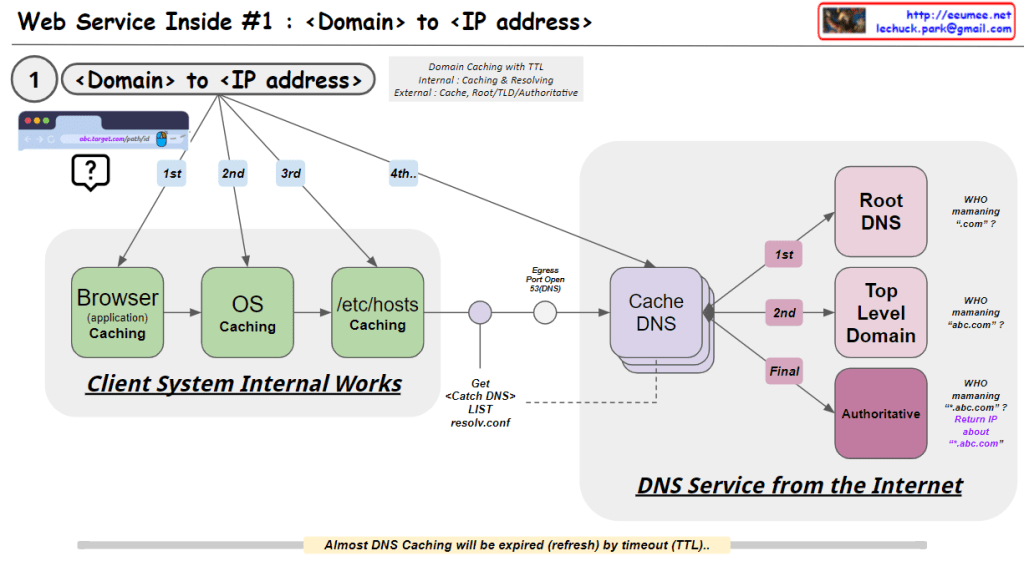
Domain to IP

From Claude with some prompting
This image illustrates the process of converting a domain name to an IP address, which is the first step in web service operations. Here’s a breakdown of the image:

  1. Client System Internal Works:
    • Browser (application) Caching: The first level of caching occurs in the web browser.
    • OS Caching: The second level of caching is at the operating system level.
    • /etc/hosts Caching: The third level involves checking the local hosts file.
  2. DNS Service from the Internet:
    • Cache DNS: This is the first point of contact with external DNS services.
    • Root DNS: Manages top-level domains like “.com”.
    • Top Level Domain: Manages specific top-level domains (e.g., “.com”, “.org”).
    • Authoritative DNS: Provides the final, authoritative IP address for the specific domain.

The process follows a hierarchical order:

  1. Check Browser cache
  2. Check OS cache
  3. Check /etc/hosts file
  4. Query Cache DNS server
  5. If not found, Cache DNS queries Root DNS
  6. Then queries Top Level Domain
  7. Finally queries Authoritative DNS to get the IP address

The image also notes:

  • DNS caching uses TTL (Time To Live) for expiration.
  • The system uses a resolve.conf file to get the Cache DNS list.
  • It questions who is managing various levels of DNS (“.com”, “abc.com”, etc.)

This process ensures efficient and hierarchical resolution of domain names to IP addresses, utilizing various caching mechanisms to improve speed and reduce network load.

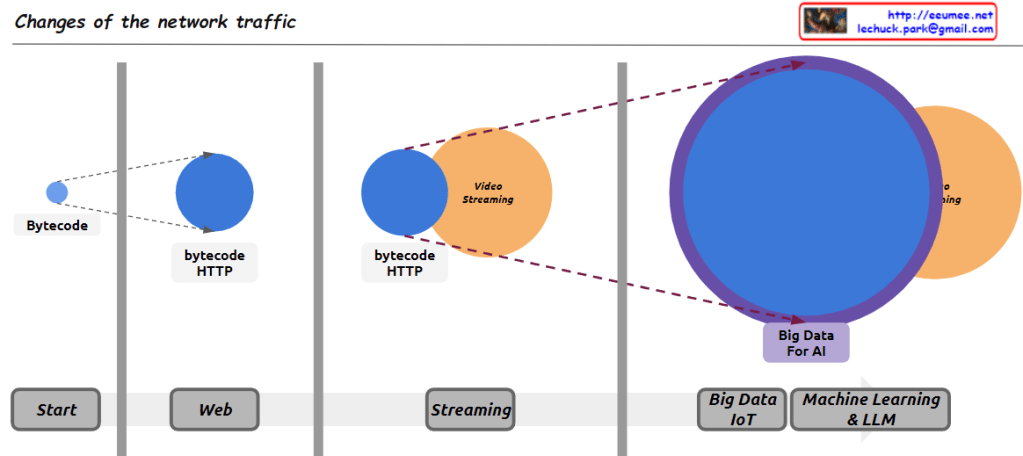
Changes of the network traffic

From Claude with some prompting
Here’s an interpretation of the diagram in English, focusing on the major changes in internet traffic types:

  1. Early Internet (Start): The small “Bytecode” circle represents the limited data exchange of the early internet. This period was primarily characterized by simple, text-based information exchange.
  2. Web Era (Web): The larger “bytecode HTTP” circle illustrates the surge in HTTP traffic with the advent of the World Wide Web. This represents increased traffic from web browsing, email, and early online services.
  3. Streaming Age (Streaming): The addition of the “Video Streaming” circle signifies the explosive growth in video streaming traffic, driven by platforms like YouTube and Netflix. This marks a paradigm shift in internet bandwidth usage.
  4. Big Data and AI Era (Big Data IoT / Machine Learning & LLM): The largest circle, “Big Data For AI,” represents the enormous traffic increase due to IoT device proliferation, cloud computing ubiquity, and large-scale data processing for AI and machine learning. This suggests it now constitutes the largest portion of internet traffic.

This diagram effectively shows the evolution of internet traffic from simple data exchange to web-based services, media streaming, and the current data-centric, AI-driven era.

Comments (points to be cautious about):

  1. Accuracy: It’s unclear if the circle sizes accurately reflect actual traffic volumes. This should be understood as a conceptual representation.
  2. Time scale: The time intervals between stages may not be uniform, which is not indicated in the diagram.
  3. Overlap: In reality, these traffic types coexist and are not as distinctly separated as the diagram suggests.
  4. Recent trends: The diagram doesn’t reflect traffic changes due to latest technological trends like 5G or edge computing.
  5. Regional differences: These changes may not have occurred uniformly worldwide, which is not reflected in the diagram.

It’s important to consider these points when interpreting the diagram. Overall, this image effectively conveys the macroscopic trends in the evolution of internet traffic in a concise and impactful manner.

HTTP Service components

From Claude with some prompting
This image illustrates the network structure of an HTTP service. The main components are:

Client Side:

  • Browser: Handles URL requests, HTML parsing, and JavaScript execution
  • OS: Runs the browser, translates URL (domain) to IP

Internet:

  • DNS: Converts domain names to IP addresses
  • IP: Transfers data using IP addresses

Server Side:

  • OS (Operating System): Runs applications, manages IP network
  • TLS: Handles encryption
  • WEB:
    • Manages HTML embedding
    • Handles JSP (JavaServer Pages)
    • Typically deals with static content and some dynamic content generation
  • WAS (Web Application Server):
    • Handles server-side programming and application logic
    • Manages complex dynamic content generation
    • Interacts with the database
    • Handles business logic of the application
  • DB: Database for storing and retrieving data for web services

The diagram shows the entire process of how an HTTP request is handled, from the web browser to the server’s database. It briefly explains the technologies and protocols involved at each step, providing a helpful overview of the basic structure of web services.