Thermal-Aware / Energy-Aware Scheduling
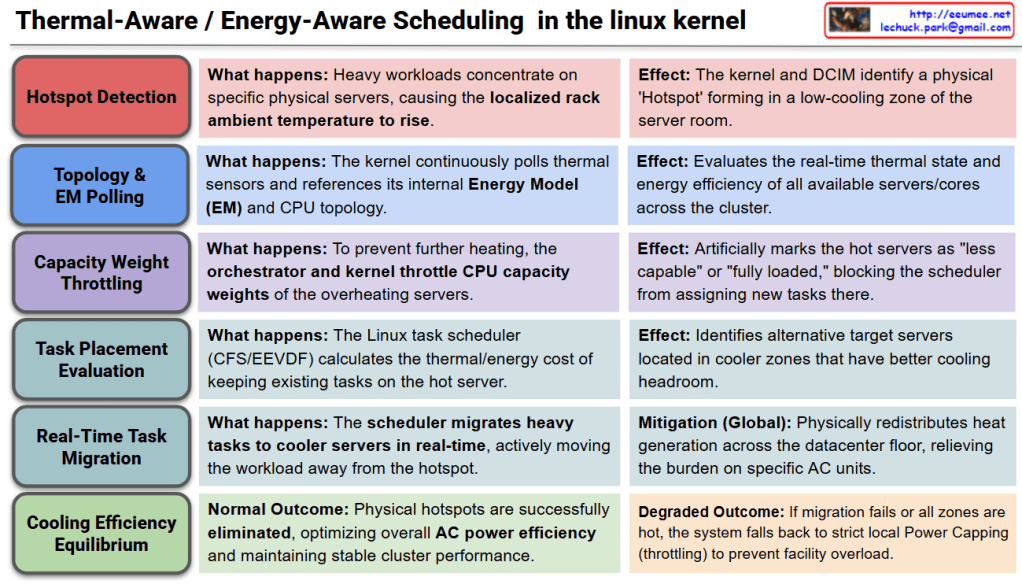
This diagram illustrates the macro-level, spatial cooling strategy within the Linux kernel. Instead of merely throttling hardware locally, the scheduler actively redistributes workloads across the datacenter floor to optimize overall cooling infrastructure. The process is broken down into six sequential stages:
- Stage 1: Hotspot DetectionWhen heavy compute workloads concentrate heavily on specific physical servers, the localized ambient temperature around that rack begins to rise. As a result, the Linux kernel and the Datacenter Infrastructure Management (DCIM) system detect a physical ‘Hotspot’ forming within a low-cooling zone of the server room.
- Stage 2: Topology & EM PollingTo assess the cluster’s environment, the kernel continuously polls hardware thermal sensors and cross-references this data with its internal Energy Model (EM) and CPU topology. This allows the system to evaluate the real-time thermal state and power efficiency of all available servers and cores across the entire cluster.
- Stage 3: Capacity Weight ThrottlingTo prevent the hotspot from worsening, the cluster orchestrator and the local kernel intervene by artificially throttling the CPU capacity weights of the overheating servers. This mechanism marks the hot servers as “less capable” or “fully loaded” to the system, effectively blocking the scheduler from assigning any new tasks to that specific physical location.
- Stage 4: Task Placement EvaluationThe Linux task scheduler (such as CFS or EEVDF) calculates the thermal and energy cost of keeping currently running tasks on the hot server. It evaluates the previously polled topology data to identify alternative target servers located in cooler zones that possess better cooling headroom.
- Stage 5: Real-Time Task MigrationIn a decisive global mitigation step, the scheduler actively migrates heavy tasks to the cooler servers in real-time. By physically moving the workload away from the hotspot, the kernel seamlessly redistributes heat generation across the datacenter floor, immediately relieving the thermal burden on specific Air Conditioning (AC) units.
- Stage 6: Cooling Efficiency Equilibrium
- Normal Outcome: The physical hotspots are successfully eliminated. The datacenter achieves an optimal thermal equilibrium, maximizing overall AC power efficiency while maintaining stable, high-performance cluster operations.
- Degraded Outcome: If task migration is impossible (e.g., all zones in the datacenter are equally hot), the system abandons spatial scheduling and falls back to strict local Power Capping (aggressive frequency/voltage throttling) to prevent total facility overload.
Summary
- Unlike traditional local throttling, Energy-Aware Scheduling actively detects physical “hotspots” in the datacenter and artificially lowers the compute capacity weight of overheating servers.
- The Linux scheduler utilizes its Energy Model (EM) to identify cooler servers and actively migrates heavy AI workloads away from the hotspot in real-time.
- This macro-level load balancing redistributes heat generation across the datacenter floor, maximizing overall AC cooling efficiency and preventing localized cooling failures.
#LinuxKernel #EnergyAwareScheduling #ThermalManagement #DataCenterOptimization #TaskMigration #GreenComputing #HPC #CloudInfrastructure

