Resolution is Speed

Resolution is Speed: Data Resolution Strategy in Rapidly Changing Environments

Core Concept

When facing rapid changes and challenges, increasing data resolution is the key strategy to maximize problem-solving speed. While low-resolution data may suffice in stable, low-change situations, high-resolution data becomes essential in complex, volatile environments.

Processing Framework

  1. High Resolution Sensing: Fine-grained detection of changing environments
  2. Computing Foundation: Securing basic computing capabilities to quantify high-resolution data
  3. Big Data Processing: Rapid processing of large-scale, high-resolution data
  4. AI Amplification: Maximizing big data processing capabilities through AI assistance

Resulting Benefits

Through this high-resolution data processing approach:

  • Fast Reaction Available: Enables rapid response to changes
  • More Stable and Efficient: Achieves real stability and efficiency
  • Attains predictable and controllable states even in highly volatile environments

Real-world Application and Necessity

These changes and challenges are occurring continuously, and AI Data Centers (AI DCs) must become the physical embodiment of rapid change response through high-resolution data processing—this is an urgent imperative. The construction and operation of AI DCs is not an option but a survival necessity, representing essential infrastructure that must be established to maintain competitiveness in the rapidly evolving digital landscape.

#DataResolution #AIDataCenter #BusinessAgility #TechImperative #FutureReady

With Claude

Data Quality

The image shows a data quality infographic with key dimensions that affect AI systems.

At the top of the image, there’s a header titled “Data Quality”. Below that, there are five key data quality dimensions illustrated with icons:

  • Accuracy – represented by a target with a checkmark. This is essential for AI models to produce correct results, as data with fewer errors and biases enables more accurate predictions.
  • Consistency – shown with circular arrows forming a cycle. This maintains consistent data formats and meanings across different sources and over time, enabling stable learning and inference in AI models.
  • Timeliness – depicted by a clock/pie chart with checkmarks. Providing up-to-date data in a timely manner allows AI to make decisions that accurately reflect current circumstances.
  • Resolution – illustrated with “HD” text and people icons underneath. This refers to increasing detailed accuracy through higher data density obtained by more frequent sampling per unit of time. High-resolution data allows AI to detect subtle patterns and changes, enabling more sophisticated analysis and prediction.
  • Quantity – represented by packages/boxes with a hand underneath. AI systems, particularly deep learning models, perform better when trained on large volumes of data. Sufficient data quantity allows for learning diverse patterns, preventing overfitting, and enabling recognition of rare cases or exceptions. It also improves the model’s generalization capability, ensuring reliable performance in real-world environments.

The bottom section features a light gray background with a conceptual illustration showing how these data quality dimensions contribute to AI. On the left side is a network of connected databases, devices, and information systems. An arrow points from this to a neural network representation on the right side, with the text “Data make AI” underneath.

The image appears to be explaining that these five quality dimensions are essential for creating effective AI systems, emphasizing that the quality of data directly impacts AI performance.

With Claude

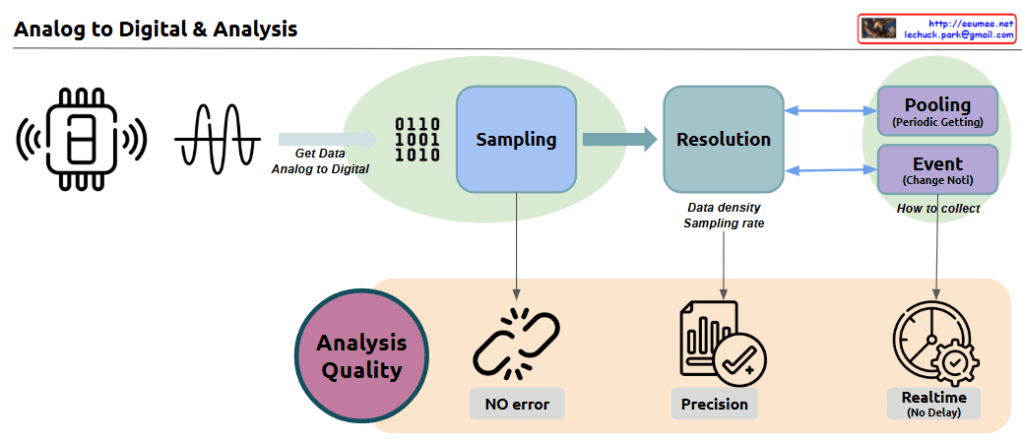
Analog to Digital & Analysis

With Claude
Here’s the analysis of the image and key elements :

  1. Sampling Stage
  • Initial stage of converting analog signals to digital values
  • Converts analog waveforms from sensors into digital data (0110 1001 1010)
  • Critical first step that determines data quality
  • Foundation for all subsequent processing
  1. Resolution Stage
  • Determines data quality through Data density and Sampling rate
  • Direct impact on data precision and accuracy
  • Establishes the foundation for data quality in subsequent analysis
  • Controls the granularity of digital conversion
  1. How to Collect
  • Pooling: Collecting data at predetermined periodic intervals
  • Event: Data collection triggered by detected changes
  • Provides efficient data collection strategies based on specific needs
  • Enables flexible data gathering approaches
  1. Analysis Quality
  • NO error: Ensures error-free data processing
  • Precision: Maintains high accuracy in data analysis
  • Realtime: Guarantees real-time processing capability
  • Comprehensive quality control throughout the process

Key Importance in Data Collection/Analysis:

  1. Accuracy: Essential for reliable data-driven decision making. The quality of input data directly affects the validity of results and conclusions.
  2. Real-time Processing: Critical for immediate response and monitoring, enabling quick decisions and timely interventions when needed.
  3. Efficiency: Proper selection of collection methods ensures optimal resource utilization and cost-effective data management.
  4. Quality Control: Consistent quality maintenance throughout the entire process determines the reliability of analytical results.

These elements work together to enable reliable data-driven decision-making and analysis. The success of any data analysis system depends on the careful implementation and monitoring of each component, from initial sampling to final analysis. When properly integrated, these components create a robust framework for accurate, efficient, and reliable data processing and analysis.