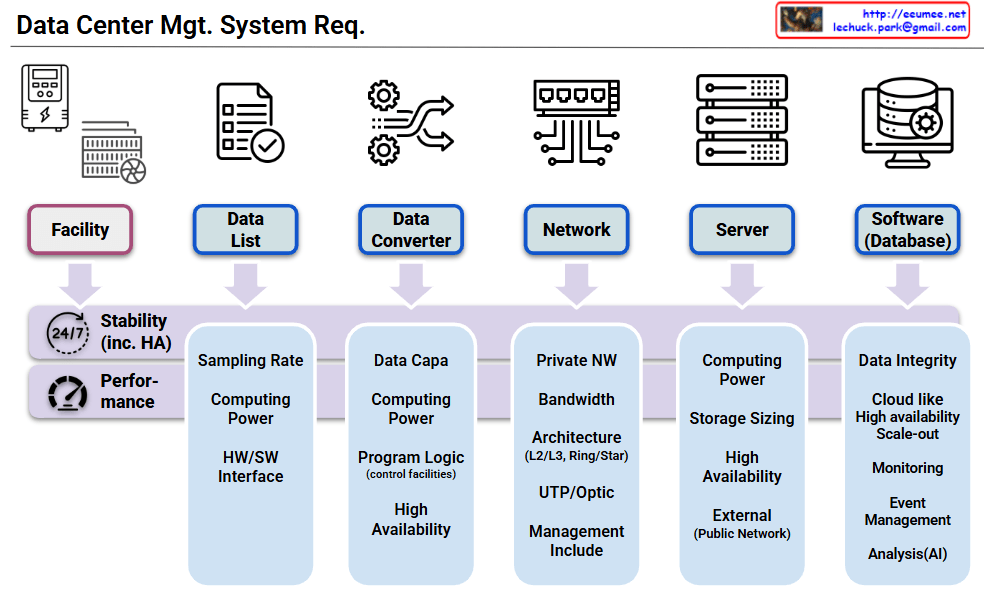
Data Center Mgt. System Req.

System Components (Top Level)

Six core components:

  • Facility: Data center physical infrastructure
  • Data List: Data management and cataloging
  • Data Converter: Data format conversion
  • Network: Network infrastructure
  • Server: Server hardware
  • Software (Database): Applications and database systems

Universal Mandatory Requirements

Fundamental requirements applied to ALL components:

  • Stability (24/7 HA): 24/7 High Availability – All systems must operate continuously without interruption
  • Performance: Optimal performance assurance – All components must meet required performance levels

Component-Specific Additional Requirements

1. Data List

  • Sampling Rate, Computing Power, HW/SW Interface

2. Data Converter

  • Data Capacity, Computing Power, Program Logic (control facilities), High Availability

3. Network

  • Private NW, Bandwidth, Architecture (L2/L3, Ring/Star), UTP/Optic, Management Include

4. Server

  • Computing Power, Storage Sizing, High Availability, External (Public Network)

5. Software/Database

  • Data Integrity, Cloud-like High Availability & Scale-out, Monitoring, Event Management, Analysis (AI)

This architecture emphasizes that stability and performance are fundamental prerequisites for data center operations, with each component having its own specific additional requirements built upon these two essential foundation requirements.

With Claude

AI Data Center : Power Req.

This image illustrates a diagram of power requirements and management for AI data centers:

Top Section – “More Power & Control”:

  • Diverse power sources: SMR (Small Modular Reactor), Reusable Energy (wind, solar), and ESS (Energy Storage System)
  • Power control system directing electricity from these various sources to the data center through “Power Control with Grid”
  • Integrated system for reliable and sustainable power supply

Bottom Section – “Optimization”:

  • Power distribution system through transformers and power supply units
  • Central control system for power routing
  • Load Balancing and Dynamic Power Management capabilities
  • Efficient power distribution to server racks based on GPU workload
  • “More Stable” indication emphasizing system reliability

This diagram highlights the importance of diversifying reliable power sources, efficient power control, and optimized power management according to GPU workload in AI data centers.

With Claude

Requires 4 Digitalizations

From DALL-E with some prompting
The image appears to be a flowchart or diagram explaining the requirements for digitalization. It starts on the left and moves to the right, outlining the transition from traditional facility-based operations to data service-based operations.

  • Facility-based Operation: On the top and bottom left, there are icons representing a computer and servers, symbolizing traditional facility-centric operations.
  • Operation Digitalization: In the center, there is a process that represents the transition of these facility-based operations to digitalization. It is labeled ‘Operation Digitalization’ and includes elements like data analysis and service development.
  • Data Service-based Operation: On the top right, icons representing modern data services like cloud computing illustrate the shift from facility-based to data-centric operations.

The bottom section includes the following detailed elements:

  • Enhancing Data Precision & Performance
  • Data Analysis System
  • DC Service Development
  • Data-based Operating

These elements are linked to the required experiences from traditional facilities (Facility Exp) and DC development (DevOps) as well as operational experience (DC Operation Exp). These components emphasize the various skills and experiences necessary for a digital transformation.

The overall diagram provides a high-level view of the different aspects of the digital transformation process, emphasizing that this transformation requires not only technical and operational capabilities but also a change in organizational experience and knowledge.