ARIMA

From Claude with some prompting
The image depicts the Autoregressive Integrated Moving Average (ARIMA) Integrated Moving Average Model, which is a time series forecasting technique.

The main components are:

  1. AR (Autoregressive):
    • This component models the past pattern in the data.
    • It performs regression analysis on the historical data.
  2. I (Integrated):
    • This component handles the non-stationarity in the time series data.
    • It applies differencing to make the data stationary.
  3. MA (Moving Average):
    • This component uses the past error terms to calculate the current forecast.
    • It applies a moving average to the error terms.

The flow of the model is as follows:

  1. Past Pattern: The historical data patterns are analyzed.
  2. Regression: The past patterns are used to perform regression analysis.
  3. Difference: The non-stationary data is made stationary through differencing.
  4. Applying Weights + Sliding Window: The regression analysis and differencing are combined, with a sliding window used to update the model.
  5. Prediction: The model generates forecasts based on the previous steps.
  6. Stabilization: The forecasts are stabilized and smoothed.
  7. Remove error: The model removes any remaining error from the forecasts, bringing them closer to the true average.

The diagram also includes visual representations of the forecast output, showing both upward and downward trends.

Overall, this ARIMA model integrates autoregressive, differencing, and moving average components to provide accurate time series forecasts while handling non-stationarity in the data.
Easy Prediction

From Claude with some prompting
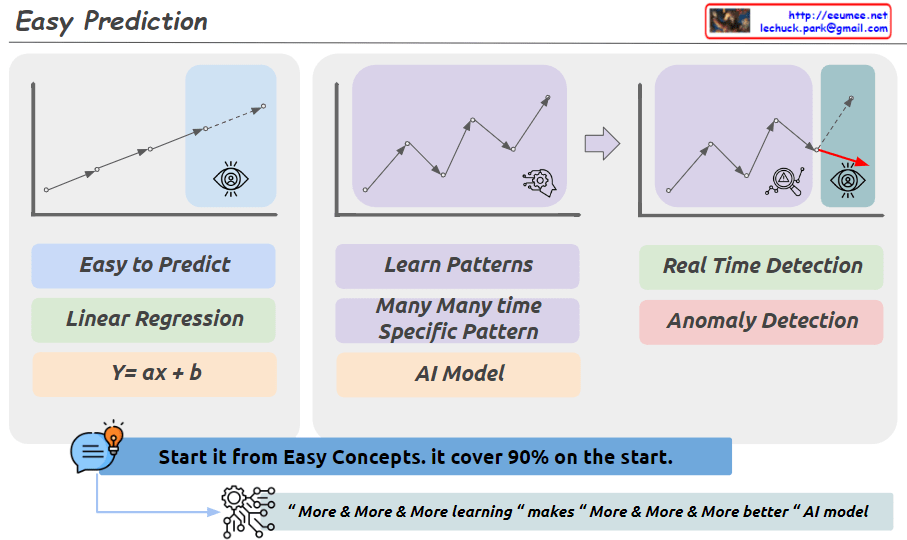
This image illustrates three main approaches to prediction and pattern recognition.

First, for easy prediction, a linear regression model (Linear Regression, y=ax+b) can be used. This is represented by a simple upward trendline. While a basic concept, it is emphasized that this can cover 90% of cases.

Second, for learning complex patterns that recur over time, an AI model is required. This is depicted by the jagged line shape.

Third, for real-time anomaly detection, sudden spike patterns need to be identified.

Additionally, at the bottom of the image, a new phrase has been added: “More & More & More learning makes More & More & More better AI model.” This conveys the idea that as an AI model learns from more and more data, its performance continues to improve.

In summary, the image highlights a step-by-step approach: starting with simple concepts to build a foundation, then utilizing AI models to learn complex patterns, and continuously improving the models through ongoing data learning and training. The key emphasis is on starting with the basics, while recognizing the potential of advanced AI techniques when combined with extensive learning from data.

Start Regression (ML)

From DALL-E with some prompting

Linear Regression:
Yields a continuous output.
Relates independent variable X with dependent variable Y through a linear relationship.
Uses Mean Squared Error (MSE) as a performance metric.
Can be extended to Multi-linear Regression for multiple independent variables.

Linear & Logistic Regression

  • The process begins with data input, as indicated by “from Data.”
  • Machine learning algorithms then process this data.
  • The outcome of this process branches into two types of regression, as indicated by “get Functions.”

Logistics Regression:
Used for classification tasks, distinguishing between two or more categories.
Outputs a probability percentage (between 0 or 1) indicating the likelihood of belonging to a particular class.
Performance is evaluated using Log Loss or Binary Cross-Entropy metrics.
Can be generalized to Softmax/Multinomial Logistic Regression for multi-class classification problems.

The image also graphically differentiates the two types of regression. Linear Regression is represented with a scatter plot and a trend line indicating the predictive linear equation. Logistic Regression is shown with a sigmoid function curve that distinguishes between two classes, highlighting the model’s ability to classify data points based on the probability threshold.