Multi-Head Latent Attention – Changes

Multi-Head Latent Attention (MLA) Interpretation

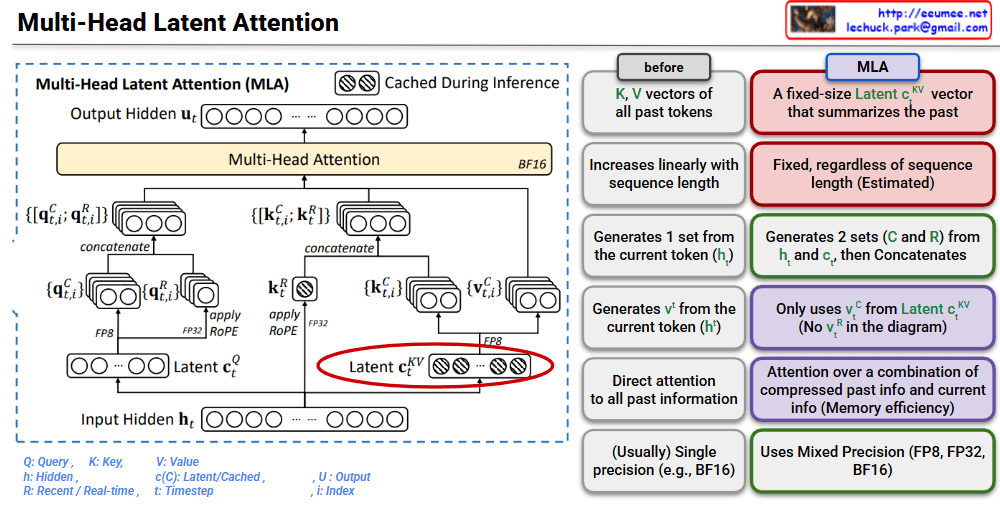
This image is a technical diagram explaining the structure of Multi-Head Latent Attention (MLA).

๐ŸŽฏ Core Concept

MLA is a mechanism that improves the memory efficiency of traditional Multi-Head Attention.

Traditional Approach (Before) vs MLA

Traditional Approach:

  • Stores K, V vectors of all past tokens
  • Memory usage increases linearly with sequence length

MLA:

  • Summarizes past information with a fixed-size Latent vector (c^KV)
  • Maintains constant memory usage regardless of sequence length

๐Ÿ“Š Architecture Explanation

1. Input Processing

  • Starts from Input Hidden State (h_t)

2. Latent Vector Generation

  • Latent c_t^Q: For Query of current token (compressed representation)
  • Latent c_t^KV: For Key-Value (cached and reused)

3. Query, Key, Value Generation

  • Query (q): Generated from current token (h_t)
  • Key-Value: Generated from Latent c_t^KV
    • Creates Compressed (C) and Recent (R) versions from c_t^KV
    • Concatenates both for use

4. Multi-Head Attention Execution

  • Performs attention computation with generated Q, K, V
  • Uses BF16 (Mixed Precision)

โœ… Key Advantages

  1. Memory Efficiency: Compresses past information into fixed-size vectors
  2. Faster Inference: Reuses cached Latent vectors
  3. Information Preservation: Maintains performance by combining compressed and recent information
  4. Mixed Precision Support: Utilizes FP8, FP32, BF16

๐Ÿ”‘ Key Differences

  • v_t^R from Latent c_t^KV is not used (purple box on the right side of diagram)
  • Value of current token is directly generated from h_t
  • This enables efficient combination of compressed past information and current information

This architecture is an innovative approach to solve the KV cache memory problem during LLM inference.


Summary

MLA replaces the linearly growing KV cache with fixed-size latent vectors, dramatically reducing memory consumption during inference. It combines compressed past information with current token data through an efficient attention mechanism. This innovation enables faster and more memory-efficient LLM inference while maintaining model performance.

#MultiHeadLatentAttention #MLA #TransformerOptimization #LLMInference #KVCache #MemoryEfficiency #AttentionMechanism #DeepLearning #NeuralNetworks #AIArchitecture #ModelCompression #EfficientAI #MachineLearning #NLP #LargeLanguageModels

With Claude

Insights into DeepSeek-V3

This image presents an insights overview of DeepSeek-V3, highlighting its key technical innovations and architectural features.

Core Technical Components

1. MLA (Multi-Head Latent Attention)

  • Focuses on memory efficiency
  • Processes attention mechanisms through latent representations to reduce memory footprint

2. MoE (Mixture-of-Experts)

  • Enables cost-effective scaling
  • Activates only relevant experts for each input, reducing computational overhead while maintaining performance

3. FP8 Mixed-Precision Training

  • Achieves efficient computation
  • Combines FP8 and FP32 precision levels strategically

4. MTP (Multi-Token Prediction)

  • Enables faster autoregressive inference
  • Predicts multiple tokens simultaneously (“look ahead two or three letters instead of one at a time”)

5. Multi-Plane Network Topology

  • Provides scalable, efficient cluster networking
  • Acts like a multi-lane highway to prevent bottlenecks

Right Panel Technical Details

KV Cache Compression (latent space)

  • Handles long contexts with low memory and fast decoding

Aux-loss-free Load Balancing + Expert Parallel (All-to-All)

  • Reduces FLOPs/costs while maintaining training/inference performance

Weights/Matmul in FP8 + FP32 Accumulation

  • Computes in lightweight units but sums precisely for critical totals (lower memory, bandwidth, compute, stable accuracy)

Predict Multiple Tokens at Once During Training

  • Delivers higher speed and accuracy boosts in benchmarks

2-tier Fat-Tree ร— Multiple Planes (separated per RDMA-NIC pair)

  • Provides inter-plane congestion isolation, resilience, and reduced cost/latency

Summary

DeepSeek-V3 represents a comprehensive optimization of large language models through innovations in attention mechanisms, expert routing, mixed-precision training, multi-token prediction, and network architecture. These techniques collectively address the three critical bottlenecks: memory, computation, and communication. The result is a highly efficient model capable of scaling to massive sizes while maintaining cost-effectiveness and performance.

#DeepSeekV3 #LLM #MixtureOfExperts #EfficientAI #ModelOptimization #MultiTokenPrediction #FP8Training #LatentAttention #ScalableAI #AIInfrastructure

With Claude