AI approach

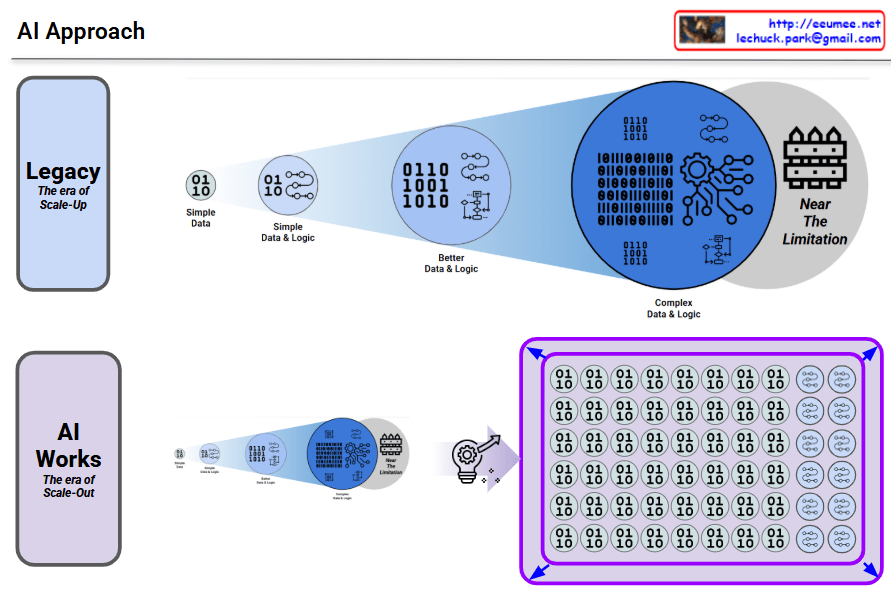
Legacy – The Era of Scale-Up

Traditional AI approach showing its limitations:

  • Simple Data: Starting with basic data
  • Simple Data & Logic: Combining data with logic
  • Better Data & Logic: Improving data and logic
  • Complex Data & Logic: Advancing to complex data and logic
  • Near The Limitation: Eventually hitting a fundamental ceiling

This approach gradually increases complexity, but no matter how much it improves, it inevitably runs into fundamental scalability limitations.

AI Works – The Era of Scale-Out

Modern AI transcending the limitations of the legacy approach through a new paradigm:

  • The left side shows the limitations of the old approach
  • The lightbulb icon in the middle represents a paradigm shift (Breakthrough)
  • The large purple box on the right demonstrates a completely different approach:
    • Massive parallel processing of countless “01/10” units (neural network neurons)
    • Horizontal scaling (Scale-Out) instead of sequential complexity increase
    • Fundamentally overcoming the legacy limitations

Key Message

No matter how much you improve the legacy approach, there’s a ceiling. AI breaks through that ceiling with a completely different architecture.


Summary

  • Legacy AI hits fundamental limits by sequentially increasing complexity (Scale-Up)
  • Modern AI uses massive parallel processing architecture to transcend these limitations (Scale-Out)
  • This represents a paradigm shift from incremental improvement to architectural revolution

#AI #MachineLearning #DeepLearning #NeuralNetworks #ScaleOut #Parallelization #AIRevolution #Paradigmshift #LegacyVsModern #AIArchitecture #TechEvolution #ArtificialIntelligence #ScalableAI #DistributedComputing #AIBreakthrough
From Tokenization to Output

From Tokenization to Output: Understanding NLP and Transformer Models

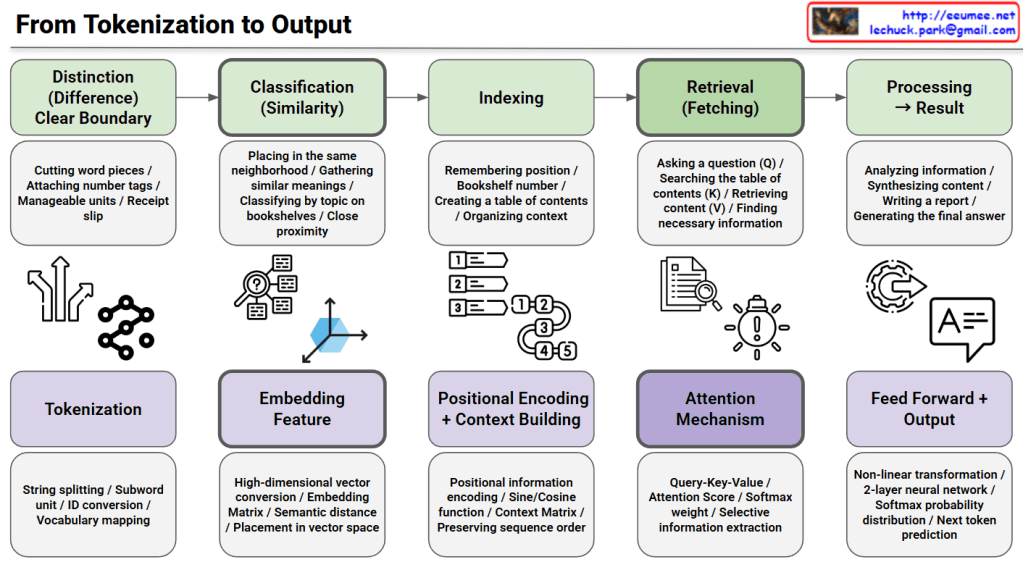
This image illustrates the complete process from tokenization to output in Natural Language Processing (NLP) and transformer models.

Top Section: Traditional Information Retrieval Process (Green Boxes)

  1. Distinction (Difference) – Clear Boundary
    • Cutting word pieces, attaching number tags, creating manageable units, generating receipt slips
  2. Classification (Similarity)
    • Placing in the same neighborhood, gathering similar meanings, classifying by topic on bookshelves, organizing by close proximity
  3. Indexing
    • Remembering position, assigning bookshelf numbers, creating a table of contents, organizing context
  4. Retrieval (Fetching)
    • Asking a question, searching the table of contents, retrieving content, finding necessary information
  5. Processing → Result
    • Analyzing information, synthesizing content, writing a report, generating the final answer

Bottom Section: Actual Transformer Model Implementation (Purple Boxes)

  1. Tokenization
    • String splitting, subword units, ID conversion, vocabulary mapping
  2. Embedding Feature
    • High-dimensional vector conversion, embedding matrix, semantic distance, placement in vector space
  3. Positional Encoding + Context Building
    • Positional information encoding, sine/cosine functions, context matrix, preserving sequence order
  4. Attention Mechanism
    • Query-Key-Value, attention scores, softmax weights, selective information extraction
  5. Feed Forward + Output
    • Non-linear transformation, 2-layer neural network, softmax probability distribution, next token prediction

Key Concept

This diagram maps traditional information retrieval concepts to modern transformer architecture implementations. It visualizes how abstract concepts in the top row are realized through concrete technical implementations in the bottom row, providing an educational resource for understanding how models like GPT and BERT work internally at each stage.


Summary

This diagram explains the end-to-end pipeline of transformer models by mapping traditional information retrieval concepts (distinction, classification, indexing, retrieval, processing) to technical implementations (tokenization, embedding, positional encoding, attention mechanism, feed-forward output). The top row shows abstract conceptual stages while the bottom row reveals the actual neural network components used in models like GPT and BERT. It serves as an educational bridge between high-level understanding and low-level technical architecture.

#NLP #TransformerModels #DeepLearning #Tokenization #AttentionMechanism #MachineLearning #AI #NeuralNetworks #GPT #BERT #PositionalEncoding #Embedding #InformationRetrieval #ArtificialIntelligence #DataScience

With Claude

Who is the first wall?

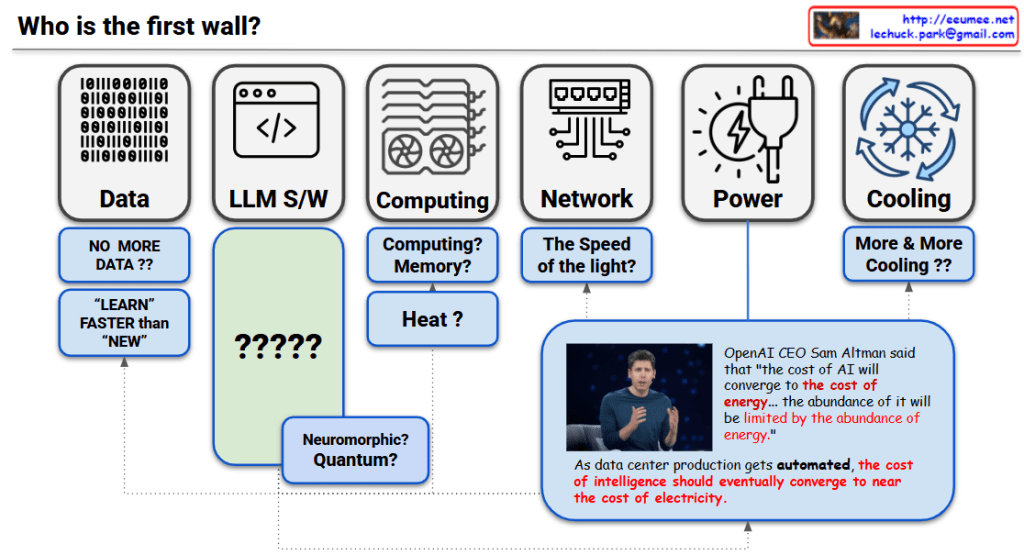
AI Scaling: The 6 Major Bottlenecks (2025)

1. Data

  • High-quality text data expected to be depleted by 2026
  • Solutions: Synthetic data (fraud detection in finance, medical data), Few-shot learning

2. LLM S/W (Algorithms)

  • Ilya Sutskever: “The era of simple scaling is over. Now it’s about scaling the right things”
  • Innovation directions: Test-time compute scaling (OpenAI o1), Mixture-of-Experts architecture, Hybrid AI

3. Computing → Heat

  • GPT-3 training required 1,024 A100 GPUs for several months
  • By 2030, largest training runs projected at 2-45GW scale
  • GPU cluster heat generation makes cooling a critical challenge

4. Memory & Network ⚠️ Current Critical Bottleneck

Memory

  • LLMs grow 410x/2yr, computing power 750x/2yr vs DRAM bandwidth only 2x/2yr
  • HBM3E completely sold out for 2024-2025. AI memory market projected to grow at 27.5% CAGR

Network

  • Speed of light limitation causes tens to hundreds of ms latency over distance. Critical for real-time applications (autonomous vehicles, AR)
  • Large-scale GPU clusters require 800Gbps+, microsecond-level ultra-low latency

5. Power 💡 Long-term Core Constraint

  • Sam Altman: “The cost of AI will converge to the cost of energy. The abundance of AI will be limited by the abundance of energy”
  • Power infrastructure (transmission lines, transformers) takes years to build
  • Data centers projected to consume 7.5% of US electricity by 2030

6. Cooling

  • Advanced technologies like liquid cooling required. Infrastructure upgrades take 1+ year

“Who is the first wall?”

Critical Bottlenecks by Timeline:

  1. Current (2025): Memory bandwidth + Data quality
  2. Short-to-Mid term: Power infrastructure (5-10 years to build)
  3. Long-term: Physical limit of the speed of light

Summary

The “first wall” in AI scaling is not a single barrier but a multi-layered constraint system that emerges sequentially over time. Today’s immediate challenges are memory bandwidth and data quality, followed by power infrastructure limitations in the mid-term, and ultimately the fundamental physical constraint of the speed of light. As Sam Altman emphasized, AI’s future abundance will be fundamentally limited by energy abundance, with all bottlenecks interconnected through the computing→heat→cooling→power chain.


#AIScaling #AIBottleneck #MemoryBandwidth #HBM #DataCenterPower #AIInfrastructure #SpeedOfLight #SyntheticData #EnergyConstraint #AIFuture #ComputingLimits #GPUCluster #TestTimeCompute #MixtureOfExperts #SamAltman #AIResearch #MachineLearning #DeepLearning #AIHardware #TechInfrastructure

With Claude

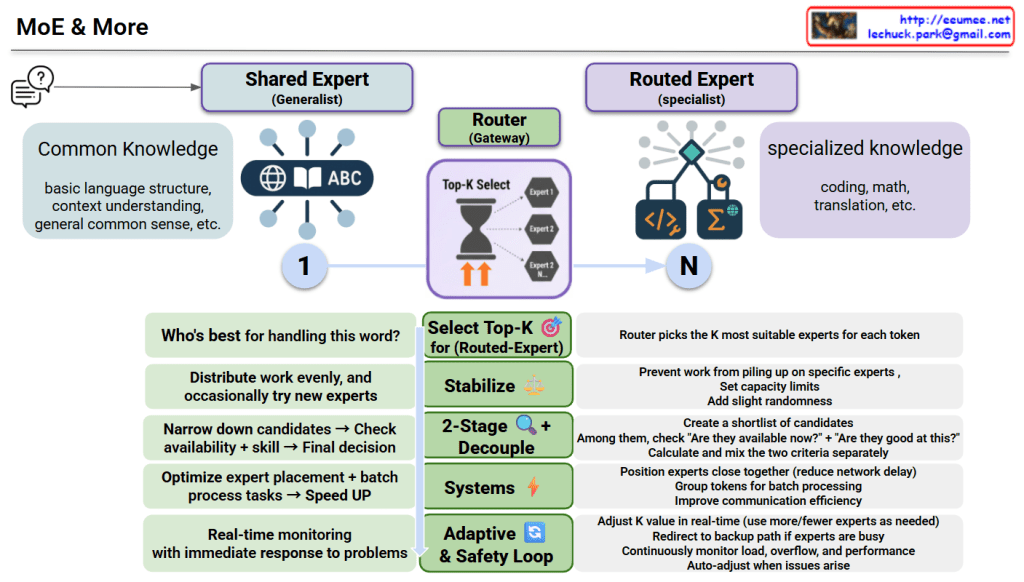
MoE & More

MoE & More – Architecture Interpretation

This diagram illustrates an advanced Mixture of Experts (MoE) model architecture.

Core Structure

1. Two Types of Experts

  • Shared Expert (Generalist)
    • Handles common knowledge: basic language structure, context understanding, general common sense
    • Applied universally to all tokens
  • Routed Expert (Specialist)
    • Handles specialized knowledge: coding, math, translation, etc.
    • Router selects the K most suitable experts for each token

2. Router (Gateway) Role

For each token, determines “Who’s best for handling this word?” by:

  • Selecting K experts out of N available specialists
  • Using Top-K selection mechanism

Key Optimization Techniques

Select Top-K 🎯

  • Chooses K most suitable routed experts
  • Distributes work evenly and occasionally tries new experts

Stabilize ⚖️

  • Prevents work from piling up on specific experts
  • Sets capacity limits and adds slight randomness

2-Stage Decouple 🔍

  • Creates a shortlist of candidate experts
  • Separately checks “Are they available now?” + “Are they good at this?”
  • Calculates and mixes the two criteria separately before final decision
  • Validates availability and skill before selection

Systems

  • Positions experts close together (reduces network delay)
  • Groups tokens for batch processing
  • Improves communication efficiency

Adaptive & Safety Loop 🔄

  • Adjusts K value in real-time (uses more/fewer experts as needed)
  • Redirects to backup path if experts are busy
  • Continuously monitors load, overflow, and performance
  • Auto-adjusts when issues arise

Purpose

This system enhances both efficiency and performance through:

  • Optimized expert placement
  • Accelerated batch processing
  • Real-time monitoring with immediate problem response

Summary

MoE & More combines generalist experts (common knowledge) with specialist experts (domain-specific skills), using an intelligent router to dynamically select the best K experts for each token. Advanced techniques like 2-stage decoupling, stabilization, and adaptive safety loops ensure optimal load balancing, prevent bottlenecks, and enable real-time adjustments for maximum efficiency. The result is a faster, more efficient, and more reliable AI system that scales intelligently.

#MixtureOfExperts #MoE #AIArchitecture #MachineLearning #DeepLearning #LLM #NeuralNetworks #AIOptimization #ScalableAI #RouterMechanism #ExpertSystems #AIEfficiency #LoadBalancing #AdaptiveAI #MLOps

With Claude