Linux kernel for GPU Workload

Linux Kernel GPU Workload Support Features

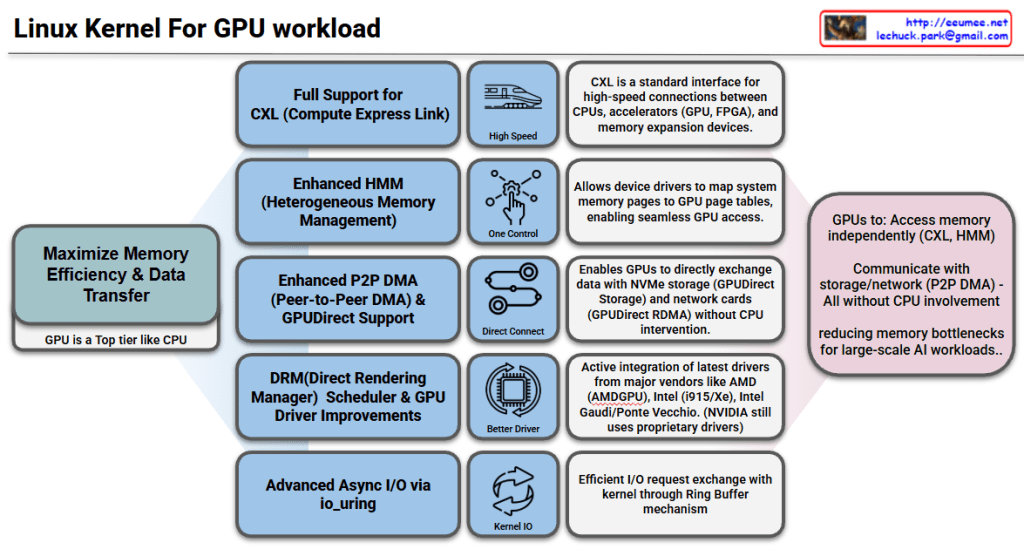
Goal: Maximize Memory Efficiency & Data Transfer

The core objective is to treat GPUs as a top-tier component like CPUs, reducing memory bottlenecks for large-scale AI workloads.

Key Features

1. Full CXL (Compute Express Link) Support

  • Standard interface for high-speed connections between CPUs, accelerators (GPU, FPGA), and memory expansion devices
  • Enables high-speed data transfer

2. Enhanced HMM (Heterogeneous Memory Management)

  • Heterogeneous memory management capabilities
  • Allows device drivers to map system memory pages to GPU page tables
  • Enables seamless GPU memory access

3. Enhanced P2P DMA & GPUDirect Support

  • Enables direct data exchange between GPUs
  • Direct communication with NVMe storage and network cards (GPUDirect RDMA)
  • Operates without CPU intervention for improved performance

4. DRM Scheduler & GPU Driver Improvements

  • Enhanced Direct Rendering Manager scheduling functionality
  • Active integration of latest drivers from major vendors: AMD (AMDGPU), Intel (i915/Xe), Intel Gaudi/Ponte Vecchio
  • NVIDIA still uses proprietary drivers

5. Advanced Async I/O via io_uring

  • Efficient I/O request exchange with kernel through Ring Buffer mechanism
  • Optimized asynchronous I/O performance

Summary

The Linux kernel now enables GPUs to independently access memory (CXL, HMM), storage, and network resources (P2P DMA, GPUDirect) without CPU involvement. Enhanced drivers from AMD, Intel, and improved schedulers optimize GPU workload management. These features collectively eliminate CPU bottlenecks, making the kernel highly efficient for large-scale AI and HPC workloads.

#LinuxKernel #GPU #AI #HPC #CXL #HMM #GPUDirect #P2PDMA #AMDGPU #IntelGPU #MachineLearning #HighPerformanceComputing #DRM #io_uring #HeterogeneousComputing #DataCenter #CloudComputing

With Claude

OOM (Out-of-Memory) Works

OOM (Out-of-Memory) Mechanism Explained

This diagram illustrates how the Linux OOM (Out-of-Memory) Killer operates when the system runs out of memory.

Main Process Flow (Left Side)

  1. Request
    • An application requests memory from the system
  2. VM Commit (Reserve)
    • The system reserves virtual memory
    • Overcommit policy allows reservation beyond physical capacity
  3. First Use (HW mapping) → Page Fault
    • Hardware mapping occurs when memory is actually accessed
    • Triggers a page fault for physical allocation
  4. Reclaim/Compaction
    • System attempts to free memory through cache, SLAB, writeback, and compaction
    • Can be throttled via cgroup memory.high settings
  5. Swap (if enabled)
    • Uses swap space if available and enabled
  6. OOM Killer
    • As a last resort, terminates processes to free memory

Detailed Decision Points (Center & Right Columns)

Memory Request

  • App asks for memory
  • Controlled via brk/sbrk, mmap/munmap, mremap, and prlimit(RLIMIT_AS)

Virtual Address Allocation

  • Overcommit policy allows reservation beyond physical limits
  • Uses mmap (e.g., MAP_PRIVATE) with madvise(MADV_WILLNEED) hints

Physical Memory Allocation

  • Checks if zone watermarks are OK
  • If yes, maps a physical page; if no, attempts reclamation
  • Optional: mlock/munlock, mprotect, mincore

Any Other Free Memory Space?

  • Attempts to free memory via cache/SLAB/writeback/compaction
  • May throttle on cgroup memory.high
  • Hints: madvise(MADV_DONTNEED)

Swap Space?

  • Checks if swap space is available to offload anonymous pages
  • System: swapon/swapoff; App: mlock* (to avoid swap)

OOM Killer

  • Sends SIGKILL to selected victim when below watermarks or cgroup memory.max is hit
  • Victim selection based on badness/oom_score_adj
  • Configurable via /proc/<pid>/oom_score_adj and vm.panic_on_oom

Summary

When an app requests memory, Linux first reserves virtual address space (overcommit), then allocates physical memory on first use. If physical memory runs low, the system tries to reclaim pages from caches and swap, but when all else fails, the OOM Killer terminates processes based on their oom_score to free up memory and keep the system running.


#Linux #OOM #MemoryManagement #KernelPanic #SystemAdministration #DevOps #OperatingSystem #Performance #MemoryOptimization #LinuxKernel

With Claude