From DALL-E with some prompting This diagram illustrates the process by which an application process requests services from the operating system through a system call. Applications running in user space cannot directly access hardware resources and must go through the operating system located in kernel space to perform necessary operations. System calls act as an interface between user space and kernel space, which is crucial for the system’s stability and security. The operating system abstracts hardware resources, facilitating easy access for applications.
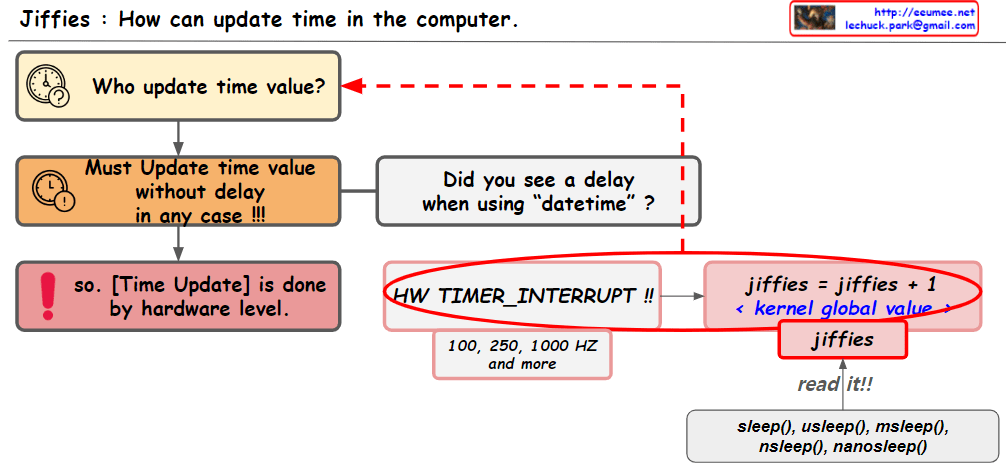
The image provides an explanation of how time updates are handled in computer systems. The key points include:
“Jiffies” refers to a global variable used by the kernel to keep track of time.
Time updates are performed at the hardware level through “timer interrupts,” which are initiated periodically by the system’s real-time clock.
The “HW_TIMER_INTERRUPT” increments the jiffies value by one, and this can be set to various frequencies such as 100, 250, or 1000 Hertz (HZ).
There is a question about whether there is a delay when using “datetime,” which is crucial as time updates need to be processed in real-time.
The jiffies value can be read using the read() function, and functions like sleep(), usleep(), msleep(), nsleep(), and nanosleep() utilize this jiffies value to pause the execution of a program for a certain amount of time.
The image visually represents the concept of how the operating system’s kernel manages time and how time-related functions use the system’s “jiffies” value.
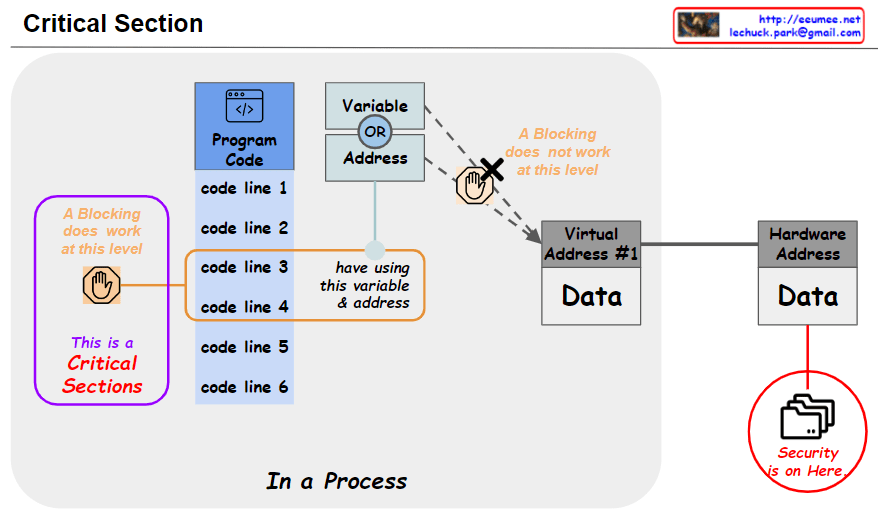
From DALL-E with some prompting The provided image delineates the concept of a “Critical Section” in process execution, where certain areas of the program code are designated as sensitive or exclusive zones to prevent concurrent access. This is not merely a matter of securing a memory location but rather about managing access to specific code blocks that interact with shared variables or addresses.
In the diagram, the “Critical Sections” are highlighted to signify that these blocks of code are where ‘blocking’ occurs, allowing only one thread or process to operate on the shared resources at a time, thus ensuring data integrity and preventing race conditions. The transition from code lines to data, through variable addresses and virtual address mapping to the actual data in hardware, suggests a layered approach to security and access control.
Moreover, the image hints at the abstraction layers from a virtual address space to the physical hardware address, underlining the importance of security protocols at each layer. These critical sections act as a checkpoint not only to enforce sequential access to shared resources but also to facilitate a systematic flow of operations, from programming syntax to system calls, and from understanding the computer architecture to the actual hardware operations. This systematic control is crucial for maintaining security and operational efficiency in digital systems.
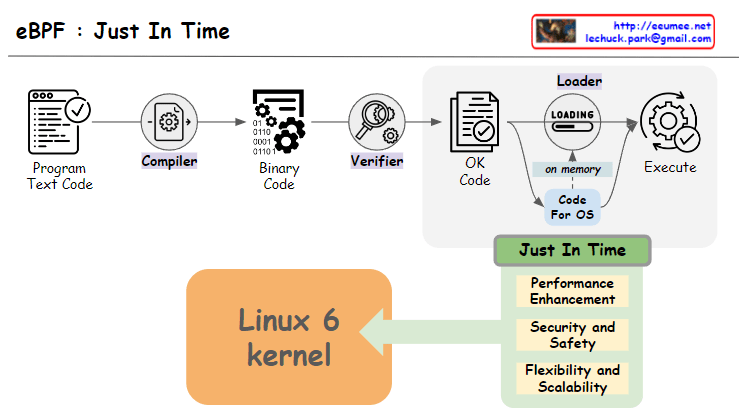
From DALL-E with some prompting The image underscores the role of Just-In-Time (JIT) compilation in the execution process of eBPF (extended Berkeley Packet Filter) code within Linux Kernel 6. Text code is transformed into binary code via a compiler, followed by verification for security and stability. Once verified, the code is loaded into memory for execution. JIT compilation plays a crucial part in this process by optimizing the code in real-time for enhanced performance. eBPF and JIT compilation have been integrated into Linux Kernel 6, serving as fundamental features that bolster performance, security, flexibility,



 Lechuck Park