OOM (Out-of-Memory) Works

OOM (Out-of-Memory) Mechanism Explained

This diagram illustrates how the Linux OOM (Out-of-Memory) Killer operates when the system runs out of memory.

Main Process Flow (Left Side)

  1. Request
    • An application requests memory from the system
  2. VM Commit (Reserve)
    • The system reserves virtual memory
    • Overcommit policy allows reservation beyond physical capacity
  3. First Use (HW mapping) → Page Fault
    • Hardware mapping occurs when memory is actually accessed
    • Triggers a page fault for physical allocation
  4. Reclaim/Compaction
    • System attempts to free memory through cache, SLAB, writeback, and compaction
    • Can be throttled via cgroup memory.high settings
  5. Swap (if enabled)
    • Uses swap space if available and enabled
  6. OOM Killer
    • As a last resort, terminates processes to free memory

Detailed Decision Points (Center & Right Columns)

Memory Request

  • App asks for memory
  • Controlled via brk/sbrk, mmap/munmap, mremap, and prlimit(RLIMIT_AS)

Virtual Address Allocation

  • Overcommit policy allows reservation beyond physical limits
  • Uses mmap (e.g., MAP_PRIVATE) with madvise(MADV_WILLNEED) hints

Physical Memory Allocation

  • Checks if zone watermarks are OK
  • If yes, maps a physical page; if no, attempts reclamation
  • Optional: mlock/munlock, mprotect, mincore

Any Other Free Memory Space?

  • Attempts to free memory via cache/SLAB/writeback/compaction
  • May throttle on cgroup memory.high
  • Hints: madvise(MADV_DONTNEED)

Swap Space?

  • Checks if swap space is available to offload anonymous pages
  • System: swapon/swapoff; App: mlock* (to avoid swap)

OOM Killer

  • Sends SIGKILL to selected victim when below watermarks or cgroup memory.max is hit
  • Victim selection based on badness/oom_score_adj
  • Configurable via /proc/<pid>/oom_score_adj and vm.panic_on_oom

Summary

When an app requests memory, Linux first reserves virtual address space (overcommit), then allocates physical memory on first use. If physical memory runs low, the system tries to reclaim pages from caches and swap, but when all else fails, the OOM Killer terminates processes based on their oom_score to free up memory and keep the system running.


#Linux #OOM #MemoryManagement #KernelPanic #SystemAdministration #DevOps #OperatingSystem #Performance #MemoryOptimization #LinuxKernel

With Claude

IO_uring

This image explains IO_uring, an asynchronous I/O framework for Linux. Let me break down its key components and features:

  1. IO_uring Main Use Cases:
  • High-Performance Databases
  • High-Speed Network Applications
  • File Processing Systems
  1. Core Components:
  • Submission Queue (SQ): Where user applications submit requests like “read this file” or “send this network packet”
  • Completion Queue (CQ): Where the kernel places the results after finishing a task
  • Shared Memory: A shared region between user space and kernel space
  1. Key Features:
  • Low Latency without copying
  • High Throughput
  • Efficient Communication with the Kernel
  1. How it Works:
  • Operates as an asynchronous I/O framework
  • User space communicates with kernel space through submission and completion queues
  • Uses shared memory to minimize data copying
  • Provides a modern interface for asynchronous I/O operations

The diagram shows the flow between user space and kernel space, with shared memory acting as an intermediary. This design allows for efficient I/O handling, particularly beneficial for applications requiring high performance and low latency.

The framework represents a significant improvement in Linux I/O handling, providing a more efficient way to handle I/O operations compared to traditional methods. It’s particularly valuable for applications that need to handle multiple I/O operations simultaneously while maintaining high performance.

With Claude

Uretprobe

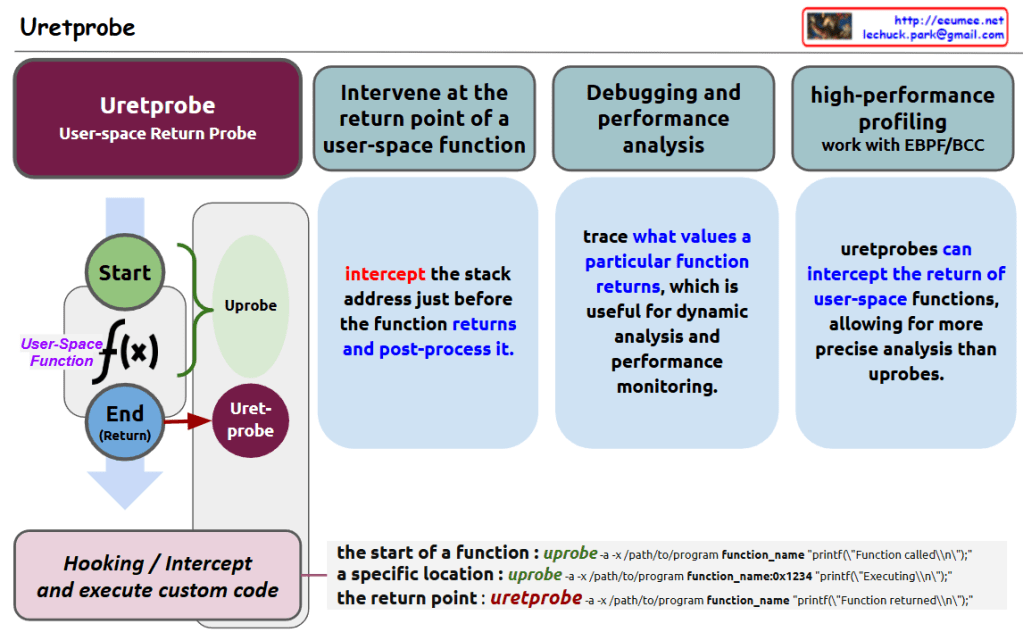
Here’s a summary of Uretprobe, a Linux kernel tracing/debugging tool:

  1. Overview:
  • Uretprobe is a user-space return probe tool designed to monitor function returns in user space
  • It can track the execution flow from function start to end/return points
  1. Key Features:
  • Ability to intervene at the return point of user-space functions
  • Intercepts the stack address just before function returns and enables post-processing
  • Supports debugging and performance analysis capabilities
  • Can trace specific function return values for dynamic analysis and performance monitoring
  1. Advantages:
  • Provides more precise analysis compared to uprobes
  • Can be integrated with eBPF/BCC for high-performance profiling

The main benefit of Uretprobe lies in its ability to intercept user-space operations and perform additional code analysis, enabling deeper insights into program behavior and performance characteristics.

Similar tracing/debugging mechanisms include:

  • Kprobes (Kernel Probes)
  • Kretprobes (Kernel Return Probes)
  • DTrace
  • SystemTap
  • Ftrace
  • Perf
  • LTTng (Linux Trace Toolkit Next Generation)
  • BPF (Berkeley Packet Filter) based tools
  • Dynamic Probes (DynProbes)
  • USDT (User Statically-Defined Tracing)

These tools form part of the Linux observability and performance analysis ecosystem, each offering unique capabilities for system and application monitoring.

Page(Memory) Replacement with AI

With Claude
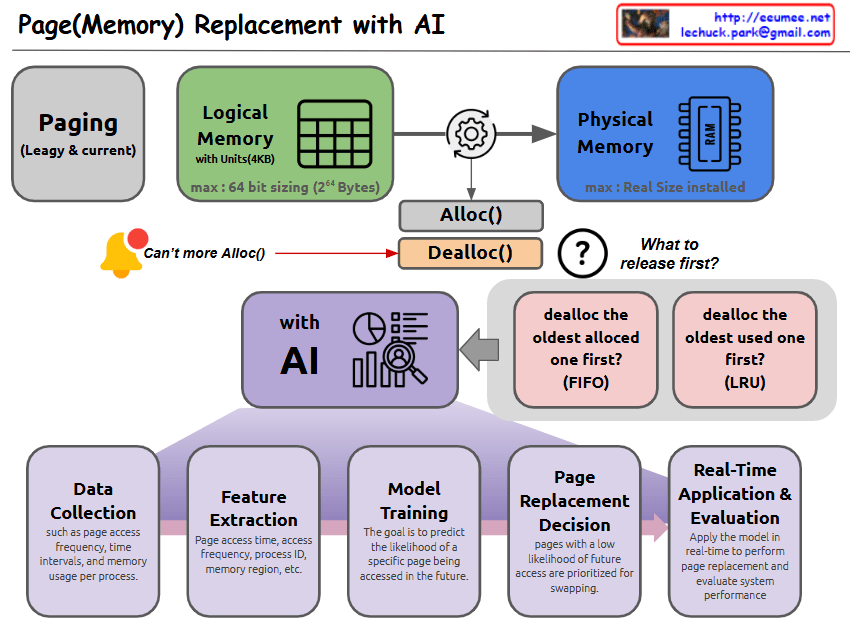
This image illustrates a Page (Memory) Replacement system using AI. Let me break down the key components:

  1. Top Structure:
  • Paging (Legacy & current): Basic paging system structure
  • Logical Memory: Organized in 4KB units, maximum 64-bit sizing (2^64 Bytes)
  • Physical Memory: Limited to the actual installed memory size
  1. Memory Allocation:
  • Shows Alloc() and Dealloc() functions
  • When no more allocation is possible, there’s a question about deallocation strategy:
    • FIFO (First In First Out): Deallocate the oldest allocated memory first
    • LRU (Least Recently Used): Deallocate the oldest used memory first
  1. AI-based Page Replacement Process:
  • Data Collection: Gathers information about page access frequency, time intervals, and memory usage patterns
  • Feature Extraction: Analyzes page access time, access frequency, process ID, memory region, etc.
  • Model Training: Aims to predict the likelihood of specific pages being accessed in the future
  • Page Replacement Decision: Pages with a low likelihood of future access are prioritized for swapping
  • Real-Time Application & Evaluation: Applies the model in real-time to perform page replacement and evaluate system performance

This system integrates traditional page replacement algorithms with AI technology to achieve more efficient memory management. The use of AI helps in making more intelligent decisions about which pages to keep in memory and which to swap out, based on learned patterns and predictions.

Deterministic Scheduling

With Claude
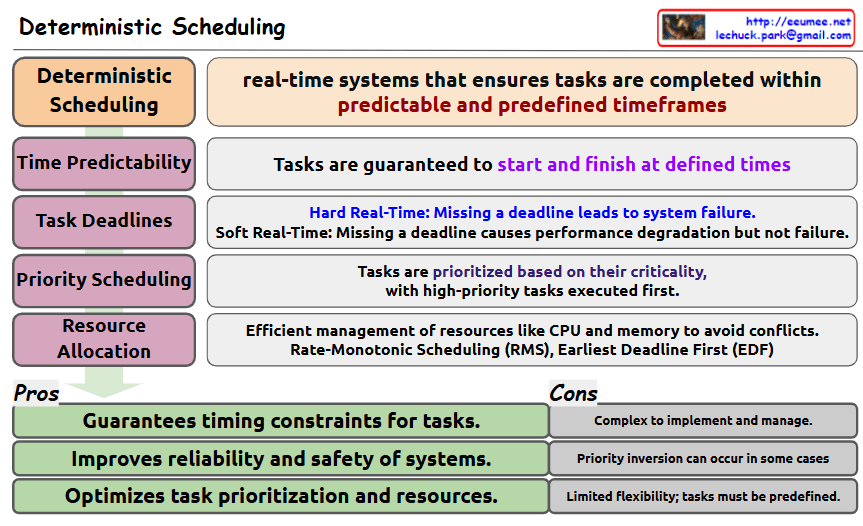
Definition: Deterministic Scheduling is a real-time systems approach that ensures tasks are completed within predictable and predefined timeframes.

Key Components:

  1. Time Predictability
  • Tasks are guaranteed to start and finish at defined times
  1. Task Deadlines
  • Hard Real-Time: Missing a deadline leads to system failure
  • Soft Real-Time: Missing a deadline causes performance degradation but not failure
  1. Priority Scheduling
  • Tasks are prioritized based on their criticality
  • High-priority tasks are executed first
  1. Resource Allocation
  • Efficient management of resources like CPU and memory to avoid conflicts
  • Uses Rate-Monotonic Scheduling (RMS) and Earliest Deadline First (EDF)

Advantages (Pros):

  • Guarantees timing constraints for tasks
  • Improves reliability and safety of systems
  • Optimizes task prioritization and resources

Disadvantages (Cons):

  • Complex to implement and manage
  • Priority inversion can occur in some cases
  • Limited flexibility; tasks must be predefined

The system is particularly important in real-time applications where timing and predictability are crucial for system operation. It provides a structured approach to managing tasks while ensuring they meet their specified time constraints and resource requirements.

High-Resolution Timers

With a Claude’s Help
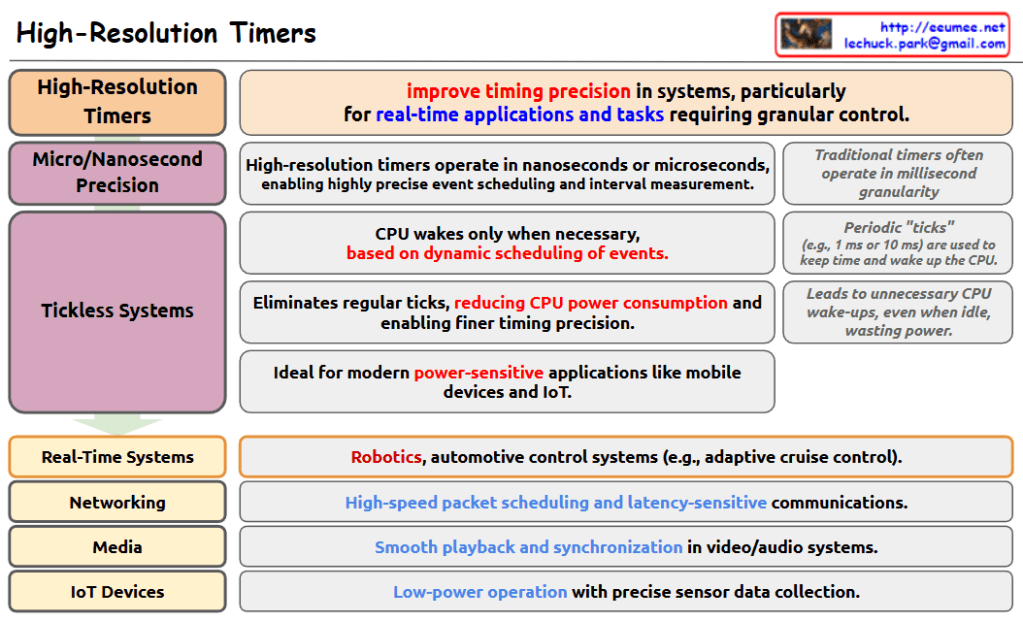
Comprehensive Analysis of High-Resolution Timers

  1. Core Technical Components
  • Micro/Nanosecond Precision
    • Evolution from traditional millisecond units to more precise measurements
    • Enables accurate event scheduling and time measurement
  • Tickless Systems
    • CPU management based on dynamic event scheduling
    • Prevents unnecessary CPU wake-ups, reducing power consumption
    • Optimized architecture for power-sensitive applications
  1. Primary Application Areas
  • Real-Time Systems: Robotics, automotive control
  • Networking: High-speed packet processing, low-latency communications
  • Media: Video/audio synchronization
  • IoT: Low-power sensor data collection
  1. Extended Application Fields
  • Medical Monitoring
    • Real-time vital sign monitoring
    • Precise medication delivery control
    • Immediate emergency response
  • Financial Trading
    • High-frequency trading systems
    • Precise transaction recording
    • Real-time data synchronization
  • Scientific Research
    • Precise experimental data collection
    • High-precision equipment control
    • Astronomical observation systems
  • Smart Grid
    • Power grid real-time monitoring
    • Supply-demand precise control
    • Distributed generation system management
  1. Technical Advantages
  • Enhanced Precision: Nano/microsecond measurement capability
  • Power Efficiency: CPU activation only when necessary
  • Flexibility: Applicable to various fields
  • Reliability: Improved system reliability through accurate timing control
  1. Future Development Directions
  • Optimization for IoT and mobile devices
  • Expanded application in industrial precision control systems
  • Integration with real-time data processing systems
  • Implementation of energy-efficient systems

This technology has evolved beyond simple time measurement to become a crucial infrastructure in modern digital systems. It serves as an essential component in implementing next-generation systems that pursue both precision and efficiency. The technology is particularly valued for achieving both power efficiency and precision, meeting various technical requirements of modern applications.

Key Features:

  1. System timing precision improvement
  2. Power efficiency optimization
  3. Real-time application performance enhancement
  4. Precise data collection and control capability
  5. Extended battery life for IoT and mobile devices
  6. Foundation for high-precision system operations

The high-resolution timer technology represents a fundamental advancement in system timing, enabling everything from precise scientific measurements to efficient power management in mobile devices. Its impact spans across multiple industries, making it an integral part of modern technological infrastructure.

This technology demonstrates how traditional timing systems have evolved to meet the demands of contemporary applications, particularly in areas requiring both precision and energy efficiency. Its versatility and reliability make it a cornerstone technology in the development of advanced digital systems.

Interrupt Handling for real-time

With a Claude’s Help
the real-time interrupt handling :

Interrupt Handling Components and Process:

  1. Interrupt Prioritization
  • Uses assigned priority levels to determine which interrupt should be handled first
  • Ensures critical tasks are processed in order of importance
  1. Interrupt Queuing
  • When multiple interrupts occur, they are placed in a queue for sequential processing
  • Helps maintain organized processing order
  1. Efficient Handling Process
  • Uses a data structure that maps each interrupt to its corresponding Interrupt Service Routine (ISR)
  • Implements this mapping through the Interrupt Vector Table (IVT)
  1. Interrupt Controllers
  • Modern systems utilize interrupt controllers
  • Manages and prioritizes interrupts efficiently
  1. Types of Interrupts
  • Maskable Interrupts (IRQs)
  • Non-Maskable Interrupts (NMIs)
  • High-priority Interrupts
  • Software Interrupts
  • Hardware Interrupts

Real-Time Performance Benefits:

  1. Critical Task Management
  • Ensures critical tasks are always handled first
  • Maintains system responsiveness
  1. System Stability
  • Ensures no interrupt is missed or lost
  • Maintains reliable system operation
  1. Scalability
  • Efficiently manages a growing number of devices and interrupts
  • Adapts to increasing system complexity
  1. Improved User Experience
  • Creates responsive systems that react quickly to user inputs or events
  • Enhances overall system performance and user interaction

This structure provides a comprehensive framework for handling interrupts in real-time systems, ensuring efficient and reliable processing of system events and user interactions.CopyR