CFD & AI/ML

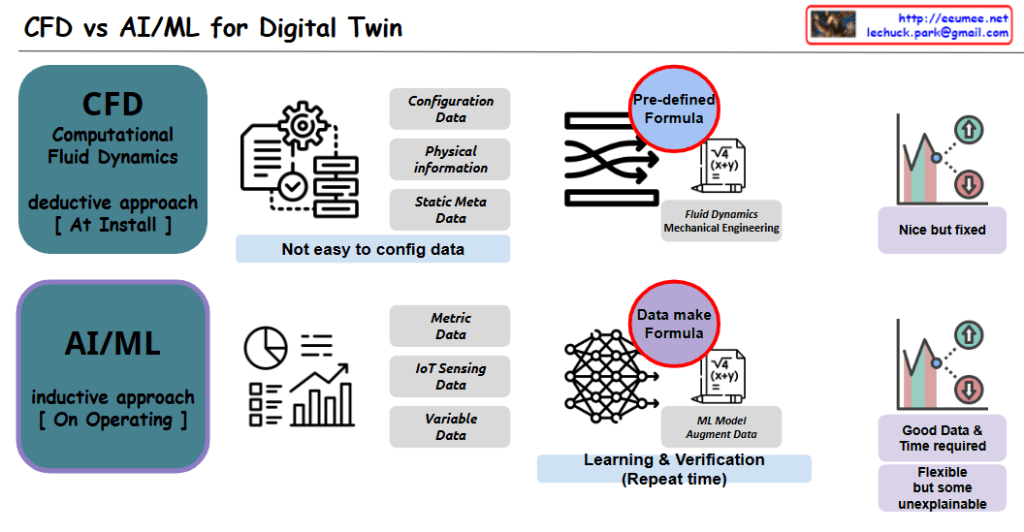
CFD (Computational Fluid Dynamics) – Deductive Approach [At Installation]

  • Data Characteristics
    • Configuration Data
    • Physical Information
    • Static Meta Data
  • Features
    • Complex data configuration
    • Predefined formula usage
    • Result: Fixed and limited
    • Stable from engineering perspective

AI/ML – Inductive Approach [During Operation]

  • Data Characteristics
    • Metric Data
    • IoT Sensing Data
    • Variable Data
  • Features
    • Data-driven formula generation
    • Continuous learning and verification
    • Result: Flexible but partially unexplainable
    • High real-time adaptability

Comprehensive Comparison

Harmonious integration of both approaches is key to future digital twin technologies

CFD: Precise but rigid modeling

AI/ML: Adaptive but complex modeling

The key insight here is that both CFD and AI/ML approaches have unique strengths. CFD provides a rigorous, physics-based model with predefined formulas, while AI/ML offers dynamic, adaptive learning capabilities. The future of digital twin technology likely lies in finding an optimal balance between these two methodologies, leveraging the precision of CFD with the flexibility of machine learning.

With Claude

One Value to Value(s)

With Claude
“A Framework for Value Analysis: From Single Value to Comprehensive Insights”

This diagram illustrates a sophisticated analytical framework that shows how a single value transforms through various analytical processes:

  1. Time Series Analysis Path:
    • A single value evolves over time
    • Changes occur through two mechanisms:
      • Self-generated changes (By oneself)
      • External influence-driven changes (By influence)
    • These changes are quantified through a mathematical function f(x)
    • Statistical measures (average, minimum, maximum, standard deviation) capture the characteristics of these changes
  2. Correlation Analysis Path:
    • The same value is analyzed for relationships with other relevant data
    • Weighted correlations indicate the strength and significance of relationships
    • These relationships are also expressed through a mathematical function f(x)
  3. Integration and Machine Learning Stage:
    • Both analyses (time series and correlation) feed into advanced analytics
    • Machine Learning and Deep Learning algorithms process this dual-perspective data
    • The final output produces either a single generalized value or multiple meaningful values

Core Purpose: The framework aims to take a single value and:

  • Track its temporal evolution within a network of influences
  • Analyze its statistical behavior through mathematical functions
  • Identify weighted correlational relationships with other variables
  • Ultimately synthesize these insights through ML/DL algorithms to generate either a unified understanding or multiple meaningful outputs

This systematic approach demonstrates how a single data point can be transformed into comprehensive insights by considering both its temporal dynamics and relational context, ultimately leveraging advanced analytics for meaningful interpretation.

The framework’s strength lies in its ability to combine temporal patterns, relational insights, and advanced analytics into a cohesive analytical approach, providing a more complete understanding of how values evolve and relate within a complex system.

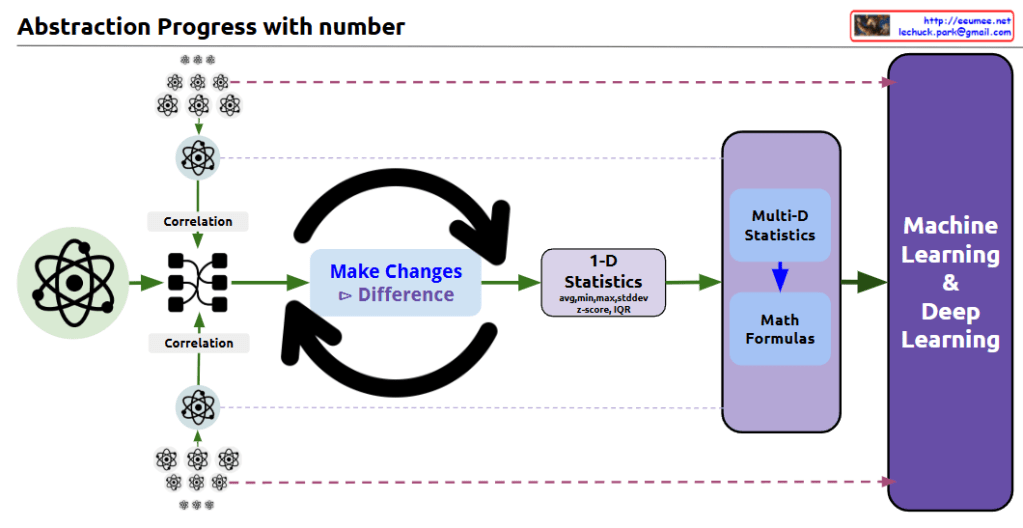
Abstraction Progress with number

With Claude
this diagram shows the progression of data abstraction leading to machine learning:

  1. The process begins with atomic/molecular scientific symbols, representing raw data points.
  2. The first step shows ‘Correlation’ analysis, where relationships between multiple data points are mapped and connected.
  3. In the center, there’s a circular arrow system labeled ‘Make Changes’ and ‘Difference’, indicating the process of analyzing changes and differences in the data.
  4. This leads to ‘1-D Statistics’, where basic statistical measures are calculated, including:
    • Average
    • Median
    • Standard deviation
    • Z-score
    • IQR (Interquartile Range)
  5. The next stage incorporates ‘Multi-D Statistics’ and ‘Math Formulas’, representing more complex statistical analysis.
  6. Finally, everything culminates in ‘Machine Learning & Deep Learning’.

The diagram effectively illustrates the data science abstraction process, showing how it progresses from basic data points through increasingly complex analyses to ultimately reach machine learning and deep learning applications.

The small atomic symbols at the top and bottom of the diagram visually represent how multiple data points are processed and analyzed through this system. This shows the scalability of the process from individual data points to comprehensive machine learning systems.

The overall flow demonstrates how raw data is transformed through various statistical and mathematical processes to become useful input for advanced machine learning algorithms. CopyRet

From Data

From Claude with some prompting
following the overall sequence from data collection to AI systems development.

  1. Data Collection and Processing (Upper “From Data” section): a) Collecting data from people worldwide b) “Get Data”: Acquiring raw data c) “Gathering Data”: Converting data into binary format d) “Statistics Analysis”: Performing data analysis e) “Making Rules/Formula”: Generating rules or formulas based on analysis
  2. Evolution of AI Systems (Lower “Human-made AI (Legacy)” section): a) Human-centered analysis:
    • “Combine formulas”: Combining rules and formulas directly created by humans
    b) Machine Learning-based analysis:
    • Rule-based Machine Learning: • Utilizes Big Data • Generates rules/formulas through machine learning • Results evaluated as “True or False”
    • Statistical Machine Learning (e.g., LLM): • Utilizes Big Data • Performs statistical analysis using advanced machine learning • Results evaluated as “Better or Worse”

Key Points Summary:

  1. Data Processing Flow: Illustrates the step-by-step process from raw data collection to rule/formula generation.
  2. AI System Evolution:
    • Begins with human-centered rule-based systems
    • Progresses to machine learning models that learn rules from data
    • Advances to sophisticated statistical models (like LLMs) that recognize complex patterns and provide nuanced results
  3. Shift in Result Interpretation:
    • Moves from simple true/false outcomes
    • To relative and context-dependent “better/worse” evaluations

This image effectively demonstrates the progression of data processing and AI technology, particularly highlighting how AI systems have become more complex and sophisticated. It shows the transition from human-derived rules to data-driven machine learning approaches, culminating in advanced statistical models that can handle nuanced analysis and produce more contextualized results.

The infinite is in the hands

From Claude with some prompting
This image illustrates the profound concept of capturing infinity through a simple human-made equation, y = 2x. Here’s an updated interpretation:

  1. The title “Y=2x, The infinite is in the hands” suggests humanity’s ability to grasp and manipulate the concept of infinity.
  2. The large circular area on the left represents various instances of the equation, showing both finite and seemingly infinite cases (e.g., very large numbers, algebraic expressions).
  3. The arrow pointing to the right symbolizes the unification of all these cases into a single, elegant formula: y = 2x.
  4. The rectangle on the right, containing “y = 2x” with “include ∞”, represents how this human-created formula can encompass infinite possibilities.
  5. The infinity symbols (∞) scattered throughout the image emphasize the all-encompassing nature of this relationship.

The core message is one of wonder and potential:

  1. Wonder: It expresses amazement at how a simple, human-devised equation can capture and represent infinite cases and possibilities.
  2. Potential: It implies that by understanding and harnessing such powerful concepts, humans can use them as building blocks for further creativity and innovation.

This visualization celebrates human ingenuity in mathematics, showing how we can encapsulate the vastness of infinity within a concise formula. It suggests that by creating such tools to understand and work with infinity, we open doors to new realms of thought and creation.

The image invites viewers to appreciate the elegance of mathematics and to consider how such fundamental concepts can lead to further breakthroughs and applications across various fields of human endeavor.

Definitions for The MORE NEXT DEVELOPMENT

From DALL-E with some prompting
The image depicts the process of how knowledge and ideas are defined and how these definitions enable advanced thinking and discussions among people. Information obtained from observations and experiences is documented, and these records evolve into definitions such as words, rules, and formulas. These definitions create the foundation of knowledge, upon which discussions and the exchange of ideas build increasingly complex and advanced thoughts. Ultimately, this process leads to exponential development of knowledge, visualized as an ascending growth chart. Definitions act as the pivot enabling advanced thinking and discourse, leading to continuous learning and innovation.