Questions

From Claude with some prompting
This image highlights the significance of questions in the AI era and how those questions originate from humanity’s accumulated knowledge. The process begins with “Sensing the world” by gathering various inputs. However, the actual generation of questions is driven by humans. Drawing upon their existing knowledge and insights, humans formulate meaningful inquiries.

These human-generated questions then drive a combined research and analysis effort leveraging both AI systems and human capabilities. AI provides immense data processing power, while humans contribute analysis and interpretation to create new knowledge. This cyclical process allows for continuously refining and advancing the questions.

The ultimate goal is to “Figure out!!” – to achieve better understanding and solutions through the synergy of human intellect and AI technologies. For this, the unique human capacity for insight and creativity in asking questions is essential.

The image underscores that even in an AI-driven world, the seeds of inquiry and the formulation of profound questions stem from the knowledge foundation built by humans over time. AI then complements and accelerates the path toward enhanced comprehension by augmenting human cognition with its processing prowess.

Time Series Data in a DC

From Claude with some prompting
This image illustrates the concept of time series data analysis in a data center environment. It shows various infrastructure components like IT servers, networking, power and cooling systems, security systems, etc. that generate continuous data streams around the clock (24 hours, 365 days).

This time series data is then processed and analyzed using different machine learning and deep learning techniques such as autoregressive integrated moving average models, generalized autoregressive conditional heteroskedasticity, isolation forest algorithms, support vector machines, local outlier factor, long short-term memory models, and autoencoders.

The goal of this analysis is to gain insights, make predictions, and uncover patterns from the continuous data streams generated by the data center infrastructure components. The analysis results can be further utilized for applications like predictive maintenance, resource optimization, anomaly detection, and other operational efficiency improvements within the data center.

Down data

From Claude with some prompting
I can interpret the contents of this image as follows:

  1. Sampling is a method to reduce the “Down Count”, i.e., the number of data points, by extracting only a subset of the entire data.
  2. Roll Up is a method to reduce the “Down Count” by aggregating data over time units. The aggregation functions (Count, Sum, Avg, Max, Min, etc.) are included as examples to help understand the concept of Roll Up.
  3. Quantization is a method to reduce the data size (“Down Size”) by converting floating-point numbers to nearby integers.
  4. “And More…” mentions additional data reduction techniques like Sparse Data Encoding, Feature Selection, and Dimensionality Reduction.

Overall, the image effectively explains how Sampling and Roll Up reduce the number of data points (“Down Count”), while Quantization reduces the data size (“Down Size”).

Data

From Claude with some prompting
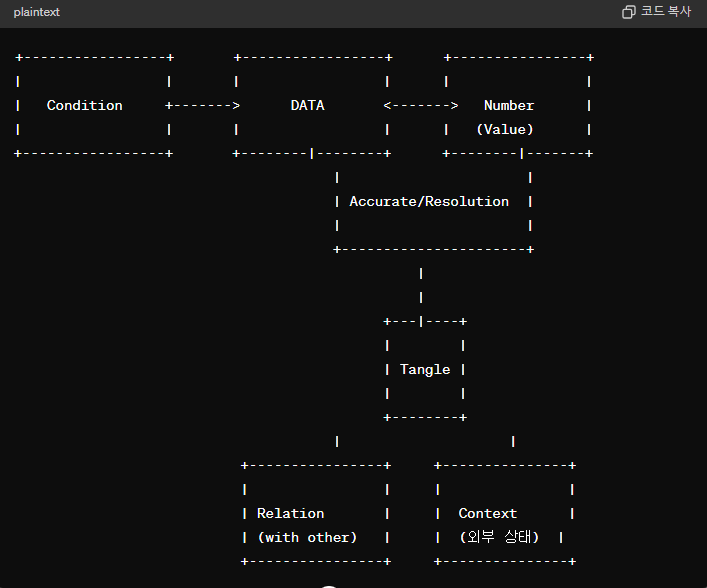
This image presents a comprehensive definition of data that goes beyond just numerical values. To clearly understand data, several elements must be considered.

First, the accuracy and resolution of the data itself are crucial. The “Number (Value)” represents numerical values that must be precise and have an appropriate level of resolution.

Second, data is closely related to external factors. “Condition” indicates a relationship with the state or condition of other data, while “Relation with other” suggests interconnectedness with other data sets.

Third, “Tangle” illustrates that data is not merely a simple number but is complexly intertwined with various elements. To clearly define data, these intricate interconnections and interdependencies must be accounted for.

In essence, the image presents a definition of data that encompasses accuracy, resolution, relationships with external conditions, and intricate interconnectedness. It emphasizes that to truly grasp the nature of data, one must comprehensively consider all these aspects.

The image underscores that data cannot be reduced to just numeric values; rather, it is a multifaceted concept intricately tied to precision, granularity, external factors, and interdependent relationships. Fully understanding data requires a holistic examination of all these interlinked elements.

Updated by GPT-4o

Evolution and AI

From Claude with some prompting
The image metaphorically connects the process of evolution in the universe with the development stages of AI. After the Big Bang and the subsequent increase in entropy (disorder), life forms evolved through a process of self-organization, creating complex and ordered structures, thereby continuously decreasing entropy as long as life exists in the universe. Similarly, the image suggests that data-intensive AI systems will emerge as the next evolutionary stage after humans.

However, a critical point made is that the data driving AI itself does not possess any inherent intent or purpose, unlike living organisms. Data is merely a collection of information without any intrinsic goals or consciousness. Therefore, it is crucial to imbue the data with appropriate values and ethical principles to prevent AI from spiraling out of human control and indiscriminately increasing entropy.

Ultimately, this image emphasizes the importance of human-centric, value-driven AI development. Rather than warning against AI technology itself, it cautions against the unbridled advancement of data-driven AI systems without proper oversight and ethical frameworks in place, as imposed by humans.

Furthermore, the image implies that while life and AI may continue to evolve, decreasing entropy in the process, they will ultimately succumb to the universal law of increasing entropy and reach a state of thermodynamic equilibrium.

In essence, the image thoughtfully juxtaposes scientific concepts of entropy, evolution, and the emergence of AI, highlighting the need for responsible and value-aligned AI development under human guidance, while acknowledging the overarching principles of entropy and equilibrium that govern the universe.

The Limitation of the AI

From Claude with some prompting
This image illustrates the process of creating a “human-like AI” through the stages of “Big Data -> Learning -> Good AI.”

The first stage is “Big Data,” which serves as the foundation for AI training. It requires collecting vast amounts of accurate and reliable data from various sources.

The second stage is “Learning,” where the big data is fed into deep learning algorithms and neural network models for training. This process requires immense computing power and optimized AI models.

The third stage yields a “Good AI” capable of tasks like data classification and processing as a result of the learning process.

However, the image suggests that the goal goes beyond creating an AI with “Many Numbers” and “Classification” abilities. The ultimate aim is to develop an AI that reaches “Human-Like” levels of intelligence and capability.

Crucially, the entire process is underpinned by the availability of “Accurate & Reliable DATA.” No matter how advanced the algorithms and computing power, if the data itself lacks quality and trustworthiness, achieving a truly “Human-Like AI” will be extremely challenging.

Therefore, the key message conveyed by this image is that the quality and reliability of data will be the critical factor determining the competitiveness of AI systems in the future. Securing accurate and trustworthy data is emphasized as the fundamental requirement for realizing human-level artificial intelligence.

DC Data Collecting Performance Factors

From Claude with some prompting
This image conceptually illustrates various factors that can affect the performance of DC data collection. The main components include the facility generating the data, the facility network, PLC/DDC converters, an integration network, and the final collection/analysis system.

Factors that can impact data collection performance include the data generation rate, CPU performance, bandwidth limitations of the network medium, network topology, protocols used (such as TCP/IP and SNMP), input/output processing performance, and program logic.

The diagram systematically outlines the overall flow of the DC data collection process and the performance considerations at each stage. It covers elements like the facility, network infrastructure, data conversion, integration, and final collection/analysis.

By mapping out these components and potential bottlenecks, the image can aid in the design and optimization of data collection systems. It provides a comprehensive overview of the elements that need to be accounted for to ensure efficient data gathering performance.