Image Analysis: Full Data AI Analysis vs. Change-Triggered Urgent Response
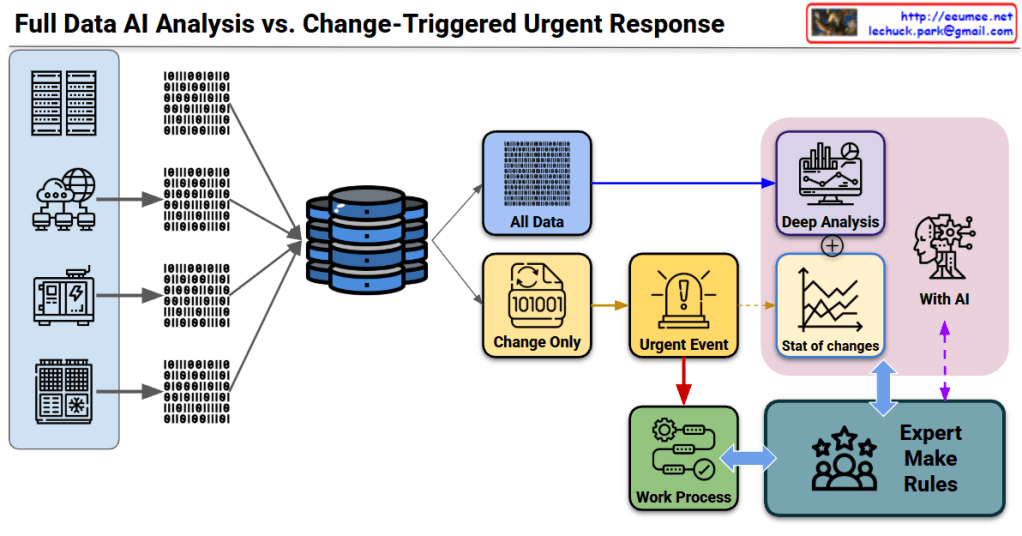
This diagram illustrates a system architecture comparing two core strategies for data processing.
🎯 Core 1: Two Data Processing Approaches
Approach A: Full Data Processing (Analysis)
- All Data path (blue)
- Collects and comprehensively analyzes all data
- Performs in-depth analysis through Deep Analysis
- AI-powered statistical change (Stat of changes) analysis
- Characteristics: Identifies overall patterns, trends, and correlations
Approach B: Separate Change Detection Processing
- Change Only path (yellow)
- Selectively detects only changes
- Extracts and processes only deltas (differences)
- Characteristics: Fast response time, efficient resource utilization
🔥 Core 2: Analysis→Urgent Response→Expert Processing Flow
Stage 1: Analysis
- Full Data Analysis: AI-based Deep Analysis
- Change Detection: Change Only monitoring
Stage 2: Urgent Response (Urgent Event)
- Immediate alert generation when changes detected (⚠️ Urgent Event)
- Automated primary response process execution
- Direct linkage to Work Process
Stage 3: Expert Processing (Expert Make Rules)
- Human expert intervention
- Integrated review of AI analysis results + urgent event information
- Creation and modification of situation-appropriate rules
- Work Process optimization
🔄 Integrated Process Flow
[Data Collection]
    ↓
[Path Bifurcation]
    ├─→ [All Data] → [Deep Analysis] ─┐
    │                                  ├→ [AI Statistical Analysis]
    └─→ [Change Only] → [Urgent Event]─┘
                            ↓
                    [Work Process] ↔ [Expert Make Rules]
                            ↑_____________↓
                         (Feedback loop with AI)
💡 Core System Value
- Dual Processing Strategy: Stability (full analysis) + Agility (change detection)
- 3-Stage Response System: Automated analysis → Urgent process → Expert judgment
- AI + Human Collaboration: Combines AI analytical power with human expert judgment
- Continuous Improvement: Virtuous cycle where expert rules feed back into AI learning
This system is an architecture optimized for environments where real-time response is essential while expert judgment remains critical (manufacturing, infrastructure operations, security monitoring, etc.).
Summary
- Dual-path system: Comprehensive full data analysis (stability) + selective change detection (speed) working in parallel
- Three-tier response: AI automated analysis triggers urgent events, followed by work processes and expert rule refinement
- Human-AI synergy: Continuous improvement loop where expert knowledge enhances AI capabilities while AI insights inform expert decisions
#DataArchitecture #AIAnalysis #EventDrivenArchitecture #RealTimeMonitoring #HybridProcessing #ExpertSystems #ChangeDetection #UrgentResponse #IndustrialAI #SmartMonitoring #DataProcessing #AIHumanCollaboration #PredictiveMaintenance #IoTArchitecture #EnterpriseAI

 Lechuck Park