From RNN to Transformer

Visual Analysis: RNN vs Transformer

Visual Structure Comparison

RNN (Top): Sequential Chain

  • Linear flow: Circular nodes connected left-to-right
  • Hidden states: Each node processes sequentially
  • Attention weights: Numbers (2,5,11,4,2) show token importance
  • Bottleneck: Must process one token at a time

Transformer (Bottom): Parallel Grid

  • Matrix layout: 5×5 grid of interconnected nodes
  • Self-attention: All tokens connect to all others simultaneously
  • Multi-head: 5 parallel attention heads working together
  • Position encoding: Separate blue boxes handle sequence order

Key Visual Insights

Processing Pattern

  • RNN: Linear chain → Sequential dependency
  • Transformer: Interconnected grid → Parallel freedom

Information Flow

  • RNN: Single path with accumulating states
  • Transformer: Multiple simultaneous pathways

Attention Mechanism

  • RNN: Weights applied to existing sequence
  • Transformer: Direct connections between all elements

Design Effectiveness

The diagram succeeds by using:

  • Contrasting layouts to show architectural differences
  • Color coding to highlight attention mechanisms
  • Clear labels (“Sequential” vs “Parallel Processing”)
  • Visual metaphors that make complex concepts intuitive

The grid vs chain visualization immediately conveys why Transformers enable faster, more scalable processing than RNNs.

Summary

This diagram effectively illustrates the fundamental shift from sequential to parallel processing in neural architecture. The visual contrast between RNN’s linear chain and Transformer’s interconnected grid clearly demonstrates why Transformers revolutionized AI by enabling massive parallelization and better long-range dependencies.

With Claude

“Encoder/Decoder” in a Transformer

Transformer Encoder-Decoder Architecture Explanation

This image is a diagram that visually explains the encoder-decoder structure of the Transformer model.

Encoder Section (Top, Green)

Purpose: Process “questions” by converting input text into vectors

Processing Steps:

  1. Tokenize input tokens and apply positional encoding
  2. Capture relationships between tokens using multi-head attention
  3. Extract meaning through feed-forward neural networks
  4. Stabilize with layer normalization

Decoder Section (Bottom, Purple)

Purpose: Generate new stories from text

Processing Steps:

  1. Apply positional encoding to output tokens
  2. Masked Multi-Head Self-Attention (Key Difference)
    • Mask future tokens using “Only Next” approach
    • Constraint for sequential generation
  3. Reference input information through encoder-decoder attention
  4. Apply feed-forward neural networks and layer normalization

Key Features

  • Encoder: Processes entire input at once to understand context
  • Decoder: References only previous tokens to sequentially generate new tokens
  • Attention Mechanism: Focuses on highly relevant parts for information processing

This is the core architecture used in various natural language processing tasks such as machine translation, text summarization, and question answering.

With Claude

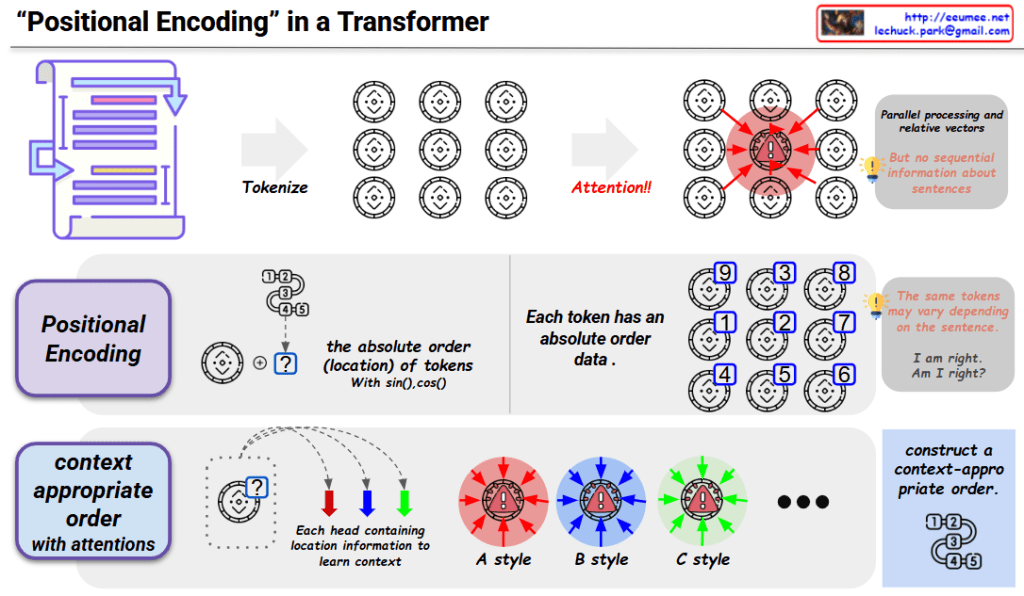
“Positional Encoding” in a Transformer

Positional Encoding in Transformer Models

The Problem: Loss of Sequential Information

Transformer models use an attention mechanism that enables each token to interact with all other tokens in parallel, regardless of their positions in the sequence. While this parallel processing offers computational advantages, it comes with a significant limitation: the model loses all information about the sequential order of tokens. This means that without additional mechanisms, a Transformer cannot distinguish between sequences like “I am right” and “Am I right?” despite their different meanings.

The Solution: Positional Encoding

To address this limitation, Transformers implement positional encoding:

  1. Definition: Positional encoding adds position-specific information to each token’s embedding, allowing the model to understand sequence order.
  2. Implementation: The standard approach uses sinusoidal functions (sine and cosine) with different frequencies to create unique position vectors:
    • For each position in the sequence, a unique vector is generated
    • These vectors are calculated using sin() and cos() functions
    • The position vectors are then added to the corresponding token embeddings
  3. Mathematical properties:
    • Each position has a unique encoding
    • The encodings have a consistent pattern that allows the model to generalize to sequence lengths not seen during training
    • The relative positions of tokens can be expressed as a linear function of their encodings

Integration with Attention Mechanism

The combination of positional encoding with the attention mechanism enables Transformers to process tokens in parallel while maintaining awareness of their sequential relationships:

  1. Context-aware processing: Each attention head learns to interpret the positional information within its specific context.
  2. Multi-head flexibility: Different attention heads (A style, B style, C style) can focus on different aspects of positional relationships.
  3. Adaptive ordering: The model learns to construct context-appropriate ordering of tokens, enabling it to handle different linguistic structures and semantics.

Practical Impact

This approach allows Transformers to:

  • Distinguish between sentences with identical words but different orders
  • Understand syntactic structures that depend on word positions
  • Process variable-length sequences effectively
  • Maintain the computational efficiency of parallel processing while preserving sequential information

Positional encoding is a fundamental component that enables Transformer models to achieve state-of-the-art performance across a wide range of natural language processing tasks.

With Claude

Attention in a Transformer

Attention Mechanism in Transformer Models

Overview

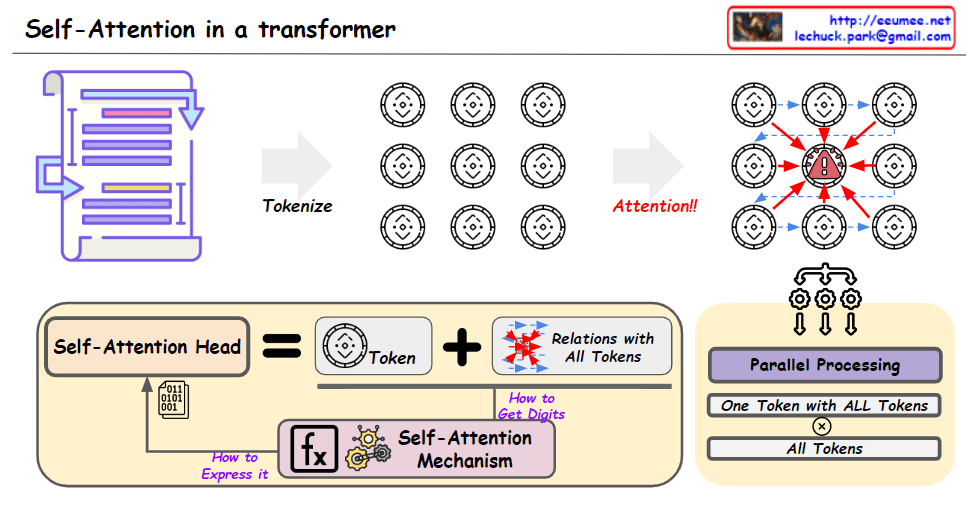
The attention mechanism in Transformer models is a revolutionary technology that has transformed the field of natural language processing. This technique allows each word (token) in a sentence to form direct relationships with all other words.

Working Principles

  1. Tokenization Stage: Input text is divided into individual tokens.
  2. Attention Application: Each token calculates its relevance to all other tokens.
  3. Mathematical Implementation:
    • Each token is converted into Query, Key, and Value vectors.
    • The relevance between a specific token (Query) and other tokens (Keys) is calculated.
    • Weights are applied to the Values based on the calculated relevance.
    • This is expressed as the ‘sum of Value * Weight’.

Multi-Head Attention

  • Definition: A method that calculates multiple attention vectors for a single token in parallel.
  • Characteristics: Each head (styles A, B, C) captures token relationships from different perspectives.
  • Advantage: Can simultaneously extract various information such as grammatical relationships and semantic associations.

Key Benefits

  1. Contextual Understanding: Enables understanding of word meanings based on context.
  2. Long-Distance Dependency Resolution: Can directly connect words that are far apart in a sentence.
  3. Parallel Processing: High computational efficiency due to simultaneous processing of all tokens.

Applications

Transformer-based models demonstrate exceptional performance in various natural language processing tasks including machine translation, text generation, and question answering. They form the foundation of modern AI models such as GPT and BERT.

With Claude

Attention in a LLM

From Copilot with some prompting
Certainly! Let’s discuss the concept of multi-head attention in the context of a Language Learning Model (LLM).

Input Sentence: The sentence “Seagulls fly over the ocean.”
Attention Weight Visualization: The image illustrates how different words in the sentence attend to each other. For instance, if the attention weight between “seagulls” and “ocean” is high, it indicates that these two words are closely related within the sentence.
Multiple Heads: The model employs multiple attention heads (sub-layers) to compute attention from different perspectives. This allows consideration of various contexts and enhances the model’s ability to capture important information.
Multi-head attention is widely used in natural language processing (NLP) tasks, including translation, question answering, and sentiment analysis. It helps improve performance by allowing the model to focus on relevant parts of the input sequence.