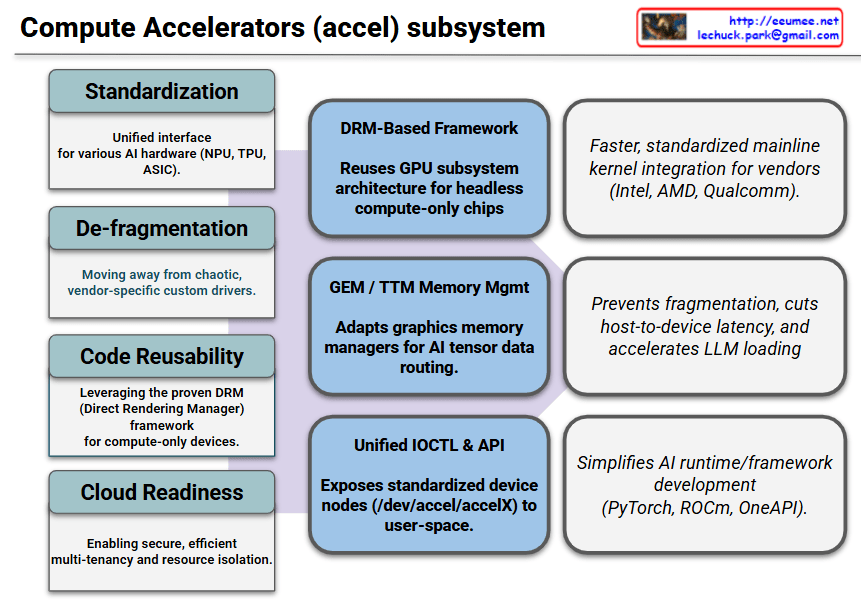
Here is the explanation of the provided diagram, which illustrates the architectural flow of the Linux kernel’s Compute Accelerators (accel) subsystem from its initial goals to its final real-world impacts.
1. Objectives & Background (Left Grey Blocks)
This section defines the systemic issues the accel subsystem was created to solve.
- Standardization: Establishes a unified, consistent interface across diverse AI hardware types such as NPUs, TPUs, and custom ASICs.
- De-fragmentation: Eliminates the chaotic era of vendor-specific, closed, or fragmented custom drivers.
- Code Reusability: Leverages the mature and battle-tested DRM (Direct Rendering Manager) framework specifically tailored for “headless” (compute-only) devices.
- Cloud Readiness: Lays the foundation for secure, efficient multi-tenancy and robust hardware resource isolation in data centers.
2. Key Features (Center Blue Blocks)
These are the core technical mechanisms implemented inside the Linux kernel to achieve the defined goals.
- DRM-Based Framework: Reuses the underlying GPU subsystem architecture to manage headless compute chips smoothly within
drivers/accel/. - GEM / TTM Memory Mgmt: Adapts established graphics memory management technologies (GEM and TTM) to efficiently route massive AI tensor data.
- Unified IOCTL & API: Exposes standardized device nodes (e.g.,
/dev/accel/accelX) directly to user-space applications.
3. Real-World Effects & Benefits (Right White Blocks)
This section outlines the concrete performance gains and development advantages delivered to hardware vendors and AI developers.
- For Hardware Vendors (Intel, AMD, Qualcomm, etc.): Enables faster, highly standardized integration of physical drivers directly into the upstream mainline Linux kernel.
- For System Performance: Prevents system memory fragmentation, radically slashes host-to-device latency, and accelerates the loading speeds of massive LLM (Large Language Model) weights.
- For AI Framework Development: Significantly simplifies the engineering efforts required to build and optimize upper-layer AI runtimes and frameworks like PyTorch, AMD ROCm, and Intel OneAPI.
The Linux kernel’s accel subsystem leverages the proven DRM framework and GEM/TTM memory management to standardize diverse AI hardware interfaces, thereby eliminating vendor driver fragmentation, slashing data latency for LLMs, and drastically simplifying cloud multi-tenancy and AI framework development.
#LinuxKernel #AIAccelerator #ComputeAccelerators #NPU #GPU #DRM #KernelArchitecture #OpenSource #PyTorch #LLM #CloudComputing

