Both are equally unexplainable

From Claude with some prompting
This image compares human intelligence and artificial intelligence, emphasizing that both are “equally unexplainable” in certain aspects:

  1. Human Intelligence:
    • Uses 100% math and logic, but based on limited experience and data.
    • Labeled “Not 100% depend on Experience,” indicating experience alone is insufficient.
    • When decision-making under time constraints, humans make the “best choice” rather than a 100% perfect choice.
    • Shows a process of: Event → Decision with Time Limit → Action.
  2. Artificial Intelligence:
    • Based on big data, GPU/CPU processing, and AI models (including LLMs).
    • Labeled as “Unexplainable AI Model,” highlighting the difficulty in fully interpreting AI decision-making processes.
    • Demonstrates a flow of: Data input → Neural network processing → “Nice but not 100%” output.
    • Like human intelligence, AI also makes best choices within limited data and time constraints.
  3. Key Messages:
    • AI is not a simple logic calculator but a system mimicking human intelligence.
    • AI decisions, like human decisions, are not 100% perfect but the best choice under given conditions.
    • We should neither overestimate nor underestimate AI, but understand its limitations and possibilities in a balanced way.
    • Both human and artificial intelligence have unexplainable aspects, reflecting the complexity and limitations of both systems.

This image emphasizes the importance of accurately understanding and appropriately utilizing AI capabilities by comparing it with human intelligence. It reminds us that while AI is a powerful tool, human judgment and ethical considerations remain crucial. The comparison underscores that AI, like human intelligence, is making the best possible decisions based on available data and constraints, rather than providing infallible, 100% correct answers.


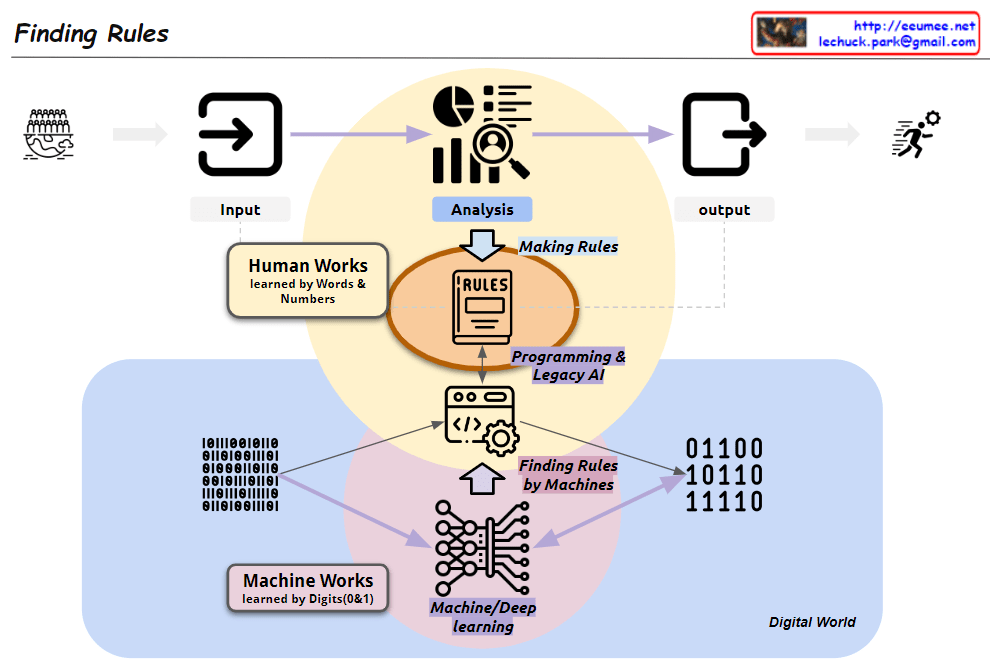
Finding Rules

From Claude with some prompting
This image, titled “Finding Rules,” illustrates the contrast between two major learning paradigms:

  1. Traditional Human-Centric Learning Approach:
    • Represented by the upper yellow circle
    • “Human Works”: Learning through human language and numbers
    • Humans directly analyze data and create rules
    • Leads to programming and legacy AI systems
  2. Machine Learning (ML) Approach:
    • Represented by the lower pink circle
    • “Machine Works”: Learning through binary digits (0 and 1)
    • Based on big data
    • Uses machine/deep learning to automatically discover rules
    • “Finding Rules by Machines”: Machines directly uncover patterns and rules

The diagram showcases a paradigm shift:

  • Two coexisting methods in the process from input to output
  • Transition from human-generated rules to machine-discovered rules
  • Emphasis on data processing in the “Digital World”

Key components:

  • Input and Output: Marking the start and end of the process
  • Analysis: Central to both approaches
  • Rules: Now discoverable by both humans and machines
  • Programming & Legacy AI: Connected to the human-centric approach
  • Machine/Deep Learning: Core of the ML approach

This visualization effectively demonstrates the evolution in data analysis and rule discovery brought about by advancements in artificial intelligence and machine learning. It highlights the shift from converting data into human-readable formats for analysis to leveraging vast amounts of binary data for machine-driven rule discovery.

A series of decisions

From Claude with some prompting
The image depicts a diagram titled “A series of decisions,” illustrating a data processing and analysis workflow. The main stages are as follows:

  1. Big Data: The starting point for data collection.
  2. Gathering Domains by Searching: This stage involves searching for and collecting relevant data.
  3. Verification: A step to validate the collected data.
  4. Database: Where data is stored and managed. This stage includes “Select Betters” for data refinement.
  5. ETL (Extract, Transform, Load): This process involves extracting, transforming, and loading data, with a focus on “Select Combinations.”
  6. AI Model: The stage where artificial intelligence models are applied, aiming to find a “More Fit AI Model.”

Each stage is accompanied by a “Visualization” icon, indicating that data visualization plays a crucial role throughout the entire process.

At the bottom, there’s a final step labeled “Select Results with Visualization,” suggesting that the outcomes of the entire process are selected and presented through visualization techniques.

Arrows connect these stages, showing the flow from Big Data to the AI Model, with “Select Results” arrows feeding back to earlier stages, implying an iterative process.

This diagram effectively illustrates the journey from raw big data to refined AI models, emphasizing the importance of decision-making and selection at each stage of the data processing and analysis workflow.

Stability + Efficiency = Optimization

From Claude with some prompting
This image illustrates the concept of optimization, which is achieved through a balance between stability and efficiency.

  1. Stability:
    • Represented by the 24-hour clock icon, this refers to the consistency and reliability of a system over time.
  2. Efficiency:
    • Depicted by the gear/dollar sign icon, this represents the ability to maximize output or performance with minimal resources.
  3. Trade-off:
    • The central element shows the conflicting relationship between stability and efficiency.
    • Humans struggle to achieve both stability and efficiency simultaneously.
  4. Programmatic Automation:
    • The system icon suggests that automation or programmatic control can enable a “win-win” scenario, where both stability and efficiency can be optimized.
    • Systems have the capability to overcome the “trade-off” tendency that humans often exhibit.
  5. Optimization:
    • Represented by the gear and chart icon, this is the final, optimized state achieved through the balance of stability and efficiency.
    • By combining the human “trade-off” tendency and the system’s “win-win” capability, a more integrated optimization can be attained.

In summary, this image contrasts the differences between human and system approaches in the pursuit of optimization. By leveraging the strengths of both, the optimal balance between stability and efficiency can be achieved.